
How Smart Thermostats Handle Multi-Zone HVAC Systems Efficiently
Multi-zone HVAC works best when thermostats, zone controls, sensors, and equipment capacity cooperate instead of fighting each other.
Quick answer
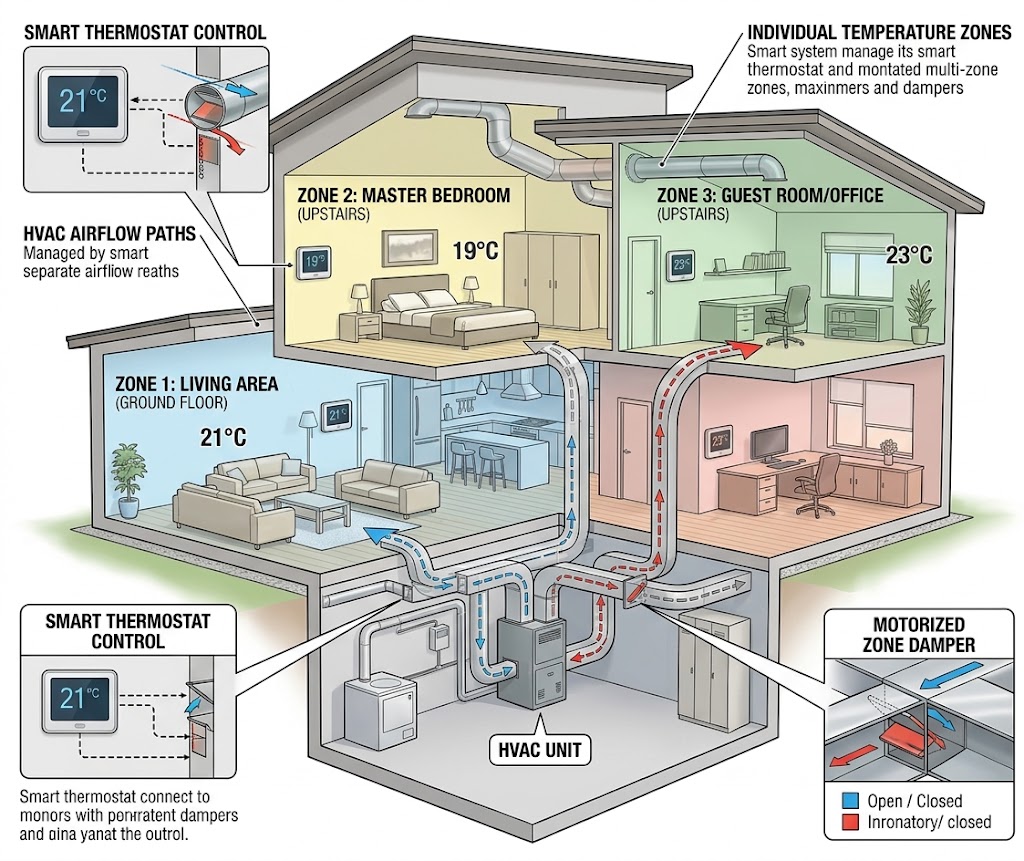
Smart thermostats manage multi-zone HVAC efficiently by giving each true HVAC zone its own temperature demand while a zone panel, dampers, or individual indoor units direct heating and cooling only where it is needed. The thermostat improves scheduling, occupancy response, and setpoints, but the underlying zoning hardware still determines which rooms can actually receive independent heating or cooling.
Table of contents
- What “multi-zone HVAC” actually means
- How a ducted multi-zone system works
- Why the zone panel matters
- How smart thermostats improve a zoned ducted system
- Independent schedules
- Occupancy-aware setbacks
- Better control of the zone that matters now
- Remote temperature sensors do not create new zones
- Keep sensors inside the zone they control
- Multi-zone mini-splits work differently
- The outdoor unit is still shared
- Multi-zone is not the same as multi-stage
- Why variable capacity can pair well with zoning
- The most efficient scheduling strategy is usually zone-specific
- Avoid extreme setbacks that create synchronized recovery loads
- Do not close zones manually to “force efficiency”
- Smart thermostat compatibility is more complicated in zoned homes
- Should every zone use the same thermostat brand?
- Where smart thermostats actually save energy in a multi-zone home
- Conditioning fewer spaces at unnecessary times
- Better occupancy matching
- Better partial-load operation
- Avoiding temperature battles
- Reducing manual overrides
- A practical multi-zone optimization checklist
- 1. Map the actual zones
- 2. Verify every remote sensor
- 3. Give each zone its own schedule
- 4. Use moderate setbacks first
- 5. Check simultaneous calls
- 6. Confirm zone hardware is working
- 7. Leave airflow and equipment-protection settings alone unless qualified
- When remote sensors are enough—and when you need real zoning
- Conclusion
Key takeaways
- A smart thermostat does not create zoning by itself; true zones require dampers, separate indoor units, or another way to control heating and cooling independently.
- In a ducted zoned system, each thermostat normally sends demand to a zone panel that coordinates dampers and the shared HVAC equipment.
- Remote room sensors can improve comfort inside a zone, but placing a sensor in another HVAC zone can cause poor control and unnecessary runtime.
- The most efficient multi-zone strategy uses independent schedules, moderate setbacks, occupancy-aware control, and HVAC equipment that can handle partial-zone demand correctly.
Editorial transparency
Who worked on this article and how it was handled.
- Written by
- Maya Chen
- Creation method
- Editorial research
AI assistance: AI assisted with research organization and drafting. Sources, factual claims, and the final article should be reviewed by a human editor before publication.
A home can have three thermostats and still feel uneven, or one smart thermostat and still waste energy trying to satisfy the wrong room. The reason is that multi-zone HVAC is a system architecture, not a thermostat feature.
Smart thermostats can make zoning more efficient by giving each area its own schedule, occupancy logic, setback strategy, and temperature target. But the thermostat is only the decision layer. Dampers, zone panels, indoor air handlers, refrigerant circuits, and equipment capacity determine whether the HVAC system can actually send heating or cooling to one area without conditioning every other room.
Understanding that distinction prevents one of the most common smart-home mistakes: expecting remote sensors or several app-connected thermostats to solve an HVAC design problem. This guide explains how smart thermostats work with true multi-zone systems, how remote sensors fit into the picture, and which control strategies improve comfort without making the equipment fight itself.
What “multi-zone HVAC” actually means
A true HVAC zone is an area whose heating or cooling demand can be controlled independently from another area.
That independent control can be created in several ways.
| System architecture | How zones are created | Typical thermostat/control arrangement |
|---|---|---|
| Ducted central HVAC with zoning | Motorized dampers route air through different duct branches | One thermostat per zone plus a zone control panel |
| Ductless or ducted multi-split | Separate indoor units condition separate areas | Individual controller or thermostat per indoor unit/zone |
| Multiple independent HVAC systems | Each area has its own furnace, heat pump, AC, or air handler | One thermostat per HVAC system |
| Single-zone HVAC with room sensors | No independent airflow; sensors change which room influences the thermostat | One thermostat plus one or more remote sensors |
The last row is where confusion begins.
A remote temperature sensor can tell a thermostat, “The bedroom is warmer than the hallway.” What it cannot do on a conventional single-zone duct system is stop cooling the hallway while continuing to cool only the bedroom.
Google’s Nest documentation makes this distinction explicitly: separate simultaneous room temperatures require a zoned system or another mechanism that can physically control where conditioned air goes.
How a ducted multi-zone system works
A common zoned forced-air system still has one furnace, heat pump, or central air conditioner. The house is divided by motorized dampers installed in different duct branches.
Each zone has a thermostat.
When one zone needs cooling, the sequence is roughly:
- The zone thermostat sends a cooling request.
- The zone control panel receives that request.
- The panel positions the dampers so the calling zone receives airflow.
- The panel starts the appropriate HVAC equipment.
- When the zone reaches its target, the thermostat ends the call and the panel updates the damper and equipment state.
Resideo’s TrueZONE documentation describes this basic architecture as a zone panel, thermostats, and dampers working together. Google also notes that zoned systems with multiple thermostats commonly use dampers coordinated through a zone relay panel.
The smart thermostat therefore does not directly become the zoning system. It replaces or augments the thermostat at one zone and sends demand into the existing zoning architecture.
Why the zone panel matters
A shared furnace or heat pump can receive competing requests.
For example:
- the sunny upstairs zone may need cooling;
- the shaded downstairs zone may already be comfortable;
- one bedroom may be unoccupied;
- another zone may have just reached its setpoint.
The zone panel is responsible for coordinating those calls with the HVAC equipment and dampers. Depending on the system, it can also participate in staging, equipment protection, purge logic, or discharge-air temperature management.
That is why replacing zoned thermostats should start with the zone panel model and wiring diagram, not with the thermostat app.
How smart thermostats improve a zoned ducted system
Once the underlying zoning hardware is correct, smart thermostats can improve how each zone requests conditioning.
Independent schedules
Google documents that Nest thermostats in the same home can maintain separate temperature schedules for their respective zones.
That is exactly what zoning should enable.
A two-story home might use:
- a comfortable downstairs temperature during breakfast and evening;
- a relaxed upstairs setpoint during daytime hours;
- a bedroom-focused schedule overnight;
- a lower-demand guest zone most of the week.
The efficiency benefit comes from avoiding the assumption that every zone needs the same comfort target at the same time.
Occupancy-aware setbacks
Smart thermostats can also reduce unnecessary calls from unused zones.
A home office may need conditioning on weekdays but almost none during the weekend. A guest suite may remain at a wider setback until someone arrives. An upstairs bedroom zone can relax after everyone leaves for work or school.
The important word is relax, not disable.
Aggressive temperature extremes can create long recovery periods and can be inappropriate for humidity control, freeze protection, pets, building materials, or HVAC equipment. The efficient strategy is usually a moderate zone-specific setback rather than treating an unused area as if it no longer belongs to the building.
Better control of the zone that matters now
A smart thermostat can also use remote sensors to improve control inside its own zone.
A large upstairs zone might include a hallway thermostat plus bedroom sensors. During the day, the hallway reading may be adequate. At night, the thermostat can prioritize or average bedroom sensors instead.
That improves comfort without pretending the sensors are separate HVAC zones.
Remote temperature sensors do not create new zones
This deserves its own section because it affects buying decisions.
Suppose one central thermostat controls the entire apartment or house. You add three wireless temperature sensors:
- living room;
- bedroom;
- office.
You now have four temperature measurements.
You do not automatically have four HVAC zones.
If the duct system has no independently controlled dampers, the furnace or AC still sends conditioned air through the same duct network when it runs.
Depending on the thermostat, the software may:
- prioritize one sensor;
- average selected sensors;
- change the active sensor by schedule;
- consider occupancy when deciding which reading matters.
Those are useful features, but they solve a measurement problem, not an air-distribution problem.
Keep sensors inside the zone they control
Google specifically warns that in a home with multiple zoned thermostats, a remote temperature sensor should be placed in the same zone as the thermostat it is assigned to.
That makes sense physically.
Imagine the first-floor thermostat controls first-floor duct dampers, but its active sensor sits upstairs. The thermostat may continue calling for cooling because the upstairs sensor is warm, while the zone panel keeps sending that cooling only to the first floor.
The result can be:
- overcooling in the controlled zone;
- unnecessary runtime;
- confusing temperature behavior;
- poor comfort upstairs anyway.
A smart sensor cannot compensate for being assigned to the wrong airflow zone.
Multi-zone mini-splits work differently
Ductless and ducted multi-split heat pumps create zones in a different way.
Instead of one central blower pushing air through dampers, a multi-zone system can connect one outdoor unit to several indoor units. Each indoor unit serves its own comfort area.
Mitsubishi Electric describes multi-zone systems in which one outdoor unit can serve multiple indoor units, with individual temperature sensing and control for each zone.
In that architecture, there may be no central duct damper panel at all.
Each zone can have its own:
- indoor unit;
- setpoint;
- fan behavior;
- operating schedule;
- controller or compatible thermostat.
The outdoor unit is still shared
Independent indoor zones do not mean unlimited independent capacity.
The outdoor heat pump still has a finite capacity that is shared across the connected indoor units. The system manages that load, often with inverter-driven compressor operation that varies capacity rather than operating only at full output.
This matters when evaluating “smart thermostat efficiency.”
A thermostat can decide that three rooms need heating. It cannot create more compressor capacity than the outdoor unit can provide.
The HVAC design still needs correct:
- equipment sizing;
- indoor-unit sizing;
- refrigerant configuration;
- control compatibility;
- commissioning.
Smart scheduling sits on top of that design.
Multi-zone is not the same as multi-stage
Another common terminology problem is confusing zones with stages.
A zoned system controls where heating or cooling goes.
A multistage or variable-capacity system controls how much capacity the HVAC equipment produces.
Google’s documentation describes multistage systems as one system with multiple levels of heating or cooling, such as additional heating or cooling stages. That is different from having multiple thermostats controlling different areas.
The two technologies can also exist together.
For example, a home could have:
- three duct zones;
- three thermostats;
- one zone panel;
- a two-stage air conditioner.
In that case, the zoning system decides which areas need cooling, while the equipment and controls decide whether first-stage or higher-capacity cooling is appropriate.
Why variable capacity can pair well with zoning
From an engineering perspective, a zoning system frequently operates under partial-load conditions because only some zones may be calling.
Equipment that can modulate capacity may be better able to match those smaller loads than equipment that only operates at one full-output level.
However, compatibility is system-specific. Do not assume that adding a variable-speed furnace, inverter heat pump, or communicating thermostat to an existing zone panel will automatically work correctly.
Proprietary communicating HVAC systems can have control requirements that differ from conventional 24-volt thermostat wiring.
The most efficient scheduling strategy is usually zone-specific
A multi-zone system loses much of its value if every thermostat receives the same schedule.
Instead, build schedules around actual room use.
A practical example:
| Time | Living zone | Bedroom zone | Home office zone |
|---|---|---|---|
| 6–8 a.m. | Comfort | Comfort | Relaxed |
| 8 a.m.–5 p.m. | Relaxed | Relaxed | Comfort on workdays |
| 5–10 p.m. | Comfort | Moderate | Relaxed |
| 10 p.m.–6 a.m. | Relaxed | Comfort | Relaxed |
This is not a universal temperature prescription. The exact setpoints depend on climate, humidity, health needs, HVAC type, and personal comfort.
The useful principle is that different zones should have different priorities when their usage patterns differ.
Avoid extreme setbacks that create synchronized recovery loads
Multi-zone scheduling can become inefficient when several zones are allowed to drift far from comfort and then all recover at once.
Imagine this schedule:
- upstairs setback ends at 5:00 p.m.;
- downstairs setback ends at 5:00 p.m.;
- office setback ends at 5:00 p.m.
All three thermostats may call simultaneously just as occupants return home.
Depending on the HVAC system, that can produce a long high-load recovery period.
A better approach can be to:
- use moderate setbacks;
- stagger recovery times where appropriate;
- use smart recovery features supported by the thermostat;
- prioritize zones based on actual occupancy;
- avoid forcing every zone to the same target simultaneously unless needed.
With heat pumps, aggressive setbacks deserve additional caution because recovery strategies can interact with auxiliary heat or staging logic.
The best setting depends on the equipment, not just the thermostat brand.
Do not close zones manually to “force efficiency”
A zoned HVAC system is designed around controlled airflow.
That is different from manually shutting supply registers throughout the home and assuming the HVAC system will automatically become more efficient.
Closing too much airflow can alter system pressure and equipment operation. Purpose-built zoning systems use designed dampers, control logic, and in some configurations discharge-air temperature sensing or other safeguards.
If you want to change:
- minimum damper positions;
- bypass strategy;
- staging behavior;
- discharge-air limits;
- fan speeds;
- compressor lockouts;
- zone panel configuration;
treat those as HVAC commissioning settings rather than ordinary smart-home automations.
A thermostat routine should not override equipment-protection logic.
Smart thermostat compatibility is more complicated in zoned homes
A thermostat that works perfectly on a standard single-zone furnace may still require extra checking in a zoned system.
Google notes several zoned-system compatibility issues, including:
- some zone panels may require a C wire or compatible power solution;
- some systems use proprietary damper-control wiring;
- some systems have a controlling thermostat that restricts what other thermostats can do.
The safest compatibility workflow is:
- Identify the HVAC equipment.
- Identify the zone control panel.
- Photograph and label existing thermostat wiring before disconnecting anything.
- Check whether each thermostat receives proper common-wire power.
- Confirm whether the panel expects conventional thermostat calls or proprietary communication.
- Verify heat-pump, staging, auxiliary-heat, and changeover requirements.
- Only then choose the smart thermostat model.
For a complicated zone panel, dual-fuel system, heat pump with auxiliary heat, or communicating HVAC system, a qualified HVAC professional is the appropriate person to verify compatibility.
Should every zone use the same thermostat brand?
Not always.
Google states that you do not necessarily have to replace every thermostat in an existing zoned system at the same time. Conventional zone panels may continue accepting calls from the thermostats already installed.
But using one smart ecosystem can simplify:
- app management;
- household access;
- schedules;
- presence logic;
- firmware management;
- energy reports;
- automation consistency.
The trade-off is that system compatibility comes before ecosystem uniformity.
If one zone controls specialized equipment or requires different wiring, forcing every zone onto the same model for visual consistency can be the wrong technical decision.
Where smart thermostats actually save energy in a multi-zone home
There is no credible universal percentage that applies to all zoned homes.
The energy opportunity comes from several mechanisms working together:
Conditioning fewer spaces at unnecessary times
If a guest room, office, or upper floor does not need the same setpoint all day, zoning can reduce unnecessary demand there.
Better occupancy matching
Smart schedules and presence features can reduce conditioning in zones that are empty while preserving comfort where people actually are.
Better partial-load operation
When HVAC equipment can reduce capacity appropriately, it may be able to serve small zone calls more efficiently than repeatedly operating at full output.
Avoiding temperature battles
Poorly configured sensors and schedules can make thermostats work against actual room use. Correct zone assignment reduces that behavior.
Reducing manual overrides
A predictable automation strategy is often more efficient than repeatedly changing every thermostat after the house becomes uncomfortable.
But zoning cannot fix:
- an oversized or undersized HVAC system;
- badly designed ductwork;
- severe air leakage;
- poor insulation;
- incorrect refrigerant charge;
- failing dampers;
- badly located thermostats;
- incorrect zone-panel configuration.
Smart control amplifies a good HVAC design. It does not replace one.
A practical multi-zone optimization checklist
Use this checklist before changing advanced settings.
1. Map the actual zones
Write down which rooms each thermostat physically controls.
Do not assume floor number equals zone boundary. A thermostat may control several rooms or only one section of a floor.
2. Verify every remote sensor
Confirm that each sensor belongs to the same HVAC zone as its thermostat.
If not, reassign it or move it.
3. Give each zone its own schedule
Base schedules on when that area is actually used.
Do not copy one identical schedule across every thermostat unless the whole building genuinely follows the same pattern.
4. Use moderate setbacks first
Make small changes and observe comfort, recovery time, and runtime before increasing the setback.
5. Check simultaneous calls
Look at thermostat history, if available, and identify whether several zones regularly demand maximum recovery at the same time.
6. Confirm zone hardware is working
A smart thermostat cannot compensate for a damper that does not open, a failed actuator, or a zone panel with incorrect configuration.
7. Leave airflow and equipment-protection settings alone unless qualified
Homeowner scheduling is one thing. HVAC commissioning is another.
When remote sensors are enough—and when you need real zoning
You may not need true zoning if your problem is simply that the hallway thermostat does not represent the room you care about.
Remote sensors are often enough when:
- one bedroom is consistently different from the thermostat location;
- you mainly want bedroom temperature prioritized overnight;
- the whole area can still be heated or cooled together;
- comfort matters more than independent simultaneous temperatures.
True zoning becomes more relevant when:
- different floors have very different solar exposure;
- bedrooms and living spaces follow different occupancy schedules;
- one part of the home is routinely unused;
- different areas need genuinely independent temperature control;
- the building already has zoned ductwork or multiple indoor units.
A smart thermostat can improve either setup, but it plays a different role in each.
Conclusion
Smart thermostats handle multi-zone HVAC efficiently when they are treated as part of a larger control system, not as the zoning hardware itself.
In a ducted zoned home, each thermostat normally represents one zone and sends demand to a zone panel that coordinates dampers and shared HVAC equipment. In a multi-split system, separate indoor units provide the physical zoning. Remote room sensors can improve temperature decisions inside either setup, but they do not create independent zones on their own.
For the best result, map your real HVAC zones, keep sensors inside the zones they control, give each zone a schedule that matches occupancy, and avoid aggressive settings that create simultaneous recovery or interfere with airflow. If the system uses proprietary wiring, heat-pump staging, dual fuel, or advanced zone-panel configuration, verify compatibility before replacing thermostats and leave equipment-level changes to a qualified HVAC professional.
Common questions
Questions this guide answers
Can one smart thermostat control multiple HVAC zones?
Usually not by itself. A true ducted multi-zone system normally uses one thermostat per zone plus a zone control panel and motorized dampers, while a ductless multi-zone system uses separate indoor units or controllers. Remote room sensors can influence one thermostat, but they do not create independent zones unless the HVAC system can separately control airflow.
Do I need a smart thermostat for every HVAC zone?
In a conventional ducted zoning system, each independently controlled zone generally has its own thermostat connected to the zone panel. You can sometimes replace only selected existing thermostats with smart models, but compatibility with the zone panel, wiring, and power requirements must be verified first.
Are remote temperature sensors the same as HVAC zoning?
No. Remote sensors help a thermostat measure or prioritize temperature in different rooms, but a single-zone HVAC system still heats or cools all connected rooms together. True zoning requires separate airflow control, separate indoor units, or another method of independently delivering conditioned air to each zone.
How do zone dampers work with smart thermostats?
Each zone thermostat sends a heating or cooling request to the zone control panel. The panel opens the damper for zones that need conditioning, closes or limits airflow to zones that do not, and coordinates the shared furnace, heat pump, air conditioner, or air handler.
Can multi-zone smart thermostats reduce HVAC energy use?
They can reduce unnecessary conditioning when schedules and setpoints allow less-used zones to relax, but there is no universal savings percentage. Efficiency depends on the zoning design, equipment sizing, airflow, building envelope, occupancy, climate, and whether the HVAC system can operate efficiently at partial load.
Evidence & further reading
Sources & references
Primary and authoritative references used to support or contextualize this article. Links open the original source.
- 1Check compatibility of Nest thermostat with zoned systems
Google Home and Nest Help · Accessed Aug 28, 2026
Supports the architecture of multi-thermostat zoned systems, duct dampers, zone relay panels, independent schedules, and compatibility caveats.
- 2Set up & install your Nest Temperature Sensor
Google Home and Nest Help · Accessed Aug 28, 2026
Supports keeping remote temperature sensors within the HVAC zone controlled by their thermostat and explains placement limitations.
- 3Learn about the Nest Temperature Sensor
Google Home and Nest Help · Accessed Aug 28, 2026
Supports the distinction between remote room sensing and true zoning, including the inability of a single-zone system to heat or cool rooms independently.
- 4HZ221 TrueZONE Installation Guide
Resideo · Accessed Aug 28, 2026
Supports the use of thermostats, zone panels, dampers, and discharge-air temperature sensing in ducted zoning systems.
- 5Zoning Products Catalog
Resideo · Accessed Aug 28, 2026
Supports the one-thermostat-per-zone architecture used with Resideo TrueZONE panels and zone dampers.
- 6Wall-Mounted AC & Heating Units
Mitsubishi Electric HVAC US · Accessed Aug 28, 2026
Supports multi-zone mini-split architecture with one outdoor unit serving multiple independently controlled indoor zones.
- 7Whole House Mini-Split & Heat Pump Systems
Mitsubishi Electric HVAC US · Accessed Aug 28, 2026
Supports individual temperature control by zone and variable-capacity operation in multi-zone heat-pump systems.

About the author
Maya Chen
Maya covers residential energy, HVAC controls, and practical home automation, translating technical systems into useful decisions for homeowners and renters.
More from Maya →Make your home smarter without buying every gadget.
One useful idea, one product worth knowing, and one energy-saving action—delivered weekly.
No spam. Unsubscribe anytime.
Semantic recommendations
Related reading
Selected from topic cluster, entities, tags, search intent, and editorial relationships.
Smart Thermostat Geofencing for Back-to-School Family Schedules
Use smart thermostat geofencing without leaving kids, parents, or caregivers uncomfortable when back-to-school schedules change from day to day.
How to Recalibrate Smart Thermostat Temperature Offset Sensors
Learn how to verify a smart thermostat temperature error, apply the right offset, and fix placement problems before they waste comfort or HVAC energy.
How to Automate Ceiling Fans for Reverse Rotation in Upcoming Fall
Set ceiling fans for fall without climbing a ladder: learn which smart fans can reverse from an app, what can be automated, and the safest seasonal setup.
5 Essential Home Assistant Automations for Energy Saving
These five Home Assistant automations target the biggest sources of avoidable household energy use: HVAC runtime, unnecessary lighting, standby loads, expensive tariff windows, and solar heat gain.