
Zigbee vs. Z-Wave vs. Thread: Which Smart Home Protocol Wins in 2026?
Thread is the strongest choice for new Matter-first smart homes in 2026, while Zigbee remains the value and device-selection leader and Z-Wave excels in sub-GHz reliability, security, and long-range installations.

Quick answer
Thread wins for a new Matter-first smart home in 2026 because it is an open IPv6-based low-power mesh that Matter uses natively, and Thread 1.4 improves multi-vendor network unification and border-router interoperability. Zigbee is still the strongest value choice because of its huge mature device ecosystem, low-cost sensors and lights, and the new Zigbee 4.0 roadmap including Suzi Sub-GHz. Z-Wave remains the best fit for locks, security, professional automation, and large properties because it operates below 1 GHz and Z-Wave Long Range can communicate directly over much longer distances. There is no universal winner: the best modern home often mixes protocols behind one automation platform.
Table of contents
- At a Glance
- First: Thread Is Not the Same Kind of Protocol
- Zigbee does more of the stack itself
- Z-Wave also standardizes device behavior
- Zigbee in 2026: Mature, Cheap, and Still Evolving
- The biggest Zigbee advantage remains ecosystem economics
- Zigbee’s 2.4GHz Problem Is Real but Often Overstated
- Good network design still matters
- Zigbee 4.0 Changes the Range Story
- Important consumer caveat
- Z-Wave in 2026: The Range Specialist Got Much Stronger
- Traditional Z-Wave is mesh
- Z-Wave Long Range Is Not Just Better Mesh
- Where Z-Wave Long Range makes sense
- Z-Wave’s Ecosystem Is Smaller but More Controlled
- Thread in 2026: The Strongest Greenfield Choice
- Border Router vs. Hub
- Thread 1.4 Fixed an Important Real-World Problem
- Thread’s Device Ecosystem Is No Longer Tiny
- Matter 1.6 Strengthens Thread’s Strategic Position
- Can Zigbee and Z-Wave Join a Matter Home?
- Which Has the Best Range?
- Traditional indoor ranking
- Mesh complicates this
- Long-range ranking
- Future wildcard
- Which Has the Best Battery Life?
- Zigbee
- Z-Wave
- Thread
- Which Has the Lowest Latency?
- Which Is Most Secure?
- Zigbee
- Z-Wave
- Thread + Matter
- Which Has the Best Device Selection?
- Winner: Zigbee
- Second: Z-Wave
- Fastest-growing modern ecosystem: Thread
- Which Is Best for Home Assistant?
- Thread/Matter for new mainstream devices
- Zigbee for high device-count value
- Z-Wave for RF-critical or security devices
- Which Should a Beginner Choose?
- Choose Matter over Thread first when:
- Choose Zigbee first when:
- Choose Z-Wave first when:
- Which Should an Existing Zigbee Home Choose?
- Which Should an Existing Z-Wave Home Choose?
- What I Would Build From Scratch in 2026
- Core controller
- New premium devices
- Battery sensor fleet
- Door locks
- Outdoor / detached structures
- Existing Hue-style lighting
- The 2026 Scorecard
- The Biggest Mistake: Buying the Protocol Instead of the Product
- Frequently Asked Questions
- Will Matter make Zigbee and Z-Wave obsolete?
- Is Thread faster than Zigbee?
- Does Thread work without the internet?
- Does Zigbee require internet access?
- Does Z-Wave require internet access?
- Is Zigbee 4.0 backward compatible?
- Is Z-Wave Long Range a mesh?
- Conclusion
Key takeaways
- Thread is the strongest protocol for a new Matter-first home because Matter runs natively over Thread and Thread is IP-based rather than requiring protocol translation.
- Zigbee remains extremely relevant in 2026: Zigbee 4.0 launched in late 2025 with stronger security, commissioning improvements, Smart Energy harmonization, and Sub-GHz support through Suzi.
- Z-Wave remains the range and professional-installation specialist, with more than 4,500 certified devices and Z-Wave Long Range supporting up to 4,000 nodes and roughly 1.5-mile line-of-sight range in ideal conditions.
- Zigbee and Thread both commonly use IEEE 802.15.4 at 2.4GHz, while traditional Z-Wave uses regional sub-1GHz bands that avoid most Wi-Fi interference.
- The most resilient 2026 strategy is protocol-agnostic at the automation layer: use Thread/Matter for new devices while keeping good Zigbee and Z-Wave devices through bridges or a multi-radio hub.
Editorial transparency
Who worked on this article and how it was handled.
- Written by
- Daniel Reed
- Creation method
- Editorial research
AI assistance: AI assisted with research organization and drafting. Sources, protocol specifications, certification status, and the final article should be reviewed by a human editor before publication.
The smart-home protocol debate used to be relatively simple.
Zigbee offered inexpensive sensors and lighting. Z-Wave was the dependable sub-GHz choice for locks and professional automation. Wi-Fi handled higher-bandwidth devices. Then Thread arrived, Matter standardized an application layer above IP networks, and suddenly buyers were told that a new generation of smart devices would make protocol decisions disappear.
They have not disappeared.
In 2026, Zigbee, Z-Wave, and Thread are all actively evolving, but they are not competing in exactly the same way.
Zigbee is a mature full-stack IoT technology with a massive installed base and its own device language.
Z-Wave is also a mature interoperable control ecosystem, but it operates in sub-1GHz spectrum and now includes Z-Wave Long Range.
Thread is different. It is an IPv6 networking layer, not a complete smart-home application standard. Matter commonly supplies the application layer above Thread.
That distinction changes the answer to “which protocol wins?”
If you are building a brand-new smart home around Matter, Thread is the strongest long-term default.
If you want the biggest pool of inexpensive mature sensors, bulbs, buttons, and relays, Zigbee is still extremely difficult to beat.
If you care most about locks, security devices, professional installation, edge-of-property coverage, or RF performance away from 2.4GHz congestion, Z-Wave still has a compelling technical niche.
The real 2026 winner is not a single radio. It is a home automation platform that lets you use the right radio for each job.
At a Glance
| Category | Zigbee | Z-Wave | Thread |
|---|---|---|---|
| Primary role | Full smart-device stack | Full smart-device control ecosystem | IP-based low-power network layer |
| Common smart-home radio | 2.4GHz IEEE 802.15.4 | Regional sub-1GHz | 2.4GHz IEEE 802.15.4 |
| Topology | Self-healing mesh | Mesh; Z-Wave LR adds star | Self-healing mesh |
| Application language included | Yes | Yes | No |
| Native Matter transport | No | No | Yes |
| Matter integration | Via bridge | Via bridge | Native with Matter over Thread |
| Battery-device suitability | Excellent | Excellent | Excellent |
| Main 2026 advantage | Mature ecosystem + Zigbee 4.0 | Range + security + ZWLR | Matter-first future + native IP |
| Main weakness | 2.4GHz congestion on most consumer devices | Smaller consumer ecosystem and region-specific RF | Newer ecosystem and infrastructure complexity |
| Best for | Sensors, lights, switches, value automation | Locks, security, pro installs, large properties | New Matter sensors, locks, blinds, controls |
First: Thread Is Not the Same Kind of Protocol
This is the conceptual mistake behind many Zigbee-vs-Thread comparisons.
Thread is built on:
- IEEE 802.15.4 radio;
- 6LoWPAN;
- IPv6;
- mesh routing.
Thread Group describes it as a secure, low-power IP-based mesh network.
It does not define that a device is a:
- light bulb;
- thermostat;
- lock;
- motion sensor.
That behavior comes from an application layer.
In the modern consumer smart home, that application layer is usually Matter.
Zigbee does more of the stack itself
Zigbee includes both networking and an application model.
The Connectivity Standards Alliance describes Zigbee as a full-stack solution with a unified data model so certified devices can understand device types, clusters, commands, and attributes.
That is why a Zigbee light and Zigbee controller can share a standardized idea of:
- on/off;
- brightness;
- color temperature;
- battery status.
Z-Wave also standardizes device behavior
Z-Wave certification similarly goes beyond raw radio connectivity.
The Z-Wave Alliance emphasizes product-level interoperability and backward compatibility across thousands of certified devices.
So the more accurate comparison is:
Zigbee stack
vs.
Z-Wave stack
vs.
Matter over Thread
That is the comparison this article uses.
Zigbee in 2026: Mature, Cheap, and Still Evolving
Anyone who expected Matter to kill Zigbee should look at what happened in November 2025.
The Connectivity Standards Alliance released Zigbee 4.0.
This was not a maintenance-only release.
Zigbee 4.0 introduces or advances:
- modernized security;
- dynamic link-key negotiation;
- more controlled onboarding;
- Zigbee Direct over Bluetooth LE;
- harmonization with Zigbee Smart Energy;
- batch commissioning;
- Sub-GHz support through Suzi.
Zigbee is not frozen legacy technology.
The biggest Zigbee advantage remains ecosystem economics
Zigbee has been deployed for years in:
- bulbs;
- switches;
- buttons;
- contact sensors;
- temperature sensors;
- motion sensors;
- plugs;
- thermostats;
- blinds;
- leak sensors;
- energy devices.
The CSA says more than a billion Zigbee chipsets have been sold.
That manufacturing maturity matters.
It means there are:
- many silicon vendors;
- many OEMs;
- inexpensive end devices;
- multiple open-source controller options;
- a huge second-hand and installed base.
For a sensor-heavy Home Assistant home, Zigbee often remains one of the cheapest ways to add dozens of battery devices.
Zigbee’s 2.4GHz Problem Is Real but Often Overstated
Most consumer Zigbee installations use 2.4GHz.
So do:
- Wi-Fi;
- Bluetooth;
- Thread;
- many cordless peripherals.
That creates the potential for interference.
However, Zigbee does not simply shout into one giant shared frequency.
CSA’s Zigbee FAQ notes that Zigbee has 16 channels in the 2.4GHz band and includes:
- collision avoidance;
- clear-channel assessment;
- retransmission;
- link-quality monitoring.
A well-designed Zigbee network can coexist with Wi-Fi.
The practical problems usually appear when:
- the Zigbee coordinator is directly beside a Wi-Fi router;
- USB 3 interference is nearby;
- Zigbee and Wi-Fi channels overlap badly;
- there are too few mains-powered Zigbee routers;
- cheap devices implement routing poorly.
Good network design still matters
A stable Zigbee home usually benefits from:
- a coordinator positioned away from interference;
- several mains-powered routers;
- thoughtful channel selection;
- good-quality repeaters;
- avoiding unreliable router devices.
Mesh is powerful, but it does not eliminate RF engineering.
Zigbee 4.0 Changes the Range Story
Historically, Z-Wave’s strongest radio argument was simple:
sub-GHz penetrates structures better and avoids crowded 2.4GHz spectrum.
That is still true for most existing consumer Zigbee devices.
But Zigbee 4.0 introduces a new direction through Suzi, the Alliance’s Sub-GHz technology built on proven Zigbee routing concepts.
CSA describes Suzi as:
- long-range;
- low-power;
- self-healing mesh;
- better through walls and obstacles;
- suitable for residential, commercial, and industrial use.
The Suzi certification program was planned to open in the first half of 2026.
Important consumer caveat
Do not interpret that as:
every Zigbee 4.0 bulb now has Z-Wave-like Sub-GHz range.
Sub-GHz support is a new capability and ecosystem direction, not an instant conversion of existing 2.4GHz products.
For buyers in August 2026, the huge existing Zigbee market is still predominantly the familiar 2.4GHz smart-home ecosystem.
Z-Wave in 2026: The Range Specialist Got Much Stronger
Z-Wave’s core advantage has always been its radio environment.
Traditional Z-Wave operates in regional sub-1GHz frequency bands.
The Z-Wave Alliance explicitly positions this as an advantage because Z-Wave avoids much of the interference from:
- Wi-Fi;
- Bluetooth;
- 2.4GHz Zigbee;
- 2.4GHz Thread.
That can be valuable for:
- door locks;
- garage sensors;
- leak sensors;
- security devices;
- equipment at the edge of the house.
Traditional Z-Wave is mesh
Mains-powered Z-Wave devices can route traffic for other nodes.
That creates the familiar mesh behavior:
- more strategically placed powered devices can improve coverage;
- messages can hop around obstacles;
- the network can cover a full house.
But Z-Wave Long Range changes the topology.
Z-Wave Long Range Is Not Just Better Mesh
Z-Wave Long Range—ZWLR—adds a star network mode.
Instead of hopping through several repeaters, a Long Range endpoint can communicate directly with the gateway.
The Z-Wave Alliance publishes some unusually large headline numbers:
- up to 1.5 miles line of sight in ideal conditions;
- up to 4,000 nodes;
- direct gateway-to-device communication;
- optimized support for battery devices.
These are not typical indoor apartment distances.
Walls, interference, antenna design, power regulations, device installation, and regional rules reduce real range.
But the architectural difference is still important.
Where Z-Wave Long Range makes sense
- detached garages;
- gates;
- sheds;
- pool equipment;
- long driveways;
- accessory dwelling units;
- large multi-dwelling properties;
- light commercial buildings.
As of CES 2026, the Z-Wave Alliance said there were 125 Z-Wave Long Range certified devices in market.
That is enough to make ZWLR real rather than theoretical, but it is still much smaller than the full Z-Wave ecosystem.
Z-Wave’s Ecosystem Is Smaller but More Controlled
The Z-Wave Alliance currently describes an ecosystem of more than 4,500 certified devices.
One reason Z-Wave is popular with:
- security companies;
- custom installers;
- access-control vendors;
is strict certification and backward compatibility.
Z-Wave Alliance certification is mandatory for products carrying the Z-Wave mark.
That reduces one classic smart-home problem:
two devices technically use the same radio but expose incompatible behavior.
No ecosystem is perfect, but Z-Wave’s product-level certification model is a genuine strength.
Thread in 2026: The Strongest Greenfield Choice
Thread’s biggest advantage is not range.
It is architecture.
Thread uses IPv6 natively.
That means a Thread device is part of an IP network rather than living behind a protocol-specific translation gateway.
Thread Group’s explanation is useful:
A Thread Border Router does not need to translate the application protocol into IP.
It forwards IP traffic between:
- the low-power Thread mesh;
- Ethernet;
- Wi-Fi;
- the wider home network.
That makes Thread structurally different from classic Zigbee and Z-Wave hubs.
Border Router vs. Hub
The terminology causes confusion.
A Thread home often still needs infrastructure.
For Matter-over-Thread devices to connect beyond the local Thread mesh, you need a Thread Border Router.
That Border Router may be built into:
- a smart speaker;
- display;
- Wi-Fi router;
- smart-home controller;
- set-top box.
The critical difference is that the Border Router is not brand-specific protocol translation.
Multiple Border Routers can exist.
If one goes offline, another can continue routing.
That reduces the single-box dependency common in older hub-centric systems.
Thread 1.4 Fixed an Important Real-World Problem
Early Thread/Matter homes sometimes ended up with multiple separate Thread networks.
Why?
Different ecosystems could create separate credentials and meshes.
So a home might have:
- Apple Thread network;
- Google Thread network;
- another vendor’s network.
The radios worked, but the promised one-mesh experience was fragmented.
Thread 1.4 focuses heavily on improving this.
Thread Group says 1.4 standardizes how devices and Border Routers recognize and trust each other, helping new devices join an existing network rather than creating unnecessary parallel networks.
That matters more than a new speed number.
A protocol wins consumer trust when it becomes boring.
Thread’s Device Ecosystem Is No Longer Tiny
Thread Group announced in March 2026 that Thread had surpassed 1,000 consumer products.
That does not mean there are 1,000 unique Matter-over-Thread smart-home devices at your local retailer.
The certification ecosystem includes:
- routers;
- chips;
- infrastructure;
- consumer products;
- development platforms.
But it does show that Thread has moved beyond an experimental early-adopter phase.
The major consumer categories now include:
- contact sensors;
- locks;
- plugs;
- blinds;
- thermostats;
- buttons;
- lighting;
- environmental sensors.
Matter 1.6 Strengthens Thread’s Strategic Position
Matter 1.6 shipped in June 2026.
Matter is not Thread, but Thread benefits directly because Matter natively supports Thread as a transport.
The CSA’s Matter FAQ is explicit:
Matter natively supports:
- Wi-Fi;
- Ethernet;
- Thread.
Zigbee and Z-Wave participate through bridges.
That is why I give Thread the 2026 future-proofing win.
A new Matter-over-Thread sensor:
- speaks a standardized Matter application language;
- rides a standardized IPv6 mesh;
- can be commissioned into multiple ecosystems.
That is a powerful long-term architecture.
Can Zigbee and Z-Wave Join a Matter Home?
Yes.
They do not need to disappear.
Matter supports bridges.
A Matter bridge can expose a non-Matter device as a virtual Matter device.
For example:
Zigbee motion sensor → Zigbee hub / Matter bridge → Matter ecosystem
or:
Z-Wave lock → multi-radio Matter bridge → Matter controller
CSA’s certified product database already contains bridges that support both Zigbee and Z-Wave.
A late-2025 certified example, the AduroSmart GZ5, explicitly bridges:
- Zigbee;
- Z-Wave;
- Matter devices;
into a Matter fabric.
That is important because it changes the upgrade strategy.
You do not need to rip out 40 good Zigbee sensors just because you are buying new Thread devices.
Which Has the Best Range?
Traditional indoor ranking
In many real homes:
Z-Wave > Zigbee ≈ Thread
for raw wall penetration and interference resistance.
Why?
Z-Wave’s traditional sub-1GHz frequency typically propagates better through obstacles than 2.4GHz.
Mesh complicates this
Zigbee and Thread can extend coverage through mains-powered routing devices.
A dense, well-designed 2.4GHz mesh can outperform a sparse sub-GHz network in practical coverage.
Long-range ranking
When Z-Wave Long Range is available and supported:
Z-Wave LR wins clearly
for edge-of-property reach.
Future wildcard
Suzi gives the Zigbee ecosystem a new Sub-GHz long-range path.
But in August 2026, it is still too early to treat Suzi’s consumer product ecosystem as equivalent to mature Z-Wave Long Range deployments.
Which Has the Best Battery Life?
There is no honest universal winner.
All three were designed for low-power control.
Battery life depends more on:
- chipset;
- firmware;
- polling;
- reporting frequency;
- sensor type;
- temperature;
- battery chemistry;
- RF quality.
Zigbee
Excellent for sleepy end devices.
Years of real-world battery sensor experience.
Zigbee Green Power even supports extremely low-power and energy-harvesting device concepts.
Z-Wave
Also excellent.
Z-Wave Long Range specifically targets optimized battery operation and direct gateway communication.
Thread
Designed around low-power 802.15.4.
Thread supports sleepy end devices that wake only when needed.
Verdict: call it a three-way draw at protocol level. Evaluate the actual product.
Which Has the Lowest Latency?
All three are fast enough for normal smart-home controls.
A light switch should not feel slow on any well-designed network.
Thread has a conceptual advantage because:
- it is IP-native;
- local Matter control avoids cloud round trips;
- multiple routes and Border Routers can provide resilience.
Z-Wave Long Range’s direct star topology can also provide predictable communication without multiple mesh hops.
Zigbee can be extremely responsive, especially for:
- local binding;
- group lighting;
- scene control.
If a smart light takes two seconds to respond, the protocol is rarely the only suspect.
Look at:
- cloud dependencies;
- hub automation engine;
- routing quality;
- radio congestion;
- device firmware.
Which Is Most Secure?
Security should be evaluated by implementation, certification, and update policy—not just protocol marketing.
Zigbee
CSA lists:
- AES-128-CCM;
- device authentication;
- modern Zigbee 4.0 security enhancements;
- trust-center-controlled onboarding.
Zigbee’s long history also means there are older legacy deployments with weaker commissioning patterns.
Z-Wave
Modern certified Z-Wave emphasizes:
- S2 security;
- AES-128;
- mandatory certification;
- secure inclusion.
The ecosystem’s heavy use in locks and alarm systems keeps security requirements central.
Thread + Matter
Thread provides network-layer security.
Matter adds:
- device attestation;
- encrypted sessions;
- standardized commissioning;
- certificates;
- multi-ecosystem security architecture.
In a new build, Matter-over-Thread has one of the cleanest modern security models.
But a poorly maintained device with abandoned firmware can still become the weak point.
Which Has the Best Device Selection?
Winner: Zigbee
For:
- cheap sensors;
- buttons;
- bulbs;
- switches;
- plugs;
Zigbee’s global ecosystem is enormous.
Second: Z-Wave
Z-Wave is especially strong in:
- locks;
- security;
- thermostats;
- water shutoff;
- professional automation.
The total certified ecosystem exceeds 4,500 products.
Fastest-growing modern ecosystem: Thread
Thread/Matter selection is expanding rapidly, but some specialized Zigbee and Z-Wave device categories still offer more choice.
Which Is Best for Home Assistant?
A multi-protocol platform such as Home Assistant changes the entire debate.
If your controller supports:
- Zigbee;
- Z-Wave;
- Matter;
- Thread;
you can choose devices by use case instead of ideology.
A sensible Home Assistant strategy in 2026 might be:
Thread/Matter for new mainstream devices
Use it for:
- locks;
- sensors;
- plugs;
- blinds;
- thermostats;
when a good Matter-over-Thread version exists.
Zigbee for high device-count value
Use it for:
- dozens of contact sensors;
- temperature sensors;
- buttons;
- inexpensive lights.
Z-Wave for RF-critical or security devices
Use it for:
- door locks;
- garage devices;
- perimeter sensors;
- water valves;
- long-distance nodes.
That is more resilient than forcing every device onto one protocol.
Which Should a Beginner Choose?
If you are starting from zero in 2026:
Choose Matter over Thread first when:
- the exact device you want exists;
- your platform has a good Thread Border Router;
- multi-platform interoperability matters;
- you want the strongest forward-looking architecture.
Choose Zigbee first when:
- budget matters;
- you want lots of sensors;
- device choice matters more than Matter branding;
- you are comfortable owning one good coordinator/hub.
Choose Z-Wave first when:
- security and access devices dominate;
- your home is large;
- you want sub-GHz RF;
- professional-grade automation matters;
- edge-of-property coverage is important.
Which Should an Existing Zigbee Home Choose?
Do not rebuild it just because Thread is newer.
A mature Zigbee mesh with:
- 30 sensors;
- 15 lights;
- reliable automations;
has real value.
Keep it.
Add Matter/Thread where the new device is better.
Use a Matter bridge if cross-ecosystem exposure matters.
Technology maturity is an asset, not a reason to throw hardware away.
Which Should an Existing Z-Wave Home Choose?
Same answer.
Good Z-Wave devices can remain useful for many years because backward compatibility is one of the ecosystem’s design priorities.
If your Z-Wave network already controls:
- locks;
- thermostats;
- alarms;
- valves;
there is little reason to replace working devices just to make the radio layer more fashionable.
Add Matter/Thread around it.
What I Would Build From Scratch in 2026
For a new 50-device smart home:
Core controller
A local automation platform with:
- Matter Controller;
- Thread Border Router support;
- Zigbee radio;
- Z-Wave radio if available in your region.
New premium devices
Prefer Matter-over-Thread where the product is mature.
Battery sensor fleet
Compare Zigbee and Matter-over-Thread pricing.
Buy the better actual sensor.
Door locks
Compare Z-Wave and Matter-over-Thread based on:
- battery life;
- local support;
- lock quality;
- integration.
Outdoor / detached structures
Prefer Z-Wave Long Range where supported.
Existing Hue-style lighting
Keep Zigbee rather than migrating purely for protocol uniformity.
That is the architecture I would call future-proof without being wasteful.
The 2026 Scorecard
| Category | Winner | Why |
|---|---|---|
| New Matter-first home | Thread | Native IP transport for Matter |
| Cheapest mature sensors | Zigbee | Massive ecosystem and supply chain |
| Long range | Z-Wave LR | Direct star communication, sub-GHz |
| 2.4GHz interference avoidance | Z-Wave | Sub-1GHz operation |
| Mature lighting ecosystem | Zigbee | Years of deployment |
| Locks/security | Z-Wave | Strong certified ecosystem |
| Future interoperability | Thread + Matter | Native IP and multi-ecosystem Matter |
| Existing installed base value | Zigbee / Z-Wave | No reason to replace working devices |
| Protocol simplicity for IP networks | Thread | No protocol translation at Border Router |
| Large mixed smart home | No single winner | Multi-protocol controller is better |
The Biggest Mistake: Buying the Protocol Instead of the Product
Protocol specifications describe what is possible.
Products determine what you actually experience.
A great Zigbee sensor can outperform a bad Thread sensor.
A mature Z-Wave lock can be a better purchase than a first-generation Matter lock.
Evaluate:
- battery life;
- firmware history;
- local control;
- update policy;
- physical design;
- sensor accuracy;
- platform integration;
- manufacturer support.
Then use protocol as a second-level filter.
Frequently Asked Questions
Will Matter make Zigbee and Z-Wave obsolete?
No. Matter was explicitly designed to coexist with existing ecosystems through bridges. Zigbee and Z-Wave also continue active specification and certification development.
Is Thread faster than Zigbee?
Thread can offer very responsive local control, but practical latency depends on the application layer, routing, controller, and device implementation. Zigbee local bindings can also be extremely fast.
Does Thread work without the internet?
Yes. Thread is a local IP mesh and does not require internet access for local device-to-device networking. Matter automations can also operate locally when the ecosystem implements them locally.
Does Zigbee require internet access?
No. A local Zigbee coordinator can run automations entirely inside the home.
Does Z-Wave require internet access?
No. Z-Wave is a local control protocol. Cloud dependence comes from the hub or service architecture, not the radio itself.
Is Zigbee 4.0 backward compatible?
CSA positions Zigbee as backward-compatible and Zigbee 4.0 as an evolution of the existing ecosystem. Actual hub and product feature support still depends on vendor firmware and certification.
Is Z-Wave Long Range a mesh?
Long Range mode uses a star topology with direct device-to-gateway communication. Traditional Z-Wave mesh and Z-Wave Long Range can coexist in the same broader network.
Conclusion
If I had to choose one protocol for a brand-new smart home in 2026, I would choose Thread—specifically Matter over Thread.
It has the strongest strategic architecture:
- IPv6;
- low-power mesh;
- multiple Border Routers;
- native Matter transport;
- multi-ecosystem interoperability.
But that does not make Zigbee or Z-Wave losers.
Zigbee wins on value, maturity, and device breadth. Zigbee 4.0 also proves that the standard is still actively evolving rather than waiting to be replaced.
Z-Wave wins on sub-GHz reliability, access/security specialization, and long-range deployments. Z-Wave Long Range creates capabilities that current mainstream Thread and Zigbee products do not directly match.
So the smartest 2026 answer is:
Thread for the future. Zigbee for breadth and value. Z-Wave for range and mission-critical control.
And if your automation platform supports all three, you do not have to choose only one.
Common questions
Questions this guide answers
Is Thread replacing Zigbee?
No. Thread is a networking layer, while Zigbee is a more complete smart-device stack with its own application model. Matter commonly runs over Thread, but Zigbee remains widely deployed and continues to evolve through Zigbee 4.0 and the new Suzi Sub-GHz direction. Zigbee devices can also participate in Matter ecosystems through certified Matter bridges.
Is Z-Wave better than Zigbee for range?
Traditional Z-Wave has an advantage in crowded homes because it uses sub-1GHz frequencies rather than the 2.4GHz band used by most consumer Zigbee and Thread products. Z-Wave Long Range extends that advantage further with direct hub-to-device star communication rated by the Z-Wave Alliance for up to about 1.5 miles line of sight under ideal conditions.
Does Thread require a hub?
Thread does not require a proprietary protocol-conversion hub, but Matter-over-Thread devices normally need access to a Thread Border Router to connect the Thread mesh with the rest of the IP home network. Border Router functionality is often built into routers, smart speakers, displays, and other devices rather than sold as a dedicated box.
Can Zigbee and Z-Wave devices work with Matter?
Yes, through Matter bridges. Matter natively uses Wi-Fi, Ethernet, and Thread as network transports, but the Matter specification supports bridges that expose compatible Zigbee, Z-Wave, and other non-Matter devices into a Matter ecosystem.
Evidence & further reading
Sources & references
Primary and authoritative references used to support or contextualize this article. Links open the original source.
- 1The Connectivity Standards Alliance Announces Zigbee 4.0 and Suzi
Connectivity Standards Alliance · Accessed Aug 10, 2026
Supports the November 2025 launch of Zigbee 4.0 and Suzi, including stronger interoperability, security, range, and Sub-GHz direction.
- 2Zigbee FAQs
Connectivity Standards Alliance · Accessed Aug 10, 2026
Supports Zigbee frequency bands, data rates, mesh architecture, security, interoperability, low-power operation, and interference-mitigation details.
- 3Zigbee 4.0 Explained: Key Features and Benefits
Connectivity Standards Alliance · Accessed Aug 10, 2026
Supports Zigbee 4.0 security, commissioning, Smart Energy harmonization, Zigbee Direct, Suzi support, and Zigbee 3.0 transition context.
- 4Thread in Homes
Thread Group · Accessed Aug 10, 2026
Supports Thread as a low-power IPv6 mesh, self-healing architecture, device roles, low-power design, and its relationship with Matter.
- 5Thread Resources
Thread Group · Accessed Aug 10, 2026
Supports the current Thread 1.4/1.4.1 direction and improvements to shared credentials, multi-vendor networks, robustness, and interoperability.
- 6Schneider Electric Joins Thread Group Board of Directors
Thread Group · Accessed Aug 10, 2026
Supports Thread surpassing 1,000 consumer products by March 2026 and continued Thread 1.4 smart-home and building adoption.
- 7Z-Wave Long Range
Z-Wave Alliance · Accessed Aug 10, 2026
Supports Z-Wave Long Range star topology, up to 4,000 nodes, hybrid coexistence with Z-Wave mesh, and up to 1.5-mile ideal line-of-sight range.
- 8Why Z-Wave Technology
Z-Wave Alliance · Accessed Aug 10, 2026
Supports sub-1GHz operation, mesh networking, up-to-100kbps data rate, AES-128, interoperability, and avoidance of crowded 2.4GHz Wi-Fi spectrum.
- 9Z-Wave For Consumers
Z-Wave Alliance · Accessed Aug 10, 2026
Supports the current ecosystem size of more than 4,500 certified Z-Wave devices.
- 10Z-Wave Alliance Highlights Newly Certified Z-Wave Long Range Devices
Z-Wave Alliance · Accessed Aug 10, 2026
Supports 125 certified Z-Wave Long Range devices in market as of CES 2026.
- 11Matter 1.6 Enables More Intuitive Setup, Multi-Ecosystem Experiences, and Context-Driven Control
Connectivity Standards Alliance · Accessed Aug 10, 2026
Supports Matter 1.6 as the current June 2026 release and its focus on setup, multi-ecosystem coordination, and context-aware control.
- 12Matter FAQs
Connectivity Standards Alliance · Accessed Aug 10, 2026
Supports Matter's native use of Wi-Fi, Ethernet, and Thread, and its support for bridges connecting Zigbee and Z-Wave devices into Matter ecosystems.

About the author
Daniel Reed
Daniel writes about connected-home standards, small-space technology, device interoperability, and privacy-conscious urban living.
More from Daniel →Make your home smarter without buying every gadget.
One useful idea, one product worth knowing, and one energy-saving action—delivered weekly.
No spam. Unsubscribe anytime.
Semantic recommendations
Related reading
Selected from topic cluster, entities, tags, search intent, and editorial relationships.
Zigbee vs Thread Mesh Performance in Dense Apartment Buildings
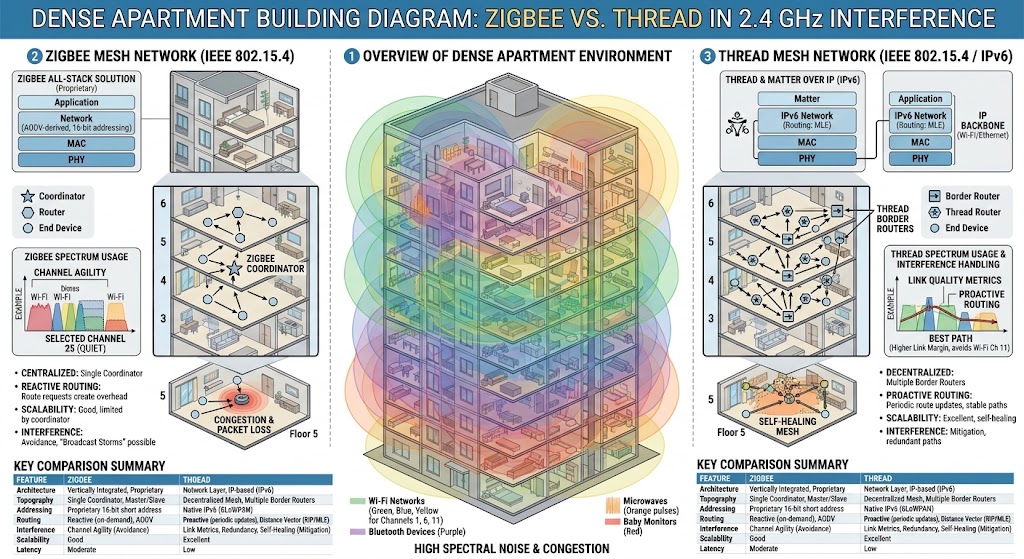
Zigbee and Thread share the same low-power 2.4 GHz radio foundation, so dense-apartment reliability depends more on RF congestion, mesh topology, and infrastructure than protocol branding.
Matter Protocol in 2026: What It Is and Why Your Next Device Needs It
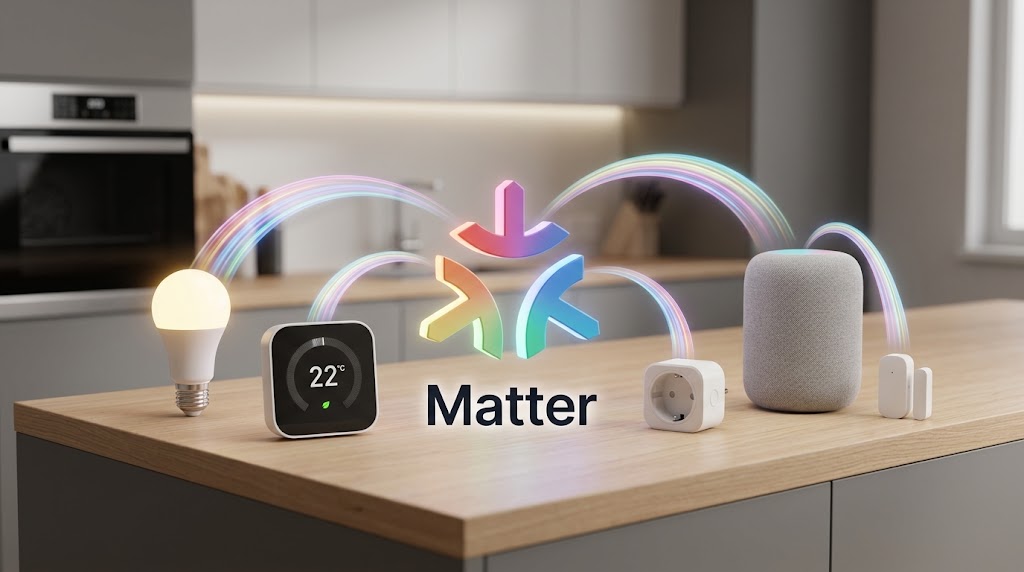
Matter 1.6 is the latest smart-home interoperability standard in 2026. Learn what Matter actually does, how Thread and Wi-Fi fit in, and when you should insist on Matter certification.
How to Set Up an Offline Smart Home Network That Works When Wi-Fi Drops
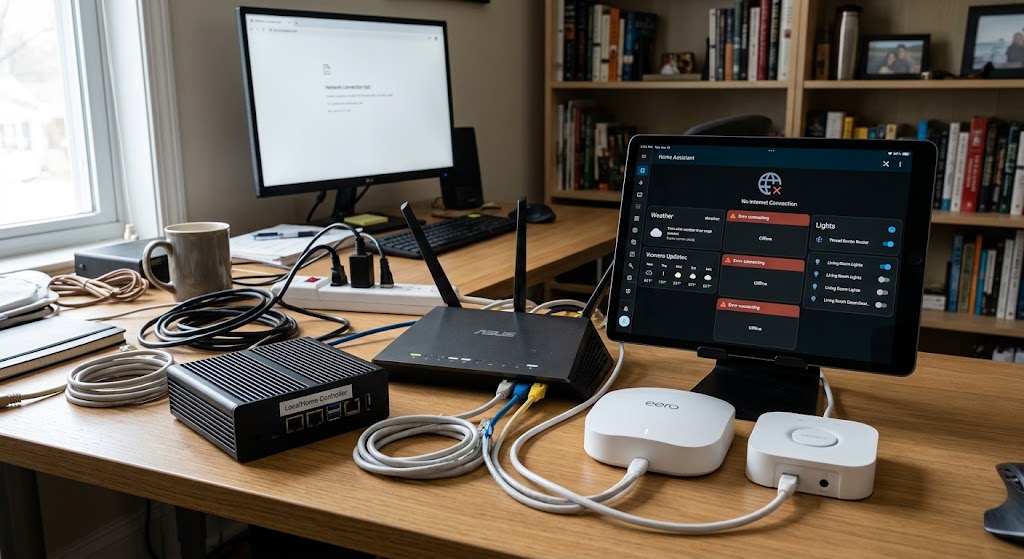
Build a local-first smart home that keeps critical lights, sensors, locks, and automations working during internet outages—and can keep core automations alive even when the Wi-Fi access point itself fails.
Local Control vs. Cloud Smart Home: Why You Should Avoid Cloud Dependency
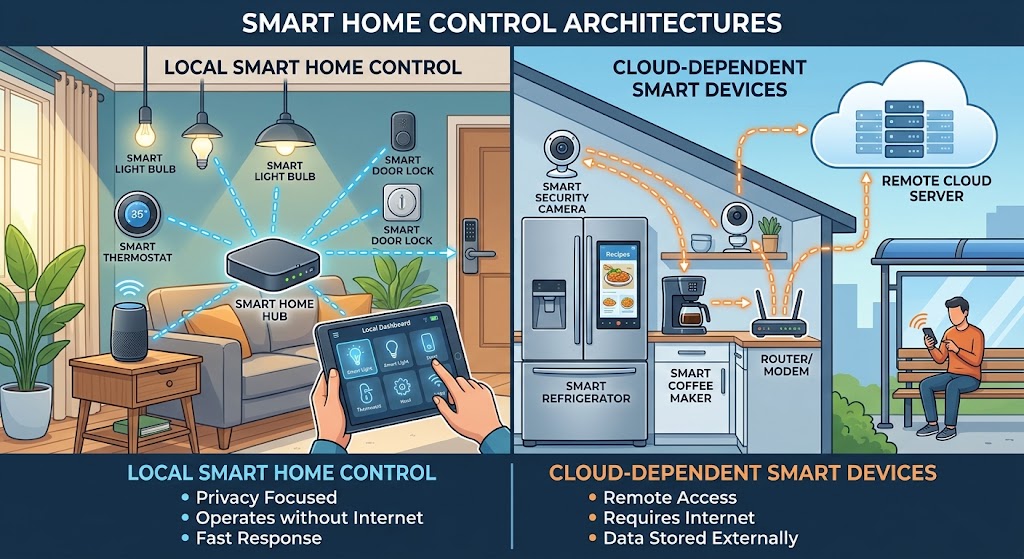
Cloud features are useful, but your lights, locks, sensors, and core automations should not stop working when the internet or a vendor service fails. Here is how to build a local-first smart home in 2026.