Matter Protocol in 2026: What It Is and Why Your Next Device Needs It
Matter 1.6 is the latest smart-home interoperability standard in 2026. Learn what Matter actually does, how Thread and Wi-Fi fit in, and when you should insist on Matter certification.
Quick answer
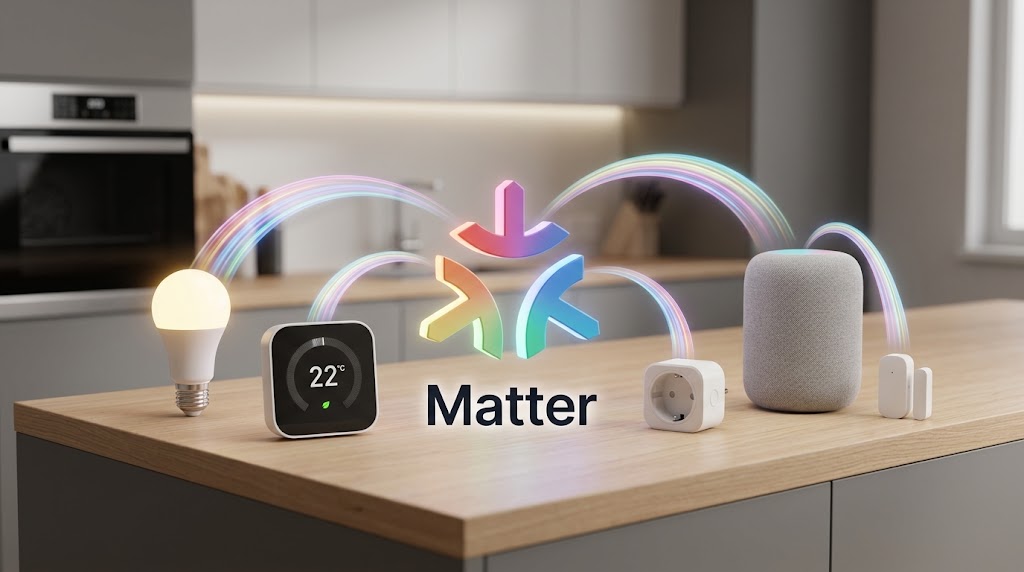
Matter is an open, IP-based smart-home application standard created by the Connectivity Standards Alliance to let certified devices work across multiple ecosystems. As of August 2026, the latest specification is Matter 1.6, released June 17, 2026. Matter can run over Wi-Fi, Ethernet, or Thread, while Bluetooth Low Energy and, increasingly, NFC are used for commissioning. Your next device does not literally need Matter, but for supported categories such as lights, plugs, switches, locks, thermostats, blinds, and sensors, Matter certification is increasingly worth prioritizing because it reduces ecosystem lock-in, supports local interoperability, and makes it easier to share devices across platforms.
Table of contents
- What Is Matter?
- The simplest explanation
- Matter Is Not Wi-Fi
- Matter Is Not Thread
- Matter
- Thread
- Why Matter Over Thread Is So Important
- Thread Border Router
- What Changed in Matter 1.6?
- 1. NFC-based commissioning
- 2. Joint Fabric
- 3. Thermostat Suggestions
- 4. Better capability reporting
- 5. Better security-sensor context
- 6. More scalable certificate revocation
- Matter 1.5 Was the Big Device Expansion
- Cameras
- Closures
- Soil sensors
- Energy management
- Why Your Next Device Probably Should Support Matter
- Reason 1: You Can Change Ecosystems More Easily
- Reason 2: Multi-Admin Is Built Into the Standard
- Reason 3: Local Control Is Part of the Architecture
- Reason 4: Certification Means More Than a Compatibility Sticker
- Reason 5: You Have More Brand Choice
- The Important Catch: Matter Version Does Not Equal Platform Support
- Check Three Layers Before Buying
- Layer 1: Matter certification
- Layer 2: Network transport
- Layer 3: Ecosystem support
- The Matter Logo Is Not Enough for Advanced Features
- Matter Bridge Devices Are Not a Failure
- Should You Replace Existing Zigbee or HomeKit Devices?
- Matter vs. HomeKit, Works With Google Home, and Alexa Skills
- Apple Home / Google Home / Alexa / SmartThings
- Matter
- Matter Over Wi-Fi vs. Matter Over Thread
- Choose Matter over Thread for:
- Choose Matter over Wi-Fi for:
- Choose Ethernet when practical for:
- Does Matter Need the Internet?
- Matter Security: What It Does and Does Not Guarantee
- The Best Device Categories to Prioritize Matter in 2026
- Smart plugs and outlets
- Lights and switches
- Sensors
- Smart locks
- Thermostats
- Blinds and shades
- Cameras
- When Matter Should Not Be Your Top Buying Criterion
- The device category is not well supported by your ecosystem
- A specialized proprietary product is clearly better
- Your existing hub-based system is already excellent
- The product only advertises “Matter-ready”
- 2026 Matter Buying Checklist
- What Matter Means for the Next Five Years
- Conclusion
Key takeaways
- Matter 1.6, released June 17, 2026, is the latest Matter specification as of this article date.
- Matter is not a radio technology: certified devices can communicate over Wi-Fi, Ethernet, or Thread.
- Matter over Thread is especially useful for low-power smart-home devices such as sensors, locks, plugs, and blinds.
- Matter certification improves interoperability, but ecosystem support for newly added Matter features can arrive later than the specification itself.
- For mainstream smart-home categories, buying Matter-certified hardware is increasingly the safest way to reduce vendor lock-in without giving up each brand's optional advanced features.
Editorial transparency
Who worked on this article and how it was handled.
- Written by
- Maya Chen
- Creation method
- Editorial research
AI assistance: AI assisted with research organization and drafting. Sources, protocol-version claims, platform support, and the final article should be reviewed by a human editor before publication.
For more than a decade, buying a smart-home device meant making an ecosystem decision at the same time.
A bulb might work beautifully with one app but poorly with another. A lock could support Apple Home but not Google Home. A sensor might require a proprietary bridge. Moving from Alexa to another platform could mean replacing hardware that was still perfectly functional.
Matter was created to reduce that fragmentation.
In 2026, it is no longer just a launch-era promise. The standard has reached Matter 1.6, released by the Connectivity Standards Alliance on June 17, 2026, and now covers a much broader range of devices and smart-home scenarios than the first 1.0 release.
But the marketing around Matter can still create the wrong expectation.
Matter does not mean:
- every smart device has identical features in every app;
- Thread and Matter are the same technology;
- every Matter device works without a hub or controller;
- every feature in the newest specification appears immediately in Apple Home, Google Home, Alexa, or SmartThings;
- proprietary apps suddenly become unnecessary.
The real value of Matter is more specific—and more useful.
It gives smart-home devices a common, certified language built on IP networking so compatible products can work across ecosystems without every manufacturer having to create a completely separate integration for each one.
What Is Matter?
Matter is an application-layer smart-home interoperability standard developed by the Connectivity Standards Alliance.
It defines how compatible devices:
- identify themselves;
- describe their capabilities;
- authenticate securely;
- expose controls and status;
- interact with controllers;
- participate in automations;
- share access across supported ecosystems.
Matter is built on Internet Protocol.
That is important because it means Matter devices can use standard IP networking rather than requiring every ecosystem to translate a proprietary device protocol into its own format.
The simplest explanation
Think of Matter as the common smart-home language.
The network underneath that language can be:
- Wi-Fi
- Thread
- Ethernet
Bluetooth Low Energy has traditionally been used during commissioning, and Matter 1.6 adds a more substantial NFC-based commissioning option.
Matter Is Not Wi-Fi
A Matter logo does not tell you which radio the device uses.
A Matter smart plug might use Wi-Fi.
A Matter contact sensor might use Thread.
A Matter bridge may use Ethernet.
All three can still speak Matter.
This is why a good product listing should ideally tell you two separate things:
- Application protocol: Matter
- Network transport: Wi-Fi, Thread, or Ethernet
If a retailer only says “Matter compatible,” you may still need to inspect the technical specifications.
Matter Is Not Thread
Thread is often mentioned in the same sentence as Matter, so the two are frequently confused.
They solve different layers of the problem.
Matter
Defines:
- device types;
- commands;
- attributes;
- interoperable smart-home behavior;
- setup and security rules.
Thread
Provides:
- a low-power wireless mesh;
- IPv6 networking;
- routing between Thread devices;
- battery-friendly operation;
- resilient local connectivity.
Thread Group describes Thread as a low-power IP network designed specifically for smart-home and IoT devices.
Matter can run over Thread, but it can also run over Wi-Fi or Ethernet.
Why Matter Over Thread Is So Important
Matter over Thread is one of the strongest combinations for devices that do not need high bandwidth.
Good candidates include:
- door and window sensors;
- motion sensors;
- temperature sensors;
- smart locks;
- smart plugs;
- in-wall switches;
- blinds and shades;
- low-power buttons and controllers.
Thread uses a mesh architecture.
Battery-powered devices can remain low-power end devices, while mains-powered Thread devices can route traffic and help extend the mesh.
That makes it fundamentally different from putting every tiny sensor directly on Wi-Fi.
Thread Border Router
A Thread device needs a path between the Thread mesh and the rest of the home’s IP network.
That function is provided by a Thread Border Router.
The good news is that a Border Router often does not need to be a separate dedicated hub.
Thread Border Router functionality can be built into:
- smart speakers;
- smart displays;
- streaming devices;
- Wi-Fi routers;
- home hubs.
Current Apple and Google ecosystems already have several products that provide this function.
What Changed in Matter 1.6?
Matter 1.6 is the latest specification as of August 2026.
It is a more focused release than Matter 1.5. Instead of adding a long list of new device categories, it improves how devices are installed, administered across ecosystems, and controlled in context.
1. NFC-based commissioning
Earlier Matter setup normally started with:
- QR code;
- numeric setup code;
- Bluetooth Low Energy.
Matter 1.4.1 introduced NFC onboarding information, but the full commissioning process still depended on BLE.
Matter 1.6 goes further.
The Connectivity Standards Alliance says full commissioning can now happen through bi-directional NFC, even before the device is fully powered.
That is particularly useful for:
- ceiling fixtures;
- in-wall switches;
- installed hardware;
- large multi-device deployments.
A device can potentially be provisioned before it is placed in a difficult-to-reach location.
2. Joint Fabric
Multi-Admin has always been one of Matter’s most important concepts.
It allows a device to be shared between multiple ecosystems rather than forcing you to choose only one.
Matter 1.6 adds Joint Fabric, a new standardized administration model.
Instead of every ecosystem maintaining a completely separate Matter fabric for the same devices, multiple authorized controllers can co-administer one shared Matter network.
Potential use cases include:
- households using more than one platform;
- property management;
- new-home handover;
- professional smart-home installations;
- family members using different interfaces.
This is a deeper form of cross-platform interoperability than simply exposing one device to several apps.
3. Thermostat Suggestions
Smart thermostats can receive commands from many places:
- user;
- utility;
- automation;
- home platform;
- energy-management service.
Those commands can conflict.
Matter 1.6 introduces a standardized Thermostat Suggestions model.
Instead of every ecosystem forcing a direct temperature change, a controller can send a time-limited suggestion.
The thermostat can then evaluate that suggestion against:
- recent manual changes;
- energy-saving preferences;
- humidity priorities;
- demand-response commitments;
- other user context.
The goal is more predictable behavior when multiple systems are trying to influence one thermostat.
4. Better capability reporting
Matter devices can now communicate operational capabilities and limits more clearly.
That matters because interoperability is not only about “on” and “off.”
Controllers need to know:
- which modes exist;
- which limits apply;
- what a device can actually do;
- whether a requested operation is valid.
Better standardized capability reporting reduces the chance that an ecosystem presents controls the device cannot properly execute.
5. Better security-sensor context
Matter 1.6 adds standardized event-history reporting for security sensors.
That can give platforms more context around:
- when an event happened;
- recent activity;
- current status.
Smoke and carbon monoxide alarms can also report an unmounted state, allowing a platform to know when a device has been removed from its installed position.
6. More scalable certificate revocation
Matter uses device identity and certificate-based trust.
Matter 1.6 adds partitioned certificate revocation lists, improving how revocation information can scale as the number of certified Matter devices grows.
This is infrastructure users may never directly see—but it matters to long-term platform security.
Matter 1.5 Was the Big Device Expansion
To understand Matter in 2026, Matter 1.5 is just as important as 1.6.
Released in November 2025, Matter 1.5 added several categories users had been waiting for.
Cameras
Matter 1.5 introduced standardized camera support including:
- live video;
- audio;
- two-way communication;
- WebRTC;
- pan, tilt, and zoom;
- detection and privacy zones;
- flexible recording architecture.
Matter 1.5.1, released in March 2026, improved camera support further with multi-stream video and audio plus expanded media capabilities.
Closures
Matter 1.5 redesigned support for:
- blinds;
- shades;
- drapes;
- awnings;
- gates;
- garage doors.
This created a more flexible model for different types of movement and position reporting.
Soil sensors
Matter expanded into garden automation with standardized:
- soil moisture;
- optional soil temperature.
That creates a path for interoperable plant and irrigation automations.
Energy management
Matter 1.5 also expanded energy-related capabilities for:
- electricity tariffs;
- grid carbon intensity;
- energy pricing;
- smart metering;
- power limits;
- solar data;
- EV charging;
- bidirectional charging.
This is one of the most important long-term directions for Matter because it allows devices from different manufacturers to participate in the same home-energy system.
Why Your Next Device Probably Should Support Matter
The title of this article is intentionally strong.
Your next device does not literally need Matter.
A proprietary device can still be:
- excellent;
- secure;
- local;
- reliable;
- deeply integrated with one ecosystem.
But for mainstream device categories, Matter increasingly removes reasons not to choose interoperable hardware.
Reason 1: You Can Change Ecosystems More Easily
Suppose you buy a smart plug today.
Your current home uses Google Home.
Next year you move in with someone who prefers Apple Home.
Later you add Home Assistant or SmartThings.
A well-supported Matter device gives you a better chance of keeping the hardware rather than replacing it just because the control platform changed.
This is one of Matter’s biggest consumer benefits:
separate the device purchase from the ecosystem commitment.
Reason 2: Multi-Admin Is Built Into the Standard
Traditional smart-home integrations often made one ecosystem primary and others secondary.
Matter is designed to let supported devices be commissioned into multiple ecosystems.
That means one light can potentially be controlled from:
- Apple Home;
- Google Home;
- Alexa;
- SmartThings;
without relying on a chain of proprietary cloud-to-cloud integrations.
Matter 1.6’s Joint Fabric capabilities expand the architecture for multi-controller environments further.
Reason 3: Local Control Is Part of the Architecture
Matter is designed around local IP communication.
That does not mean every product works perfectly with the internet disconnected.
Manufacturers may still depend on cloud services for:
- remote video storage;
- AI features;
- firmware delivery;
- advanced analytics;
- historical data.
But basic Matter control is not designed around mandatory cloud translation between ecosystems.
For common commands such as:
- turn on;
- dim;
- lock;
- read temperature;
- open blinds;
local communication can reduce latency and dependence on third-party cloud integrations.
Reason 4: Certification Means More Than a Compatibility Sticker
Only Matter-certified products are supposed to carry the Matter logo.
Connectivity Standards Alliance certification includes conformance testing and creates a certified product record.
Matter also uses device attestation.
Each Matter device has an identity that controllers can validate during commissioning.
The Alliance’s Matter FAQ describes security features including:
- unique device identity;
- encrypted data;
- fine-grained access control;
- device attestation certificates.
That does not mean every Matter product is equally secure in every aspect.
Matter protocol security is not the same as total product security.
A manufacturer still needs good:
- firmware practices;
- update policies;
- cloud security;
- account security;
- hardware security.
But certification creates a useful baseline for protocol interoperability and identity.
Reason 5: You Have More Brand Choice
Without an open interoperability layer, buying one product can push you toward the rest of the same manufacturer’s ecosystem.
Matter reduces that pressure.
You can potentially choose:
- one brand for locks;
- another for lights;
- another for blinds;
- another for sensors;
and still expose the standard capabilities to the same home platform.
That is healthier for both competition and the user.
The Important Catch: Matter Version Does Not Equal Platform Support
This is probably the most important buying warning in 2026.
The Matter specification can support a device before your preferred smart-home platform fully supports it.
For example, Matter 1.5 introduced cameras in November 2025.
But as of August 2026, Apple’s current Matter support documentation lists:
- air conditioners;
- bridges;
- lights;
- locks;
- outlets;
- switches;
- thermostats;
- blinds and shades;
- selected sensors.
Apple’s current support page does not yet list Matter cameras as a supported Home category.
Google also explicitly warns that smart-home platforms adopt newly added Matter device categories on different timelines.
So:
“Matter 1.6 supports it” and “my ecosystem supports it today” are two different questions.
Check Three Layers Before Buying
A good Matter purchase needs three compatibility checks.
Layer 1: Matter certification
Look for:
- Matter logo;
- exact product certification where possible.
Layer 2: Network transport
Is it:
- Matter over Wi-Fi?
- Matter over Thread?
- Matter over Ethernet?
If it uses Thread, make sure you have a compatible Thread Border Router.
Layer 3: Ecosystem support
Does your preferred platform currently support:
- that device category?
- the feature you care about?
- the transport?
- the required home hub?
This is where many disappointing purchases happen.
The Matter Logo Is Not Enough for Advanced Features
Matter standardizes a core set of interoperable capabilities.
Manufacturers can still offer additional features through their own apps.
A Matter light might expose:
- power;
- brightness;
- color temperature;
- color;
to all supported ecosystems.
The vendor app might also provide:
- custom animations;
- firmware settings;
- power-loss behavior;
- experimental effects.
A robot vacuum might expose standard cleaning controls through Matter but keep detailed:
- maps;
- object avoidance;
- AI camera features;
- cleaning history;
inside the manufacturer’s app.
Matter does not prevent innovation.
The goal is to standardize the common layer so basic functionality is not trapped behind one ecosystem.
Matter Bridge Devices Are Not a Failure
Some users assume:
If a device still needs a bridge, it is not really Matter.
That is incorrect.
Matter supports bridges intentionally.
A bridge can expose existing devices from technologies such as Zigbee into Matter-compatible ecosystems.
This lets mature product families gain interoperability without replacing every radio inside every accessory.
For example, a well-designed lighting bridge can still be an excellent architecture because:
- the low-power device network stays efficient;
- the bridge handles IP connectivity;
- Matter exposes devices to multiple ecosystems.
“Hubless” is not automatically better.
Should You Replace Existing Zigbee or HomeKit Devices?
Usually no.
If your existing devices:
- work reliably;
- receive security updates;
- integrate with your platform;
- meet your automation needs;
there is no reason to replace them only to gain a Matter logo.
Matter is most valuable when:
- buying new hardware;
- changing ecosystems;
- creating a new room;
- replacing failed devices;
- building a mixed-brand smart home.
Do not create e-waste to solve a compatibility problem you do not have.
Matter vs. HomeKit, Works With Google Home, and Alexa Skills
Matter does not replace the smart-home platforms themselves.
You still need an ecosystem for:
- dashboards;
- voice assistants;
- scenes;
- automations;
- user accounts;
- remote access;
- household permissions.
Matter replaces much of the device-to-platform integration layer.
Think of it this way:
Apple Home / Google Home / Alexa / SmartThings
Answer:
“How do I control and automate my home?”
Matter
Answers:
“How does this device expose interoperable smart-home capabilities to those platforms?”
Both layers are needed.
Matter Over Wi-Fi vs. Matter Over Thread
Which should you buy?
Choose Matter over Thread for:
- battery sensors;
- locks;
- buttons;
- small switches;
- blinds;
- low-bandwidth devices.
Why:
- low power;
- mesh networking;
- no direct Wi-Fi client requirement;
- designed for constrained devices.
Choose Matter over Wi-Fi for:
- higher-bandwidth devices;
- mains-powered devices;
- products that already need conventional IP networking.
Examples can include:
- appliances;
- some bridges;
- selected cameras;
- larger controllers.
Choose Ethernet when practical for:
- fixed bridges;
- controllers;
- stationary devices that benefit from maximum network stability.
The goal is not one universal radio.
Matter’s strength is that devices can share an interoperable application layer across several appropriate network transports.
Does Matter Need the Internet?
Matter’s local architecture means basic communication does not inherently require the cloud.
However, your actual smart-home experience may still need internet access for:
- control while away from home;
- cloud recording;
- manufacturer services;
- voice processing;
- firmware downloads;
- utility services;
- account synchronization.
A good question for any device is:
Which functions still work if my ISP connection goes down?
Matter improves the possibility of local operation, but the product design still matters.
Matter Security: What It Does and Does Not Guarantee
Matter includes strong protocol-level security concepts.
According to the Connectivity Standards Alliance:
- devices have unique identities;
- commissioning verifies authentic certified devices;
- communications are encrypted;
- access control restricts operations.
Matter 1.6 also improves certificate-revocation scalability.
But do not read “Matter” as:
This product can never be hacked.
Matter certification does not automatically evaluate every part of:
- manufacturer cloud infrastructure;
- mobile app security;
- account recovery;
- hardware supply chain;
- privacy policy.
The Alliance maintains a separate Product Security certification program specifically because protocol security and whole-product security are not identical.
The Best Device Categories to Prioritize Matter in 2026
Smart plugs and outlets
Matter is almost a default choice here.
The core feature set is simple:
- on;
- off;
- status;
- selected energy data where supported.
There is little benefit to proprietary lock-in for a basic smart plug.
Lights and switches
Another strong Matter category.
Choose based on:
- brightness quality;
- color quality;
- dimming;
- reliability;
- Thread vs. Wi-Fi;
- ecosystem compatibility.
Sensors
Matter over Thread is especially attractive for:
- motion;
- contact;
- temperature;
- humidity;
- ambient light.
Smart locks
Matter is increasingly valuable because locks are long-lived devices.
Thread can also make sense for battery life and local responsiveness.
Still check whether ecosystem-specific features such as Apple Home Key are supported by the exact lock; Matter certification alone does not guarantee every platform-specific credential feature.
Thermostats
Matter gives thermostats broader interoperability, and Matter 1.6 adds smarter standardized suggestion handling.
This category will become increasingly important as:
- demand response;
- energy pricing;
- home energy management;
become more connected.
Blinds and shades
Matter is a strong fit because:
- commands are standardized;
- Thread works well for low-bandwidth motor control;
- cross-platform automation is genuinely useful.
Cameras
This category needs more caution.
Matter 1.5 and 1.5.1 now define serious camera capabilities.
But platform support and vendor implementation are still catching up.
In 2026, do not buy a camera solely because the Matter specification supports cameras.
Confirm:
- your ecosystem supports Matter cameras;
- the camera is actually Matter-certified for the relevant features;
- recording and notification behavior match your expectations.
When Matter Should Not Be Your Top Buying Criterion
The device category is not well supported by your ecosystem
Compatibility today matters more than theoretical future support.
A specialized proprietary product is clearly better
Some products offer deep functionality beyond the Matter standard.
If you are committed to one platform and those advanced features matter more than interoperability, proprietary integration may still be the better choice.
Your existing hub-based system is already excellent
A stable Zigbee or other system does not become bad because Matter exists.
The product only advertises “Matter-ready”
Be careful with language such as:
- Matter ready;
- Matter coming soon;
- future Matter support.
Prefer:
- Matter certified;
- certification record;
- shipping firmware that actually supports Matter.
Do not pay today for a compatibility promise that depends on a future firmware update.
2026 Matter Buying Checklist
Before buying your next smart-home device:
- Does the product carry the official Matter certification mark?
- Is Matter support available now rather than promised later?
- What Matter specification/device capability is actually certified?
- Does it use Wi-Fi, Thread, or Ethernet?
- If Thread, do I already have a compatible Thread Border Router?
- Does Apple Home, Google Home, Alexa, SmartThings, or my chosen platform support this exact device category today?
- Which features are available through Matter?
- Which advanced features still require the manufacturer app?
- Can the device work locally if the internet is unavailable?
- Does the manufacturer have a credible firmware-update policy?
- Can the device be shared with another ecosystem through Matter Multi-Admin?
- Is there a bridge-based option that makes more sense than replacing existing hardware?
If you can answer all twelve, you are not just buying a Matter logo.
You are buying an interoperable device with a clear place in your smart-home architecture.
What Matter Means for the Next Five Years
Matter’s biggest impact may not be visible in one product feature.
It changes the default assumption behind smart-home hardware.
The old assumption was:
First choose your ecosystem. Then choose devices that fit inside it.
The Matter assumption is:
Choose a good certified device, then decide which compatible ecosystem should control it.
That difference matters as smart homes become more connected to:
- electricity prices;
- home batteries;
- EV charging;
- cameras;
- access control;
- environmental sensors;
- energy demand response.
Matter 1.5 pushed strongly into energy and camera use cases.
Matter 1.6 pushes the standard toward smarter multi-ecosystem administration and context-aware control.
The specification is becoming less about “can Alexa turn on my light?” and more about “can many connected systems safely coordinate one home?”
Conclusion
Matter has reached the point in 2026 where it should be part of the default buying checklist for most mainstream smart-home devices.
The latest release, Matter 1.6, improves setup, multi-ecosystem administration, contextual thermostat control, status reporting, and security infrastructure. Matter 1.5 and 1.5.1 expanded the standard into cameras, closures, soil sensing, energy management, and richer media.
But Matter is not magic.
You still need to check:
- whether the device uses Wi-Fi or Thread;
- whether your ecosystem supports the category;
- which features are standardized;
- which features remain vendor-specific.
For lights, plugs, sensors, locks, thermostats, and blinds, Matter-certified hardware is increasingly the safer long-term purchase because it separates the useful life of the device from the fortunes of one app or ecosystem.
So your next device does not absolutely need Matter.
But in 2026, if two comparable products exist and only one is properly Matter certified, the Matter model is usually the one with the better interoperability story—and the better chance of still fitting your smart home several years from now.
Common questions
Questions this guide answers
What is Matter in a smart home?
Matter is an application-layer interoperability standard. It defines a common way for certified smart-home devices and controllers to describe capabilities, authenticate, communicate, and work across compatible ecosystems. Matter uses IP networking and can operate over Wi-Fi, Ethernet, or Thread.
What is the latest version of Matter in 2026?
Matter 1.6 is the latest released specification as of August 2026. The Connectivity Standards Alliance released it on June 17, 2026 with NFC-based commissioning, Joint Fabric multi-ecosystem administration, smarter thermostat suggestions, improved device-status reporting, and additional security-related refinements.
Is Matter the same as Thread?
No. Matter is the smart-home application protocol, while Thread is one of the network transports Matter can use. A Matter device may use Thread, Wi-Fi, or Ethernet. Battery-powered sensors, locks, and similar low-bandwidth devices are especially good candidates for Matter over Thread.
Does every Matter device work with every smart-home feature?
Not necessarily. Matter defines interoperable device capabilities, but platform support can lag behind the newest Matter specification, and manufacturers may keep advanced features inside their own apps. Always confirm that your preferred ecosystem supports the exact device category and features you need before buying.
Evidence & further reading
Sources & references
Primary and authoritative references used to support or contextualize this article. Links open the original source.
- 1Matter 1.6 Enables More Intuitive Setup, Multi-Ecosystem Experiences, and Context-Driven Control
Connectivity Standards Alliance · Accessed Aug 10, 2026
Supports Matter 1.6 as the latest release, its June 17, 2026 release date, NFC commissioning, Joint Fabric, Thermostat Suggestions, device capability communication, event history, alarm state, and certificate revocation improvements.
- 2Matter 1.5 Introduces Cameras, Closures, and Enhanced Energy Management Capabilities
Connectivity Standards Alliance · Accessed Aug 10, 2026
Supports Matter 1.5 additions including cameras, closures, soil sensors, energy-management data, enhanced metering, EV charging, and TCP support.
- 3Matter 1.5.1: Enhancing Camera Performance and Expanding Device Flexibility
Connectivity Standards Alliance · Accessed Aug 10, 2026
Supports 2026 camera refinements including multi-stream media delivery and expanded media-format support.
- 4Matter FAQ
Connectivity Standards Alliance · Accessed Aug 10, 2026
Supports Matter's use of BLE for setup and Wi-Fi, Thread, and Ethernet for connectivity, Matter certification, device identity, encryption, access control, and device attestation.
- 5Certification Process
Connectivity Standards Alliance · Accessed Aug 10, 2026
Supports the meaning of Alliance certification, interoperability testing, certified product logos, and Matter certification records.
- 6Thread with Matter: Better Connections, Smarter Homes
Thread Group · Accessed Aug 10, 2026
Supports Matter's use of Thread, Wi-Fi, and Ethernet, the role of Thread Border Routers, and Thread's low-power mesh characteristics.
- 7Thread in Homes
Thread Group · Accessed Aug 10, 2026
Supports Thread as a low-power IPv6 mesh, device roles, Border Router requirements, and its complementary relationship with Wi-Fi.
- 8Pair and manage your Matter accessories
Apple Support · Accessed Aug 10, 2026
Supports current Apple Home Matter device categories and Thread home-hub requirements, illustrating that ecosystem implementation can lag behind the newest Matter specification.
- 9Prepare your smart home for Matter
Google Home and Nest Help · Accessed Aug 10, 2026
Supports Google Home Matter requirements, Wi-Fi versus Thread distinctions, Thread Border Router needs, and Google's warning that Matter device-category support is adopted over time.

About the author
Maya Chen
Maya covers residential energy, HVAC controls, and practical home automation, translating technical systems into useful decisions for homeowners and renters.
More from Maya →Make your home smarter without buying every gadget.
One useful idea, one product worth knowing, and one energy-saving action—delivered weekly.
No spam. Unsubscribe anytime.
Semantic recommendations
Related reading
Selected from topic cluster, entities, tags, search intent, and editorial relationships.
Zigbee vs Thread Mesh Performance in Dense Apartment Buildings
Zigbee and Thread share the same low-power 2.4 GHz radio foundation, so dense-apartment reliability depends more on RF congestion, mesh topology, and infrastructure than protocol branding.
How to Use Home Assistant SkyConnect to Run Matter and Thread Simultaneously
SkyConnect can power a Home Assistant Thread network for Matter-over-Thread devices, but Matter and Thread are different layers—not two radio modes. Here is the correct 2026 setup.

Zigbee vs. Z-Wave vs. Thread: Which Smart Home Protocol Wins in 2026?
Thread is the strongest choice for new Matter-first smart homes in 2026, while Zigbee remains the value and device-selection leader and Z-Wave excels in sub-GHz reliability, security, and long-range installations.

How to Create a Smart Home Setup in a Studio Apartment Without Wi-Fi Congestion
Build a responsive studio-apartment smart home without overloading Wi-Fi by using one well-placed router, Matter over Thread for low-bandwidth devices, and Wi-Fi only where it makes sense.