
Soundproofing Apartment Walls: Smart Acoustic Panels & Tech Hacks
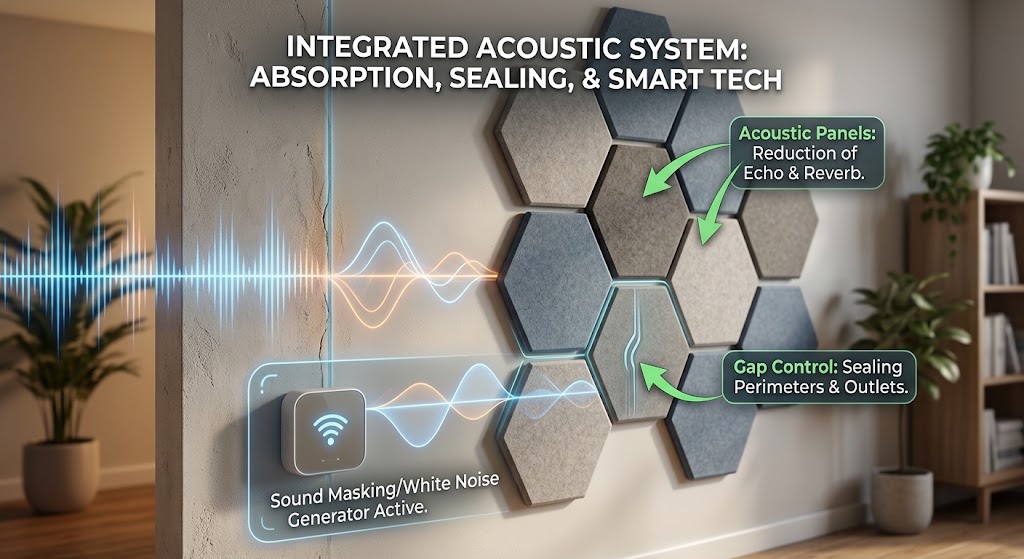
Acoustic panels can reduce echo, but they do not truly soundproof a shared apartment wall. Here is how renters can combine absorption, gap control, sound masking, and smart tech for a noticeably quieter space.
Quick answer
Acoustic wall panels can make an apartment sound calmer by absorbing reflections and reducing reverberation, but they do not substantially increase the Sound Transmission Class of a shared wall by themselves. For renters, the best practical strategy is layered: identify the noise path, add removable absorptive panels and soft furnishings for room acoustics, seal obvious air gaps where permitted, move noisy equipment away from shared walls, use rugs and vibration isolation for impact noise, and add low-level sound masking or headphones when structural sound isolation cannot be changed.
Table of contents
- Step 1: Diagnose the Noise Before Buying Anything
- Airborne noise
- Impact and structure-borne noise
- Reverberation inside your own apartment
- NRC vs. STC: The Two Ratings Renters Should Know
- NRC — Noise Reduction Coefficient
- STC — Sound Transmission Class
- What Acoustic Panels Can Actually Do
- Best Renter-Friendly Panel Types
- PET felt panels
- Fabric-wrapped absorbers
- Freestanding acoustic panels
- Heavy curtains
- Where to Put Acoustic Panels
- Home office
- Bedroom
- Living room
- Shared wall with a noisy neighbor
- The Best “Smart Panel” Strategy Is Measurement + Placement
- Use a phone as a comparison tool
- Move Noise Sources Away From Shared Walls
- Do not put a subwoofer directly against the party wall
- Use Furniture as an Extra Layer
- Seal the Obvious Air Paths
- Start with the entry door
- Do not seal ventilation openings
- Rugs and Underlays for Impact Noise
- Smart Tech Hack #1: Sound Masking
- Smart speaker routine
- Smart Tech Hack #2: Place the Masking Source Near You
- Smart Tech Hack #3: Noise-Triggered Automations—Use Carefully
- Smart Tech Hack #4: ANC Headphones for Work
- Smart Tech Hack #5: Directional Audio
- What Actually Blocks Sound Better?
- More mass
- Decoupling
- Airtightness
- Cavity treatment
- Better doors and windows
- When to Talk to the Landlord
- What About Mass-Loaded Vinyl and Extra Drywall?
- A Practical Renter Setup for a Noisy Bedroom
- Problem
- Layer 1: Room absorption
- Layer 2: Furniture
- Layer 3: Gaps
- Layer 4: Floor
- Layer 5: Smart masking
- Layer 6: Personal isolation
- A Practical Renter Setup for a Home Office
- Problem
- Common Mistakes
- Mistake 1: Buying thin foam and expecting soundproofing
- Mistake 2: Covering only the noisy wall
- Mistake 3: Ignoring doors and penetrations
- Mistake 4: Treating bass like speech
- Mistake 5: Turning masking too loud
- Mistake 6: Mounting heavy panels with weak adhesive
- Mistake 7: Blocking vents
- Move-Out Checklist
- Conclusion
Key takeaways
- Acoustic panels reduce reflections and reverberation inside a room; they are not a substitute for a higher-STC wall assembly.
- The first step is identifying whether your problem is airborne noise, impact vibration, flanking transmission, or simply excessive room echo.
- For renters, removable absorption, furniture placement, rugs, door-gap management, and sound masking usually offer the best risk-to-benefit ratio.
- A phone sound-level app can help compare before-and-after conditions, but consumer measurements should not be treated as a professional building-acoustics test.
- The most effective true sound isolation usually requires construction changes such as more mass, sealing, resilient channels, or decoupled assemblies—often landlord-level work.
Editorial transparency
Who worked on this article and how it was handled.
- Written by
- Maya Chen
- Creation method
- Editorial research
AI assistance: AI assisted with research organization and drafting. Sources, acoustic claims, and the final article should be reviewed by a human editor before publication.
Thin apartment walls can make ordinary life feel much louder than it should. A neighbor’s television becomes background audio in your bedroom, hallway conversations leak through the entry door, and footsteps from above can make a quiet room feel impossible.
The first instinct is often to buy a wall full of acoustic foam or decorative felt panels.
Those products can be useful—but only if you understand what problem they are designed to solve.
The most important distinction in apartment acoustics is between sound absorption and sound isolation.
- Absorption reduces sound bouncing around inside your room.
- Isolation reduces sound passing from one room or apartment to another.
A decorative acoustic panel may make your room less echoey and improve speech clarity while doing very little to stop a neighbor’s bass or conversation from transmitting through the shared wall.
That does not mean renters are powerless. It means the best renter strategy is usually a layered combination of absorption, gap control, vibration management, furniture placement, and sound masking rather than one miracle panel.
Step 1: Diagnose the Noise Before Buying Anything
Sound problems that feel identical can have completely different causes.
Before treating the wall, identify which type of noise bothers you most.
Airborne noise
Examples:
- voices;
- television;
- music;
- traffic;
- barking;
- hallway conversation.
Airborne sound travels through the air and excites walls, doors, windows, vents, and penetrations.
This is where wall construction, door seals, openings, and flanking paths matter most.
Impact and structure-borne noise
Examples:
- footsteps;
- furniture dragging;
- doors slamming;
- washing-machine vibration;
- subwoofer bass;
- plumbing vibration.
This energy travels through the building structure.
A felt panel on your wall is rarely the first-line fix for noise that is mechanically vibrating the floor or framing.
Reverberation inside your own apartment
Examples:
- your voice sounds harsh;
- video calls have strong echo;
- TV sound feels muddy;
- every small noise seems louder because the room is hard and reflective.
This is where acoustic panels work best.
NIOSH guidance explains that hard walls, floors, and ceilings reflect sound, while porous materials such as textiles and foam absorb part of that sound and reduce reverberant noise.
NRC vs. STC: The Two Ratings Renters Should Know
Marketing pages often mix these terms together.
They should not.
NRC — Noise Reduction Coefficient
NRC is associated with sound absorption.
ASTM C423 is the standard test used for sound absorption in a reverberation room.
A higher absorption rating means the material absorbs more incident sound energy in the tested frequency bands rather than reflecting it back into the room.
This is useful for:
- acoustic panels;
- ceiling tile;
- absorptive wall treatments.
STC — Sound Transmission Class
STC is about sound transmission through a building assembly.
ASTM E90 is the laboratory test used for airborne sound transmission loss, and STC is a rating derived from that type of testing.
This applies to:
- walls;
- doors;
- floor-ceiling assemblies;
- other partitions.
ASTM specifically warns not to confuse sound absorption with airborne sound transmission loss.
So if a product page says:
NRC 0.90
that can be excellent evidence that it will absorb room reflections.
It is not evidence that attaching it to a wall will raise that wall’s STC by a large amount.
What Acoustic Panels Can Actually Do
Acoustic panels are most valuable when your apartment itself is acoustically “live.”
Signs include:
- long echo after clapping;
- harsh video calls;
- difficult speech intelligibility;
- TV volume creeping higher because dialogue sounds unclear;
- noise reflecting strongly between parallel walls.
In these rooms, panels can reduce reflected energy.
That can make outside or neighboring noise feel somewhat less intrusive because your room is no longer adding as much reverberation on top of the incoming sound.
But this is a perceptual and room-acoustic improvement, not the same thing as stopping the sound at the wall.
Best Renter-Friendly Panel Types
PET felt panels
Best for: home offices, bedrooms, living rooms
Strength: lightweight and easy to mount
Renter risk: relatively low with compatible removable mounting
PET felt panels are popular because they are:
- light;
- decorative;
- available in modular shapes;
- easier to mount than heavy broadband traps.
They are a good choice for reducing mid- and high-frequency room reflections.
Fabric-wrapped absorbers
Best for: stronger broadband absorption
Strength: usually thicker than decorative felt
Renter risk: depends on mounting method and panel weight
A thicker absorber generally performs better at lower frequencies than a very thin decorative panel.
NIOSH makes the same underlying point in its noise-control guidance: thin absorptive materials are more effective at high frequencies, while thicker absorbers are needed as the target frequency gets lower.
Freestanding acoustic panels
Best for: renters who want zero wall contact
Strength: no adhesive or screws
Renter risk: very low
A freestanding panel or acoustic divider can sit:
- behind a desk;
- beside a bed;
- behind a sofa;
- between a noisy workstation and the rest of the room.
These cost floor space, but they are one of the cleanest move-out options.
Heavy curtains
Curtains are not acoustic walls, but they add soft surface area and can reduce room reflection.
They are particularly useful around:
- large windows;
- sliding doors;
- bare glass.
Treat them as absorption and comfort tools, not as a substitute for high-STC glazing.
Where to Put Acoustic Panels
Randomly covering a wall is not necessarily the best use of your budget.
Start with the surfaces creating the most reflection.
Home office
Prioritize:
- wall behind the monitor;
- sidewalls near the desk;
- wall behind your seating position if it produces strong flutter echo.
Bedroom
Prioritize:
- wall behind the headboard;
- large bare wall opposite the bed;
- reflective corner near a desk or TV.
Living room
Prioritize:
- wall behind or opposite speakers;
- large empty shared wall;
- areas around hard entertainment furniture.
Shared wall with a noisy neighbor
Panels can still be useful here—but think of them as controlling your side of the acoustic environment, not rebuilding the partition.
If the noise path is through the wall assembly, the real fix may exist inside the construction where a renter cannot access it.
The Best “Smart Panel” Strategy Is Measurement + Placement
Most acoustic panels are passive.
You do not need electronics inside the panel for the system to be “smart.”
A more useful smart workflow is:
- measure or observe the noisy condition;
- identify where reflections are strongest;
- place treatment only where it changes the result;
- compare the room afterward.
Use a phone as a comparison tool
NIOSH offers a validated Sound Level Meter app for iOS.
It is designed for occupational-noise information rather than apartment certification, but it can still help you make relative comparisons such as:
- desk before panels vs. after panels;
- window open vs. closed;
- rug installed vs. bare floor;
- speaker against shared wall vs. moved inward.
Do not treat a phone reading as an STC measurement or professional building-acoustics test.
Use it to identify patterns.
Move Noise Sources Away From Shared Walls
One of the cheapest acoustic improvements is furniture placement.
NIOSH notes that placing noisy equipment close to hard reflective surfaces can increase reflected sound.
For an apartment, that translates into practical rules:
Move these away from shared walls when possible:
- TV;
- speakers;
- subwoofer;
- gaming PC;
- air purifier;
- portable AC;
- washing machine;
- desktop speakers.
Even a modest change in placement can reduce:
- direct wall excitation;
- reflected sound;
- vibration transfer.
Do not put a subwoofer directly against the party wall
Bass is difficult to isolate because low frequencies travel effectively through building structures.
Moving the source away from the wall and adding vibration isolation under the device can be more useful than covering the wall with thin foam.
Use Furniture as an Extra Layer
A renter usually cannot add another layer of gypsum board.
But you can add mass and irregularity in front of a wall using ordinary furniture.
Good shared-wall choices include:
- full bookcase;
- wardrobe;
- filled storage unit;
- upholstered headboard;
- sofa with a small air gap behind it.
This is not equivalent to a tested sound-isolation wall assembly.
But it can:
- reduce direct reflection;
- add some mass in the room;
- change the local acoustic field.
The best choice is usually furniture you already need.
Seal the Obvious Air Paths
USG acoustic guidance makes a fundamental building-science point: sound performance is compromised wherever air can pass freely.
In apartments, common leakage paths include:
- entry-door perimeter;
- gap under the door;
- window seals;
- wall penetrations;
- poorly fitted service openings.
Start with the entry door
Many “thin wall” complaints are actually hallway-door complaints.
If voices are much clearer near the door than the shared wall, investigate:
- door sweep;
- perimeter weatherstripping;
- latch compression.
Use renter-compatible products and confirm your lease permits them.
Do not seal ventilation openings
Never block:
- HVAC supply;
- return air;
- required ventilation;
- combustion-air openings;
- life-safety devices.
Acoustic comfort is not worth creating an indoor-air-quality or safety problem.
Rugs and Underlays for Impact Noise
If the problem is footsteps or furniture movement inside your own apartment, rugs can help reduce the impact energy you transmit to neighbors below.
Use:
- thick area rug;
- dense rug pad;
- soft furniture feet;
- anti-vibration pads under appliances.
This is primarily an impact-noise management strategy.
It will not transform the STC of a wall.
For noise coming from the apartment above, the most effective structural treatment normally belongs in the floor-ceiling assembly—something the upstairs tenant, landlord, or building management may need to address.
Smart Tech Hack #1: Sound Masking
Sound masking does not block noise.
It makes unwanted sound less noticeable by adding a stable background sound.
GSA defines sound masking as a low, uniform background noise used to cover unwanted sound.
In an apartment, masking can be useful for:
- intermittent neighbor voices;
- hallway sounds;
- traffic;
- plumbing noises;
- occasional doors closing.
Smart speaker routine
You can use a smart speaker to automate:
- white noise;
- pink noise;
- brown-noise-style tracks;
- fan sounds;
- rainfall.
Example routine:
10:30 p.m.
- lights dim;
- bedroom sound masking turns on;
- volume stays low and constant;
- masking stops automatically in the morning.
The goal is not loudness.
The goal is a steady background level that reduces contrast between the room and the unwanted sound.
Smart Tech Hack #2: Place the Masking Source Near You
A common mistake is putting the sound-masking speaker beside the noisy wall.
For sleep or focus, it often makes more sense to place the masking source:
- near the bed;
- near the desk;
- between you and the direction of disturbance.
This lets the masking sound work at a lower volume at your listening position.
Lower volume is generally more comfortable than trying to fill the entire apartment.
Smart Tech Hack #3: Noise-Triggered Automations—Use Carefully
You can technically build automations around:
- microphone sensors;
- smart-home noise detectors;
- occupancy sensors;
- time of day.
For example:
If the apartment is occupied after 10 p.m., activate the low-level bedroom masking routine.
This is usually better than trying to trigger on every sudden sound.
Noise-triggered automations can create:
- false triggers;
- privacy concerns;
- constant volume changes.
A predictable schedule is often calmer and more reliable.
Smart Tech Hack #4: ANC Headphones for Work
Active noise-canceling headphones do something acoustic panels cannot: they reduce the sound reaching your ears directly.
They are especially effective for:
- low-frequency HVAC hum;
- traffic rumble;
- aircraft-like steady noise;
- some appliance sounds.
They are less perfect for:
- sudden impacts;
- very loud voices;
- unpredictable high-frequency sounds.
For work-from-home renters, ANC can be one of the highest-impact non-construction upgrades.
It does not improve the apartment’s STC.
It improves your personal acoustic environment.
Smart Tech Hack #5: Directional Audio
If your own TV or music is contributing to the noise conflict, reduce how much sound you need to fill the room.
Options include:
- near-field desktop speakers;
- headphones;
- TV listening headphones;
- soundbar placed close to the viewer;
- speakers aimed away from shared walls.
The quieter your own room can operate, the easier it is to use lower masking levels and maintain good neighbor relations.
What Actually Blocks Sound Better?
True sound isolation usually relies on building-assembly principles such as:
More mass
Heavier assemblies generally resist airborne sound transmission better.
Decoupling
USG highlights resilient channels as an effective method for reducing airborne sound transmission because they reduce rigid mechanical coupling between gypsum board and framing.
Airtightness
Openings and penetrations can undermine an otherwise strong partition.
Cavity treatment
Wall-cavity insulation can contribute to the overall assembly performance.
Better doors and windows
A weak door or window can dominate the acoustic performance of a room.
These are construction-level interventions.
If the shared wall is genuinely inadequate, the correct long-term fix may require the landlord or building owner—not another peel-and-stick panel.
When to Talk to the Landlord
Escalate the problem if you discover:
- large visible gaps;
- damaged wall penetrations;
- missing seals around building components;
- unusually clear speech transmission;
- plumbing or mechanical vibration;
- a door that does not close correctly;
- building equipment generating excessive noise.
Frame the conversation around the building defect or transmission path, not simply:
My neighbor is loud.
Examples:
- “There is a visible gap around the service penetration on the shared wall.”
- “The entry door has a continuous gap at the bottom and hallway speech is clearly audible.”
- “The pipe vibrates strongly against the wall when water runs.”
Specific observations are easier to act on.
What About Mass-Loaded Vinyl and Extra Drywall?
These products can be part of real sound-isolation assemblies.
They are usually poor DIY renter upgrades.
Why:
- heavy;
- difficult to mount safely;
- often need mechanical fastening;
- can damage walls;
- work best as part of a designed assembly;
- may create fire, code, or finish issues if installed incorrectly.
If your landlord approves a real acoustic renovation, the wall should be treated as a complete assembly rather than a decorative surface project.
A Practical Renter Setup for a Noisy Bedroom
Here is a low-risk example.
Problem
Neighbor voices through one shared wall plus strong room echo.
Layer 1: Room absorption
Install removable PET or fabric panels on:
- shared-wall reflection area;
- wall behind the bed;
- one opposing bare wall.
Layer 2: Furniture
Place:
- upholstered headboard;
- wardrobe or bookshelf along part of the shared wall.
Layer 3: Gaps
Check:
- bedroom door;
- apartment entry door;
- window seals.
Layer 4: Floor
Add:
- rug;
- dense rug pad.
Layer 5: Smart masking
Use:
- low-volume smart-speaker routine near the bed;
- scheduled from bedtime to wake-up.
Layer 6: Personal isolation
Keep:
- ANC headphones for work or temporary high-noise periods.
This setup will not turn a poor wall into a recording studio.
But it addresses several acoustic mechanisms at once without requiring demolition.
A Practical Renter Setup for a Home Office
Problem
Video-call echo plus neighbor noise.
Use:
- two to four thick absorptive panels near the desk;
- rug if the floor is hard;
- curtains over large glass;
- bookcase against the shared wall;
- near-field speakers or headphones;
- low-level masking between calls;
- phone measurements before and after treatment.
The biggest improvement may be speech clarity rather than raw decibel reduction.
That still matters.
A calmer acoustic environment reduces the temptation to turn your own speakers louder.
Common Mistakes
Mistake 1: Buying thin foam and expecting soundproofing
Thin foam can reduce reflections at higher frequencies.
It is not a replacement for a high-STC wall.
Mistake 2: Covering only the noisy wall
If your room has strong reflection from:
- glass;
- floor;
- opposite wall;
- ceiling;
one treated wall may not fix the reverberation problem.
Mistake 3: Ignoring doors and penetrations
Sound can bypass the wall through weaker paths.
Mistake 4: Treating bass like speech
Low-frequency sound is much harder to control with thin surface treatments.
Mistake 5: Turning masking too loud
Masking should reduce contrast, not become the new disturbance.
Mistake 6: Mounting heavy panels with weak adhesive
A renter-safe acoustic treatment must also be mechanically safe.
Match:
- panel weight;
- adhesive rating;
- surface type.
Mistake 7: Blocking vents
Never sacrifice ventilation or life safety for acoustics.
Move-Out Checklist
Before removing acoustic treatments:
- photograph the installation;
- remove removable strips using the manufacturer’s exact technique;
- support the panel while releasing adhesive;
- do not pull mounts straight away from painted walls;
- reinstall any original door or window accessories;
- remove temporary sweeps only if required;
- clean residue with a finish-safe product;
- factory-reset smart speakers or noise devices you are selling;
- delete old apartment routines from your smart-home system.
Keep spare adhesive tabs from day one.
A renter acoustic setup is only truly successful if the apartment can be restored cleanly.
Conclusion
Apartment soundproofing becomes much easier to plan once you stop treating every noise problem as a wall-panel problem.
Acoustic panels are for absorption. They reduce reflections, echo, and reverberation inside your room.
Sound isolation is a building-assembly problem. Walls, doors, penetrations, mass, sealing, and decoupling determine how much airborne noise actually passes between spaces.
For renters, the best compromise is layered and reversible: use removable absorptive panels, rugs, curtains, smart furniture placement, vibration isolation, gap management where permitted, and low-level sound masking for the noise you cannot structurally block.
That will not turn a rental into a professional studio.
But it can make a real apartment noticeably calmer without opening the wall—or putting your security deposit at unnecessary risk.
Common questions
Questions this guide answers
Do acoustic panels stop noise from neighbors?
Not in the way most renters expect. Acoustic panels are mainly designed to absorb sound inside a room and reduce reflections and reverberation. Blocking sound from passing through a shared wall depends more on the wall assembly, mass, sealing, decoupling, doors, penetrations, and flanking paths.
What is the difference between NRC and STC?
NRC is associated with sound absorption and room reverberation, while STC describes how well a wall, floor, door, or other partition resists airborne sound transmission. ASTM explicitly treats these as different acoustic properties and warns not to confuse absorption testing with transmission-loss testing.
What is the best renter-friendly way to reduce shared-wall noise?
Start by identifying whether the problem is airborne sound, impact or vibration, or room echo. Then use the least invasive fix that matches the problem: removable absorptive panels and soft furnishings for echo, gap sealing where permitted for leakage paths, vibration isolation and furniture placement for structure-borne sound, and sound masking for residual noise.
Can white noise or smart speakers soundproof an apartment?
No. Sound masking does not physically block noise transmission. It adds a low, steady background sound that can make intermittent speech, traffic, or neighbor noise less noticeable, which can improve perceived privacy and comfort when structural changes are not possible.
Evidence & further reading
Sources & references
Primary and authoritative references used to support or contextualize this article. Links open the original source.
- 1Acoustics and Standards: Sonic Serenity
ASTM International · Accessed Aug 10, 2026
Supports the distinction between sound absorption, ASTM C423/NRC testing, airborne sound transmission loss, ASTM E90, and STC.
- 2Implement Engineering Controls
CDC / NIOSH · Accessed Aug 10, 2026
Supports the use of porous sound-absorbing materials to reduce reflections, the importance of moving noisy equipment away from reflective walls, vibration isolation, and the limitations of barriers for low-frequency sound.
- 3NIOSH Sound Level Meter App
CDC / NIOSH · Accessed Aug 10, 2026
Supports use of the validated NIOSH iOS sound-level app for informational noise measurement and comparison.
- 4Building Systems Upgrades
U.S. General Services Administration · Accessed Aug 10, 2026
Supports combining absorption, blocking, and covering strategies and the use of sound masking as a low uniform background sound.
- 5Buildings and Health
U.S. General Services Administration · Accessed Aug 10, 2026
Supports the role of STC-rated walls, treatment of penetrations and openings, building-envelope strategies, and psychoacoustic considerations.
- 6Performance
USG · Accessed Aug 10, 2026
Supports NRC as an absorption metric and STC as a wall/floor sound-attenuation metric.
- 7USG STRUCTO-CRETE Brand Structural Panels Fire & Acoustic Manual
USG · Accessed Aug 10, 2026
Supports the importance of airtightness, resilient channels, assembly design, and decoupling for controlling airborne sound transmission.

About the author
Maya Chen
Maya covers residential energy, HVAC controls, and practical home automation, translating technical systems into useful decisions for homeowners and renters.
More from Maya →Make your home smarter without buying every gadget.
One useful idea, one product worth knowing, and one energy-saving action—delivered weekly.
No spam. Unsubscribe anytime.
Semantic recommendations
Related reading
Selected from topic cluster, entities, tags, search intent, and editorial relationships.
How to Automate Apartment Window Blinds Without Screws or Drilling
Renters can automate existing blinds without permanent mounting by using wand-motor retrofits, adhesive chain drivers, schedules, and removable smart-home controls.

10 Drill-Free Smart Home Upgrades That Won't Risk Your Security Deposit
These renter-friendly smart home upgrades add automation, energy savings, safety, and comfort without drilling holes or changing permanent wiring.

Smart Water Timer Setup for Balcony Container Vegetable Gardens
Set up a smart hose timer and drip irrigation for balcony vegetables without overwatering pots, wasting water, or creating runoff problems for neighbors below.
Renter Move-In Guide: Setting Up Smart Home Tech Without Drilling
A renter-friendly move-in plan for building a useful smart home with portable devices, removable mounts, safer privacy settings, and no permanent wall changes.