Smart Indoor Air Quality Monitors: What They Measure—and What They Miss
Learn what smart indoor air quality monitors measure, how to choose and place one, and why readings are useful trends—not a safety clearance.
Quick answer
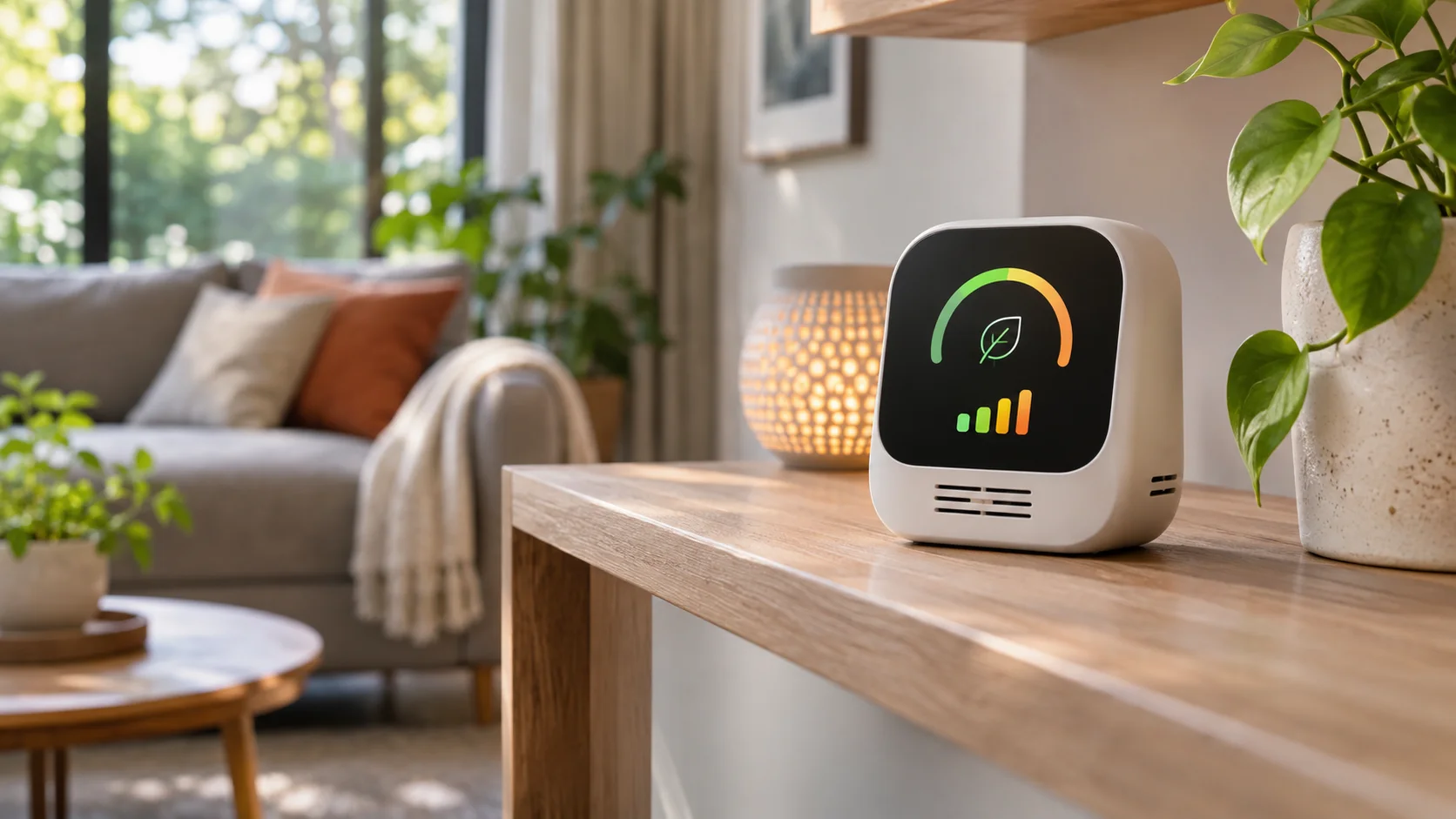
A smart indoor air quality monitor tracks only the pollutants and conditions its sensors are designed to detect. Choose one for a specific concern, place it carefully, and use readings as trends—not as a substitute for smoke, carbon monoxide, or radon safety measures.
Table of contents
- What do indoor air quality monitors measure?
- PM readings are clues, not source identification
- CO₂ is a ventilation clue—not a disease detector
- Treat TVOC as a broad trend
- What “smart” adds—and what it does not
- Place the monitor where its readings are useful
- Read patterns, not one color or one spike
- Turn a reading into a practical next step
- Keep dedicated safety devices separate
- Quick buying checklist
- Frequently asked questions
- Can one monitor measure everything in my home?
- Can a CO₂ monitor tell me whether a room is safe from viruses?
- Can a TVOC reading identify a specific chemical?
- Does an IAQ monitor replace a smoke or carbon-monoxide alarm?
- Where should I put a monitor?
- Conclusion
Key takeaways
- Choose a monitor for the specific pollutant or condition you want to understand; no single consumer device measures everything.
- Treat CO2 and TVOC readings as context-dependent trends, not infection-risk scores or chemical diagnoses.
- Place the monitor in a representative breathing-zone location and compare readings under similar conditions.
- Keep smoke and CO alarms and radon testing separate from general-purpose air monitoring.
Editorial transparency
Who worked on this article and how it was handled.
- Written by
- Daniel Reed
- Creation method
- Editorial research
Method note: This article synthesizes official consumer and ventilation guidance plus an EPA-hosted technical presentation. No products were tested or independently measured.
AI assistance: AI assisted with source synthesis and drafting. No products were tested or independently measured, and no human editorial review is claimed.
A smart indoor air quality monitor is most useful as a trend tool for the specific pollutants and conditions its sensors are designed to detect. No single consumer monitor gives a complete picture of every contaminant in a home, and its alerts are not a substitute for life-safety alarms or dedicated tests.[1]
Choose a monitor by first deciding what you want to learn—such as whether cooking raises particle levels, whether a closed room may need more ventilation, or whether a particular pollutant needs a dedicated test. Then check the exact sensors, their indoor-use guidance, and what the app’s numbers actually mean.[1]
In this guide, “smart” refers to connectivity and data features that make readings easier to review—not to a guarantee that the monitor measures every pollutant or that its sensor is more accurate.[1]
What do indoor air quality monitors measure?
Consumer monitors can combine sensors for particulate matter, gases, and environmental conditions such as temperature and humidity. Models vary: some report one measurement, while others combine several. Check the sensor list rather than assuming that a product labeled “air quality monitor” measures everything.[1]
| Measurement | What it can help you notice | Important limit |
|---|---|---|
| Particulate matter (PM, including PM2.5) | Changes during activities such as cooking or periods of smoke. | A particle reading does not identify every pollutant or act as a smoke alarm.[1] |
| Carbon dioxide (CO₂) | Ventilation trends in some well-characterized spaces. | A CO₂ number is not a universal ventilation target or an infection-risk score; its usefulness depends on the space and monitoring setup.[3] |
| VOCs or “TVOC” | Broad changes that may coincide with products, cooking, or other activities. | A total-VOC reading cannot reliably tell you which individual chemical is present or what caused the change.[7] |
| Temperature and relative humidity | Indoor environmental conditions that some monitors track alongside pollutants. | These readings are not a complete measure of air quality and do not identify every contaminant.[1] |
| Radon or carbon monoxide | Only when a device is specifically designed and appropriate for that measurement. | Do not rely on a general-purpose IAQ monitor instead of a dedicated radon test or certified CO alarm.[1][5][6] |
PM readings are clues, not source identification
A particle reading can help you see whether levels rise during a household activity. EPA, for example, describes using a particulate monitor to notice an increase while cooking, then considering exhaust ventilation such as a range hood.[1] The monitor tells you that the reading changed; it does not by itself prove which source caused the change or whether the air is safe for every person.[1]
CO₂ is a ventilation clue—not a disease detector
CO₂ monitors can be informative in some well-designed, well-characterized, and well-maintained HVAC environments. CDC/NIOSH also cautions that these monitoring systems were not designed to protect occupants from disease transmission, and a single target value may not suit every space or occupancy pattern.[3]
For a household, a CO₂ trend may help you compare a room under similar conditions—for example, before and after ventilation—rather than serve as a pass/fail verdict.[3] Do not interpret a “good” number as proof that a room is free of infectious particles or other pollutants.[3]
Treat TVOC as a broad trend
Some consumer devices report a combined volatile organic compound reading.[1][7] That may be useful for noticing that the signal changed around an activity, but it is not the same as identifying a specific chemical. An EPA-hosted presentation on low-cost VOC sensors notes that these sensors do not provide enough selectivity to measure individual gases of concern, and that total-VOC measurements can be difficult to interpret without context.[7]
If a TVOC reading rises, treat it as a prompt to review recent activities and follow product-safety directions—not as a chemical diagnosis or a health-risk measurement.[7]
What “smart” adds—and what it does not
A monitor may include a screen or internet connectivity; those features can make readings easier to access, but they do not guarantee sensor performance.[1] A colorful score or push notification does not automatically make the underlying measurement more reliable.[1]
EPA notes that monitor price does not necessarily indicate performance, and that readings can be affected by placement, time in use, data processing, temperature, humidity, and multiple contaminants. Performance can also vary across manufacturers and even across products from the same company.[1]
Before buying, check:
- Which sensors are actually included? Look for named measurements and units, not just a general “air quality” label.[1]
- Is it intended for indoor use? Follow the maker’s instructions; outdoor-only evaluations may not establish indoor performance.[1][2]
- How are alerts defined? Ask whether the app shows a pollutant-specific reading or a combined score, and whether the alert thresholds are configurable or manufacturer-defined.[1]
- What happens as the device ages? Check the expected service life, calibration guidance, and whether a sensor or the whole unit needs replacement. EPA notes that monitors have a limited lifespan and may become less reliable over time.[1]
- Do the connected features fit your setup? Confirm the app, integrations, power, and data controls you need before pairing it with a hub. For broader privacy and cloud-dependency trade-offs, see our guide to local control versus cloud smart homes.
When you read a performance report, check what was tested.[1][2] EPA’s recommended protocols for fine-particle and ozone sensors are described as supplemental, informational monitoring for fixed outdoor sites—not as a blanket indoor certification for every consumer product.[2]
Place the monitor where its readings are useful
Follow the manufacturer’s placement instructions first. EPA’s general guidance is to place an indoor monitor in the occupants’ breathing zone—about 3–6 feet for a typical adult, depending on whether they are sitting or standing—and leave room for air to move into the device.[1]
Avoid putting it right next to a stove, fireplace, stored cleaning products, an HVAC vent, an open window, or another draft. Those locations can produce readings that reflect a nearby source or airflow rather than the room as a whole.[1] Keep the device in the same location while you compare readings over time; moving it changes what it samples.
Read patterns, not one color or one spike
An app may turn readings into green, yellow, or red indicators. EPA notes that widely accepted indoor concentration limits do not exist for many pollutants, and manufacturers determine the alert levels used by their monitors.[1] Treat a color as the product’s interpretation of its sensor data—not as a universal health standard.
A more useful routine is to establish a baseline, note which activities coincide with changes, and compare like with like.[1] Keep a short log of the room, activity, window or ventilation state, and device reading.[1] If the number is unexpected, check the monitor’s placement and instructions before making a major decision based on a single alert.[1]
Turn a reading into a practical next step
A monitor measures; it does not clean the air.[1][4] EPA identifies source control and ventilation with clean outdoor air as central ways to improve indoor air, with filtration as a useful supplement.[4]
For example, if particles rise while cooking, use an effective range hood when available and consider filtration appropriate to the room. If you are considering opening a window, first account for outdoor conditions; ventilation is most useful when the incoming air is clean.[1][4]
An air purifier has a different job: it filters air rather than measuring it.[4] EPA says portable air cleaners can help improve indoor air quality, but filtration does not replace pollutant source control or ventilation.[4] For sizing and operation, see our guide to a smart air purifier for pollen and other airborne particles.
If you create an automation, base it on a specific sensor and a clear, reversible action.[1] Avoid treating a combined “air score” as permission to open a window or disable ventilation automatically; include an outdoor-condition check and a manual override.[1][4] A monitor can inform a decision, but it cannot evaluate every pollutant or household circumstance.
Keep dedicated safety devices separate
Low-cost air monitors are not designed to warn of immediate danger in the way smoke detectors and carbon-monoxide alarms are.[1] Keep working smoke and CO alarms in the locations recommended for your home. CPSC recommends CO alarms on each level and outside sleeping areas, monthly testing, and annual battery replacement for alarms with replaceable batteries.[5]
Radon also calls for the right test, not a generic air-quality score. EPA points homeowners to radon-specific test kits and advises following the kit’s placement and return instructions; state radon programs can help locate qualified measurement and mitigation professionals.[6]
Quick buying checklist
- Choose the pollutant or condition you actually want to track.[1]
- Verify the exact sensors and indoor-use instructions.[1]
- Look for clear units, alert explanations, and service-life guidance.[1]
- Place the monitor in a representative breathing-zone location, away from direct drafts and sources.[1]
- Use trends to investigate and make proportionate changes; do not treat a color as a safety certification.[1]
- Keep smoke alarms, CO alarms, and radon testing on their own dedicated safety path.[1][5][6]
Frequently asked questions
Can one monitor measure everything in my home?
No. A monitor detects only the pollutants or environmental conditions its sensors are designed for, so one device cannot provide a complete representation of indoor air quality.[1]
Can a CO₂ monitor tell me whether a room is safe from viruses?
No. CO₂ readings may inform ventilation in some settings, but they do not establish that a room is free of infectious particles or predict disease transmission.[3]
Can a TVOC reading identify a specific chemical?
Usually, a broad TVOC reading should be treated as a trend rather than a chemical identification. Low-cost VOC sensors lack the selectivity needed to identify individual gases of concern, and total-VOC readings are difficult to interpret without context.[7]
Does an IAQ monitor replace a smoke or carbon-monoxide alarm?
No. Low-cost air-pollution monitors are not designed to warn of immediate danger. Keep dedicated smoke and CO alarms installed and maintained according to safety guidance.[1][5]
Where should I put a monitor?
Follow the manufacturer’s instructions and, as a general starting point, place it in the occupants’ breathing zone with unobstructed airflow. Avoid nearby pollutant sources, HVAC vents, and open windows that can distort the reading.[1]
Conclusion
A smart indoor air quality monitor is a useful decision aid when you choose the right sensor for a specific question, place it carefully, and interpret its data as a trend rather than a complete safety verdict. Pair monitoring with appropriate source control, clean-air ventilation, or filtration—and keep dedicated CO, smoke, and radon safety measures separate.[1][4][6]
Common questions
Questions this guide answers
Can one indoor air quality monitor measure everything in my home?
No. A monitor detects only the pollutants or environmental conditions its sensors are designed for, so one device cannot provide a complete representation of indoor air quality.
Can a CO2 monitor tell me whether a room is safe from viruses?
No. CO2 readings may inform ventilation in some settings, but they do not establish that a room is free of infectious particles or predict disease transmission.
Can a TVOC reading identify a specific chemical?
Usually, a broad TVOC reading should be treated as a trend rather than a chemical identification; low-cost VOC sensors lack the selectivity needed to identify individual gases of concern.
Does an IAQ monitor replace a smoke or carbon-monoxide alarm?
No. Low-cost air-pollution monitors are not designed to warn of immediate danger. Keep dedicated smoke and CO alarms installed and maintained according to safety guidance.
Where should I put an indoor air quality monitor?
Follow the manufacturer’s instructions and, as a general starting point, place it in the occupants’ breathing zone with unobstructed airflow, away from nearby pollutant sources, HVAC vents, and open windows.
Evidence & further reading
Sources & references
Primary and authoritative references used to support or contextualize this article. Links open the original source.
- 1Low-Cost Air Pollution Monitors and Indoor Air Quality
U.S. Environmental Protection Agency · Accessed Nov 19, 2026
Supports sensor types, indoor performance and placement limits, alert interpretation, and safety-device distinctions.
- 2Enhanced Air Sensor Guidebook Webinar Q&A
U.S. Environmental Protection Agency · Accessed Nov 19, 2026
Clarifies the stated outdoor, supplemental scope of EPA's recommended sensor-testing protocols.
- 3Ventilation FAQs
CDC/NIOSH · Accessed Nov 19, 2026
Supports the context and limitations of CO2 monitoring for ventilation.
- 4Guide to Air Cleaners in the Home
U.S. Environmental Protection Agency · Accessed Nov 19, 2026
Supports source control, clean-air ventilation, and filtration as a supplement.
- 5CO Alarms
U.S. Consumer Product Safety Commission · Accessed Nov 19, 2026
Supports CO alarm placement, testing, and battery guidance.
- 6Find a Radon Test Kit or Measurement and Mitigation Professional
U.S. Environmental Protection Agency · Accessed Nov 19, 2026
Supports using radon-specific test kits and following their placement and return instructions.
- 7Tackling the Selectivity Issues in Low-Cost VOC Sensors
EPA.gov (presentation by Gabriel Isaacman-VanWertz) · Accessed Nov 19, 2026
Supports the limits of low-cost VOC sensor selectivity and the context-dependent interpretation of total-VOC readings.

About the author
Daniel Reed
Daniel writes about connected-home standards, small-space technology, device interoperability, and privacy-conscious urban living.
More from Daniel →Make your home smarter without buying every gadget.
One useful idea, one product worth knowing, and one energy-saving action—delivered weekly.
No spam. Unsubscribe anytime.
Semantic recommendations
Related reading
Selected from topic cluster, entities, tags, search intent, and editorial relationships.
Smart Bathroom Exhaust Fan Automation: Humidity Sensors vs. Timers
Learn when a humidity-sensing control or countdown timer makes sense, how to run a bathroom fan after a shower, and what to check before trusting an automation.
Smart Air Purifiers for Late-Summer Ragweed & Pollen Season
Choose and automate a smart air purifier for late-summer ragweed and pollen using the right CADR, room size, schedules, and filtration strategy.
5 Essential Home Assistant Automations for Energy Saving
These five Home Assistant automations target the biggest sources of avoidable household energy use: HVAC runtime, unnecessary lighting, standby loads, expensive tariff windows, and solar heat gain.
How to Set Up NFC Tags Around the House for One-Touch Lighting
Use inexpensive NFC tags as intentional one-touch lighting controls for bedside scenes, entryways, desks, and whole-home off routines without adding wall switches.