
Smart Bathroom Exhaust Fan Automation: Humidity Sensors vs. Timers
Learn when a humidity-sensing control or countdown timer makes sense, how to run a bathroom fan after a shower, and what to check before trusting an automation.
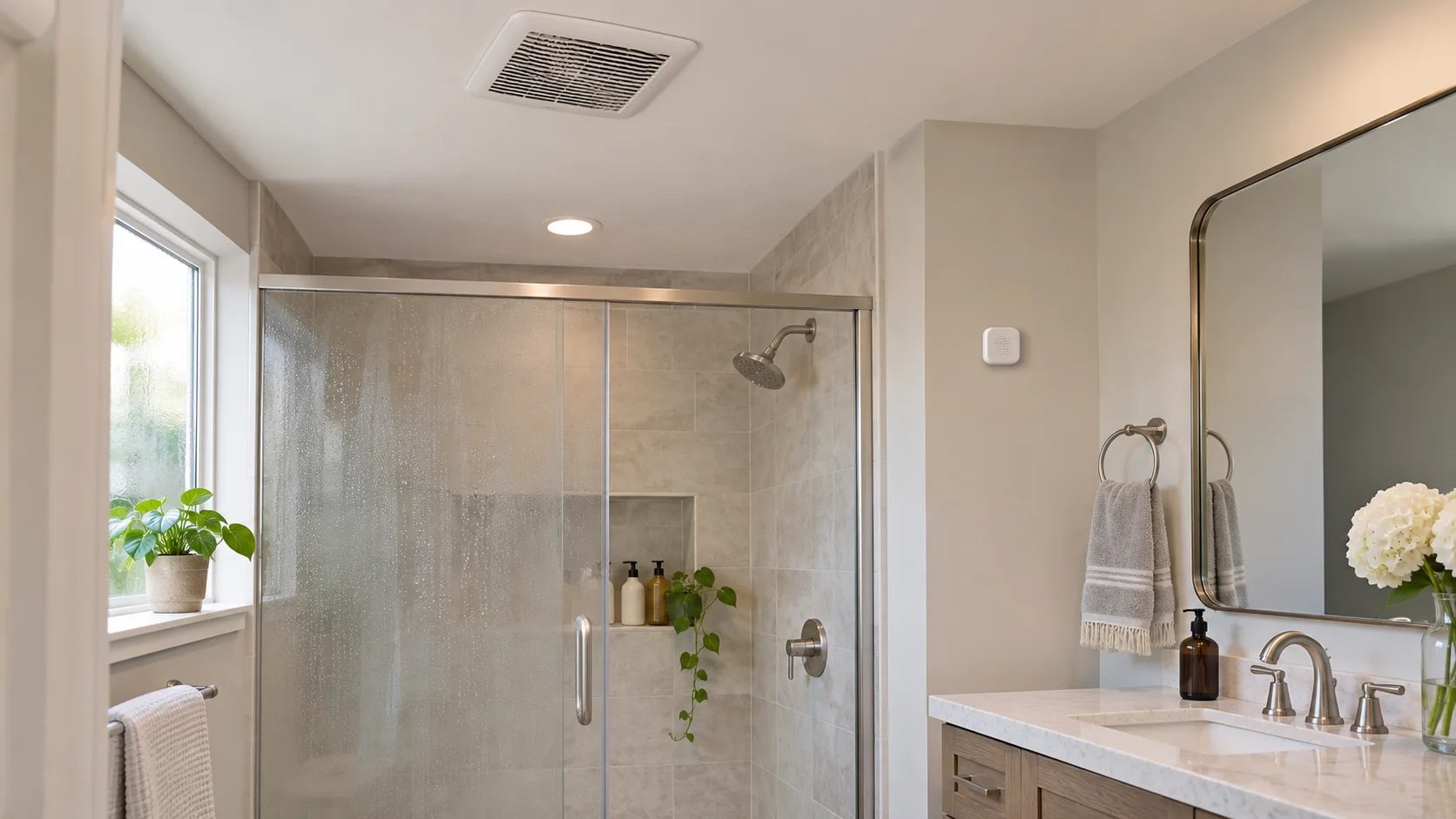
Quick answer
A delay-off timer is the simplest way to keep a bathroom exhaust fan running after a shower; HVI recommends 20 minutes after bathroom use. A humidity-sensing control can respond to a measured threshold, but either option depends on a properly operating fan that exhausts enough air outdoors.
Key takeaways
- A delay-off timer is a simple way to keep the fan running after bathroom use; HVI recommends a 20-minute run-on.
- Humidity-sensing controls can respond to an adjustable threshold, but they require compatible hardware and testing.
- Automation cannot replace adequate fan performance, outdoor duct termination, or fixing the source of persistent moisture.
Editorial transparency
Who worked on this article and how it was handled.
- Written by
- Daniel Reed
- Creation method
- Editorial research
Method note: This article synthesizes publicly available EPA, ENERGY STAR, Home Ventilating Institute, and U.S. Department of Energy guidance on bathroom moisture control, fan performance, and controls. No products were tested or independently measured.
AI assistance: AI assisted with source synthesis and drafting. Claims were checked against the cited original sources; no products were tested and no human editorial review is claimed.
A bathroom fan is easy to forget: the shower ends, the light goes off, and the fan stops while damp air remains. Automating the run-on period makes ventilation more consistent without asking everyone in the household to remember a separate switch.[4][5]
The useful question is not whether the fan can connect to an app. It is whether the control starts the fan when moisture is being produced, keeps it on long enough afterward, and works with a fan and duct that can actually remove air from the bathroom.[1][5] EPA guidance recommends using the bathroom fan or opening a window while showering, and its general indoor-humidity guidance is to stay below 60% relative humidity where possible, ideally between 30% and 50%.[2]
Choose a timer for simplicity or a humidity sensor for adaptive control
A countdown or delay-off timer runs the fan for a set period after someone activates it. HVI recommends leaving the fan on for 20 minutes after bathroom use and notes that a timer can switch it off automatically.[4] This is a straightforward choice when you want a dependable run-on without adding a hub, app, or separate sensor.[4][5]
A humidity-sensing controller responds to a measured humidity threshold. Some fan controls keep running while the level remains above an adjustable threshold, which can adapt to different shower lengths or household routines.[5] The trade-off is added cost and maintenance, and control behavior varies by model; verify how the unit starts, runs, and stops before relying on it.[5]
| Control | Best fit | Main trade-off |
|---|---|---|
| Countdown or delay-off timer | A simple, predictable run-on after each shower | Uses a fixed duration even when moisture conditions differ |
| Humidity-sensing control | A fan that should respond to measured moisture rather than only a preset schedule | Needs compatible hardware and may require setup, testing, or maintenance |
| Smart-home routine | A home already using compatible occupancy, lighting, or humidity sensors | More configuration; keep a usable manual control |
A practical default is to start with a timer if the current fan works properly and the household mainly needs a reminder-free run-on.[4][5] Choose humidity sensing when you have a clear reason to make runtime respond to measured moisture, and check the device documentation for the exact threshold and override behavior.[5]
Make sure the fan and duct are doing the real work
A smart control cannot compensate for an undersized, blocked, or poorly routed exhaust system. EPA advises checking that the fan removes a sufficient amount of air—not merely that its motor runs—and that the air is exhausted directly outdoors, not into an attic or another space in the home.[1]
Fan capacity should suit the bathroom and installation. As one example of industry guidance, HVI recommends one cubic foot per minute (CFM) per square foot for bathrooms up to 100 square feet; its larger-room guidance varies with the fixtures present.[4] Local code, the fan manufacturer, duct layout, and a qualified installer’s assessment should take precedence over treating a rule of thumb as a universal sizing formula.[4]
If you are replacing a fan, ENERGY STAR says certified ventilation fans use about 48% less energy than standard models and can help control moisture and odors.[3] That efficiency label does not guarantee that a particular installation has adequate airflow: the duct, exterior termination, and actual fan performance still matter.[1]
Build a reliable bathroom-fan routine
- Check the existing fan first. Confirm that it operates and that its exhaust path terminates outdoors. If you are unsure whether it moves enough air, ask a qualified contractor to assess the fan and duct rather than relying on motor noise alone.[1]
- Match the control to the fan. Use a timer, humidity control, or smart relay only when it is compatible with the fan and its wiring.[5] For hardwired changes, follow the manufacturer’s instructions and local requirements; use a qualified electrician if the wiring or control rating is uncertain.
- Give the fan a post-shower run-on. Set a delay-off control to a sensible starting interval; HVI’s recommendation is 20 minutes after bathroom use.[4] Treat that as guidance, not a guarantee that every room will dry in exactly 20 minutes.[4]
- Keep a manual override. Let household members turn the fan on when needed, even if an app, occupancy sensor, or schedule is unavailable.[5] A routine should make ventilation easier, not make the switch harder to use.
- Test the routine over several showers. Check that the fan starts when expected, continues after the room is empty, and shuts off according to the selected control.[5] DOE guidance specifically recommends verifying that the fan responds to its manual switch or programmed control.[5]
- Adjust based on the room, not a magic number. EPA’s relative-humidity range is general guidance for indoor spaces; do not assume that one whole-home RH value is automatically the right bathroom-fan shutoff setting.[2] Follow the fan or controller instructions and investigate persistent moisture rather than masking it with longer automation.[1][2]
An occupancy or light sensor can be a useful start signal, but it should not be the only part of the routine if the fan stops as soon as someone leaves.[5] Pair it with a delay-off period or a compatible humidity control so the fan continues to run after the shower.[4][5]
What automation cannot fix
Persistent condensation, a leak, wet building materials, or recurring mold needs attention at its source. EPA states that moisture control is central to mold control; increasing ventilation can help with recurring bathroom mold, but cleaning or automating a fan does not replace correcting a water problem.[2]
A humidity sensor is best treated as a control input, not a diagnosis.[5] If the bathroom remains damp despite the fan running, check airflow, the duct route, and the exterior termination before adding more smart devices.[1] For a related example of why sensor trends should be interpreted as clues rather than proof of a building problem, see our guide to smart humidity sensors and attic moisture.
The bottom line
For most households, a compatible delay-off timer is the cleanest first upgrade: it keeps the fan running after bathroom use without relying on anyone to remember the switch.[4][5] A humidity-sensing control is worth considering when adaptive runtime solves a real problem and the control can be installed, tested, and maintained properly.[5]
Whichever control you choose, prioritize the fundamentals: adequate fan performance, an exhaust duct that terminates outdoors, and a run-on period that actually clears shower moisture.[1][4][5] Smart automation is the reminder; correct ventilation is the solution.
Common questions
Questions this guide answers
How long should a bathroom exhaust fan run after a shower?
HVI recommends leaving the fan on for 20 minutes after bathroom use. Treat this as a starting point, then verify that the room and fan perform well with the selected setting.
Is a humidity sensor better than a timer?
Not for every home. A timer provides a fixed run-on, while a humidity-sensing control can respond to a measured threshold but adds setup and maintenance considerations.
Will a smart bathroom fan prevent mold?
It can help remove shower moisture when the fan is operating and vented correctly, but it cannot guarantee mold prevention. Fix the moisture source as well as cleaning recurring mold.
Should the fan exhaust into the attic?
No. Bathroom exhaust air should be vented directly outdoors, not into an attic or another space in the home.
Evidence & further reading
Sources & references
Primary and authoritative references used to support or contextualize this article. Links open the original source.
- 1Remodeling Your Home and Indoor Air Quality
U.S. Environmental Protection Agency · Accessed Nov 20, 2026
Supports bathroom ventilation for moisture removal, adequate fan airflow, and exhausting air directly outdoors.
- 2A Brief Guide to Mold, Moisture and Your Home
U.S. Environmental Protection Agency · Accessed Nov 20, 2026
Supports moisture control as the key to mold control, use of bathroom ventilation while showering, and general indoor relative-humidity guidance.
- 3Ventilation Fans
ENERGY STAR · Accessed Nov 20, 2026
Supports the stated energy-efficiency comparison for certified ventilation fans and their moisture- and odor-control benefits.
- 4Bathroom Ventilation
Home Ventilating Institute · Accessed Nov 20, 2026
Supports HVI bathroom airflow guidance and its recommendation to run a fan for 20 minutes after bathroom use.
- 5Measure Guideline: Selecting Ventilation Systems for Existing Homes
U.S. Department of Energy, Building America · Accessed Nov 20, 2026
Supports descriptions of delay-off, occupancy, and humidity-sensing controls, their trade-offs, and checking that controls operate the fan as intended.

About the author
Daniel Reed
Daniel writes about connected-home standards, small-space technology, device interoperability, and privacy-conscious urban living.
More from Daniel →Make your home smarter without buying every gadget.
One useful idea, one product worth knowing, and one energy-saving action—delivered weekly.
No spam. Unsubscribe anytime.
Semantic recommendations
Related reading
Selected from topic cluster, entities, tags, search intent, and editorial relationships.
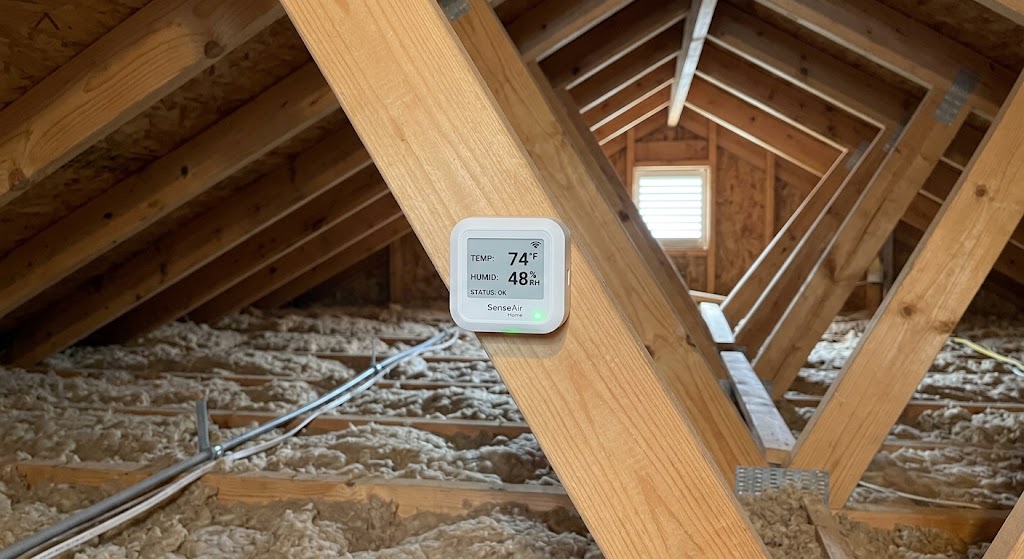
Smart Humidity Sensors: Preventing Attic Mold Before Autumn Rain
Use smart humidity sensors to catch attic moisture trends before autumn rain exposes roof leaks, condensation, air leakage, or ventilation problems.
How to Automate Ceiling Fans for Reverse Rotation in Upcoming Fall
Set ceiling fans for fall without climbing a ladder: learn which smart fans can reverse from an app, what can be automated, and the safest seasonal setup.
Smart Thermostat Geofencing for Back-to-School Family Schedules
Use smart thermostat geofencing without leaving kids, parents, or caregivers uncomfortable when back-to-school schedules change from day to day.
Smart Indoor Air Quality Monitors: What They Measure—and What They Miss
Learn what smart indoor air quality monitors measure, how to choose and place one, and why readings are useful trends—not a safety clearance.