
How Energy Monitoring Smart Switches Detect Failing Refrigerator Motors
Energy monitoring can reveal abnormal refrigerator power patterns before a breakdown, but it works best as an early-warning tool rather than a motor-failure diagnosis.
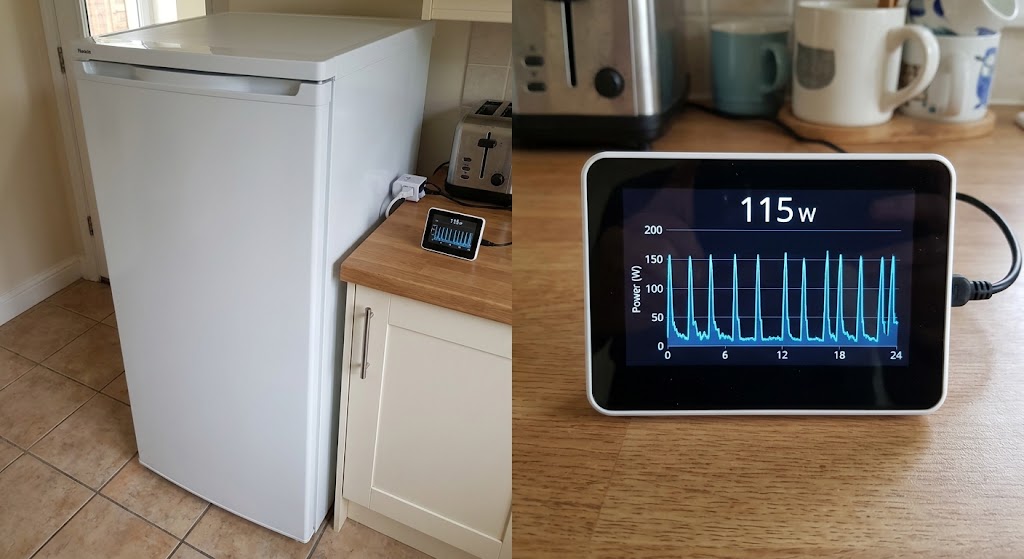
Quick answer
An energy-monitoring smart switch cannot directly diagnose a failing refrigerator motor, but it can reveal abnormal electrical patterns that justify further inspection. Useful warning signs include a sustained rise in daily kWh, longer compressor duty cycles, unusually frequent starts, or a meaningful change in running wattage compared with that refrigerator's own normal baseline. The same patterns can also be caused by hot room temperatures, dirty condenser coils, door-seal problems, heavy door use, defrost cycles, or normal variable-speed compressor behavior, so energy data should be treated as an early-warning signal rather than proof of motor failure.
Table of contents
- What energy monitoring can actually see
- The four trends that matter most
- 1. Daily energy use in kWh
- 2. Compressor duty cycle
- 3. Cycle frequency
- 4. Running power
- Why startup wattage is harder to use than it sounds
- A 15 amp label does not automatically mean refrigerator-safe
- The safer architecture: monitor without adding a remote-off relay
- Option A: energy-monitoring plug
- Option B: branch-circuit CT monitor
- How to build a useful refrigerator baseline
- Step 1: collect at least several normal days
- Step 2: note four baseline values
- Step 3: mark known disturbances
- What an early-warning pattern looks like
- What energy monitoring cannot tell you
- A simple alert strategy that avoids false alarms
- Pair power monitoring with temperature monitoring
- When the data points to maintenance rather than motor failure
- Door sealing
- Ventilation around the refrigerator
- Condenser condition
- Recent food loading
- Ambient temperature
- When to stop monitoring and call for service
- Conclusion
Key takeaways
- Energy monitoring detects changes in a refrigerator's electrical behavior; it does not identify a failed motor component with certainty.
- The refrigerator's own historical baseline is more useful than a universal wattage target, especially for variable-speed and inverter models.
- Persistent increases in daily kWh, compressor duty cycle, or cycle frequency deserve investigation, but first rule out door, airflow, ambient-temperature, and maintenance causes.
- Verify motor and inductive-load ratings before placing any smart plug between a refrigerator and its outlet; a 15 amp general-use rating alone is not enough.
Editorial transparency
Who worked on this article and how it was handled.
- Written by
- Daniel Reed
- Creation method
- Editorial research
AI assistance: AI assisted with research organization and drafting. Sources, factual claims, and the final article should be reviewed by a human editor before publication.
A refrigerator can look normal for weeks while its electrical behavior quietly changes. The food is still cold, the light still comes on, and the compressor still runs—but it may be running longer, starting more often, or consuming more energy than it used to.
That makes energy monitoring attractive as an early-warning system. A smart plug or circuit monitor can expose changes that are invisible from across the kitchen. The important limitation is that electricity data describes behavior, not the failed component. A higher power bill does not prove the compressor motor is dying.
The useful approach is therefore not “find one bad wattage number.” It is to establish a baseline for your own refrigerator, watch for persistent departures from that baseline, and then combine the energy data with temperature, sound, airflow, door-seal, and maintenance checks before deciding that the compressor or another motor needs service.
What energy monitoring can actually see
A plug-in energy monitor measures the electrical load of the entire refrigerator. Depending on the device and app, you may see instantaneous watts, accumulated kWh, historical graphs, or alerts when power crosses a threshold.
That whole-appliance view is useful because a refrigerator has a recognizable operating rhythm:
- periods of relatively low background power;
- compressor cooling cycles;
- fan operation;
- defrost events on many models;
- lighting and electronics when doors are opened;
- other short-duration loads depending on features such as ice makers.
The monitor cannot inherently label those components. It simply records the combined electrical signature.
A circuit-level monitor works similarly from a diagnostic perspective. Emporia’s Vue, for example, uses current transformers on individual branch circuits and combines current and voltage measurements to calculate real power. If the refrigerator has its own branch circuit, that provides a way to watch its electrical behavior without placing a remotely switchable relay between the appliance and the wall receptacle.
The four trends that matter most
For refrigerator condition monitoring, four metrics are more valuable than a single instantaneous watt reading.
1. Daily energy use in kWh
Daily kWh is the best high-level indicator because it captures both how much power the refrigerator draws and how long it draws it.
A refrigerator whose compressor still draws roughly the same wattage but runs much longer can consume substantially more energy over a day. That pattern may indicate a cooling-system problem—but it can also have completely ordinary causes.
Whirlpool lists several reasons a refrigerator motor may run longer:
- high room temperature;
- frequent door opening;
- recently added food or beverages;
- insufficient airflow around the cabinet;
- controls that are set too cold;
- a door that is not fully closed;
- dirty condenser coils on models where coil cleaning is applicable.
That is why a sustained change in kWh is a prompt to investigate, not a compressor verdict.
2. Compressor duty cycle
Duty cycle is the percentage of time the compressor appears to be operating.
You do not need a laboratory-grade calculation. A sufficiently detailed energy graph can often show when the main cooling load is active and when it is not.
If a refrigerator historically spends part of each hour cooling and then resting, but later spends most of the hour in a higher-power state under similar room conditions, something has changed.
Possible explanations include:
- a deteriorating door gasket;
- blocked or dirty heat rejection surfaces;
- warmer ambient conditions;
- a refrigerator that has been loaded with warm food;
- temperature settings that were changed;
- refrigeration-system or compressor performance problems.
The trend becomes more useful when room temperature and household behavior have not changed much.
3. Cycle frequency
A compressor that starts and stops far more often than usual may deserve attention.
But this metric needs context. Thermostat behavior, door opening, defrost logic, control-board behavior, thermal load, and modern variable-capacity compressors can all change the pattern.
For that reason, compare the refrigerator to its own previous behavior, not to an internet rule such as “a compressor should start X times per hour.” There is no universal healthy cycle count that applies across conventional compressors, inverter refrigerators, room temperatures, and cabinet sizes.
4. Running power
If the compressor’s apparent running wattage changes significantly over time, that is another useful clue.
Again, it is not a diagnosis. Whole-fridge power can shift because other loads overlap with the compressor, and inverter-driven refrigerators deliberately vary compressor speed and electrical demand.
The useful signal is a persistent change in the pattern you already know—not one isolated spike.
Why startup wattage is harder to use than it sounds
Compressor motors can draw a high current during startup. It is tempting to assume that watching the startup spike is the best way to detect motor deterioration.
Consumer energy monitors are not always ideal for that job.
The startup event can be very short, and many apps aggregate or downsample data before displaying it. A graph that updates every second—or every several seconds—may not capture the true peak current seen by the electrical contacts.
This creates two separate issues:
- Diagnostic limitation: the displayed startup wattage may not represent the actual instantaneous starting current.
- Hardware safety: the plug’s relay still experiences the motor load even if the app does not show the full peak.
So do not choose a refrigerator monitoring plug based only on a pretty real-time graph.
A 15 amp label does not automatically mean refrigerator-safe
This is one of the most important buying checks.
Smart plugs often advertise a maximum current such as 15 A, but that rating may apply to general or resistive loads. Motors are inductive loads and can have separate limits.
For example, TP-Link lists the Tapo P115 as a 15 A, 1,800 W general-use device in the US specification, while separately listing a 1/6 HP motor limit. Kasa’s EP25 documentation likewise lists a 15 A general rating and a separate motor rating on the relevant hardware version.
That means this logic is unsafe:
“My refrigerator uses less than 1,800 W, therefore any 1,800 W smart plug is fine.”
Instead, check all of the following:
- refrigerator nameplate data;
- smart plug voltage and current rating;
- explicit motor or inductive-load rating;
- manufacturer guidance for appliance use;
- whether startup behavior is within the device’s permitted load.
TP-Link also warns on the EP25 page that devices with erratic current can damage the plug and surrounding area even if their nominal power is below the stated maximum.
If the specifications are ambiguous, do not put that smart plug in series with the refrigerator.
The safer architecture: monitor without adding a remote-off relay
A refrigerator is different from a lamp. Accidentally turning it off can spoil food long before someone notices.
Whirlpool recommends a dedicated grounded circuit for the refrigerator, an outlet that cannot be turned off by a wall switch, and no extension cord. That same reliability principle should shape smart-home monitoring.
Option A: energy-monitoring plug
A plug-in monitor is the simplest option when the device is explicitly suitable for the refrigerator’s motor load.
If you use one, configure it as a monitor first, switch second:
- remove unnecessary on/off schedules;
- avoid voice routines that can switch it off accidentally;
- use an appropriate power-restoration behavior if the product supports it;
- prevent guests or children from controlling the outlet unnecessarily;
- verify that the refrigerator restarts normally after a real power interruption.
Do not use automation to cycle the refrigerator on and off as an energy-saving technique. The refrigerator’s own controls are designed to manage compressor operation.
Option B: branch-circuit CT monitor
If the refrigerator is on a dedicated circuit, a current-transformer monitor can avoid inserting a switchable relay between the refrigerator and the receptacle.
Emporia documents CT sensors that clamp around conductors and measure current from the magnetic field rather than by electrically connecting to the conductor itself.
This is attractive for condition monitoring because the refrigerator remains wired as intended while you still gain historical energy data.
The trade-off is installation. Panel work exposes hazardous mains voltage and should follow local electrical rules and manufacturer instructions; use a qualified electrician when required.
How to build a useful refrigerator baseline
The baseline is the part that turns an energy graph into a diagnostic tool.
Step 1: collect at least several normal days
Do not start during a party weekend, immediately after filling the refrigerator with groceries, or during an unusual heatwave if you can avoid it.
Record a period when:
- room temperature is typical;
- the refrigerator is operating normally;
- doors are used normally;
- there are no known cooling problems.
A week or two is useful because it exposes day-to-day variation, but the exact length is less important than having enough data to understand the normal range.
Step 2: note four baseline values
Capture:
- typical daily kWh;
- typical compressor-on power range;
- approximate duration of cooling periods;
- approximate number or pattern of cooling cycles.
You do not need to turn these into a complex spreadsheet. The objective is to recognize what “normal for this refrigerator” looks like.
Step 3: mark known disturbances
Energy-monitoring data becomes much easier to interpret when you annotate major events:
- unusually hot kitchen temperature;
- groceries loaded into the refrigerator;
- prolonged door opening;
- vacation absence;
- power outage;
- condenser cleaning;
- thermostat adjustment.
If energy jumps immediately after loading several bags of warm groceries, the monitor may be showing normal recovery rather than a fault.
What an early-warning pattern looks like
The most convincing signal is multiple metrics changing together.
For example:
- daily kWh rises for several days;
- compressor duty cycle rises at the same time;
- door use and kitchen temperature are normal;
- refrigerator and freezer temperatures begin drifting warmer;
- the condenser area has adequate airflow.
That combination is more meaningful than any one data point.
Another useful pattern is a refrigerator that begins running nearly continuously but still struggles to maintain temperature. Whirlpool’s troubleshooting guidance treats unusually long runtime as something to investigate while also emphasizing non-failure causes such as ventilation, ambient heat, door behavior, and condenser condition.
At that point, the energy monitor has done its job: it has helped you notice the change early.
What energy monitoring cannot tell you
A whole-refrigerator monitor normally cannot distinguish among:
- compressor motor problems;
- condenser fan problems;
- evaporator fan problems;
- dirty coils;
- airflow blockage;
- door-gasket leakage;
- defrost-system faults;
- refrigerant-system problems;
- control-board behavior.
Several of those faults can create similar electrical symptoms.
It also cannot reliably tell you whether a variable-speed compressor is unhealthy simply because it runs for long periods. Whirlpool explicitly notes that modern high-efficiency compressors may run for extended periods at varying speeds to match cooling demand.
That makes the article title useful only in an indirect sense: the smart switch is detecting behavior consistent with a problem, not identifying the failing motor itself.
A simple alert strategy that avoids false alarms
The best alerts are based on persistence rather than one spike.
Useful alerts include:
- daily energy noticeably above your established baseline for multiple days;
- refrigerator remaining in a high-power cooling state far longer than its normal pattern;
- abnormal cycling that repeats instead of appearing once;
- refrigerator power dropping to zero unexpectedly;
- simultaneous high energy use and rising cabinet temperature, if you also have a temperature sensor.
Avoid rigid universal thresholds unless the refrigerator manufacturer provides them. A 20% rise might be significant for one refrigerator and perfectly normal seasonal variation for another.
A stronger rule is:
Alert when the refrigerator behaves differently from itself under comparable conditions.
Pair power monitoring with temperature monitoring
Energy data becomes much more useful when you can answer a second question: is the refrigerator still maintaining safe temperatures?
A refrigerator that consumes more power but maintains temperature may have an efficiency problem. A refrigerator that consumes more power and is getting warmer deserves faster investigation.
Use a temperature monitoring method appropriate for food storage and follow current food-safety guidance for actual temperature limits. Do not rely on power consumption alone to determine whether food is safe after a cooling failure.
When the data points to maintenance rather than motor failure
Before assuming the compressor is failing, check the boring causes first.
Door sealing
A door that does not close completely allows warm, humid air into the cabinet and increases cooling demand. Whirlpool recommends checking that the door closes correctly and that the gasket makes proper contact.
Ventilation around the refrigerator
Poor cabinet clearance or a refrigerator installed near a heat source can force the cooling system to work harder.
Condenser condition
On models with accessible condenser coils that require cleaning, dirt can impair heat rejection. Follow the specific refrigerator manual because maintenance requirements vary by design.
Recent food loading
Large amounts of warmer food increase the cooling load temporarily.
Ambient temperature
A hot kitchen can change runtime dramatically. Compare energy use with similar room conditions whenever possible.
These checks can explain many “failing compressor” energy patterns without replacing any motor.
When to stop monitoring and call for service
Energy monitoring is valuable precisely because it can tell you when passive observation is no longer enough.
Arrange appropriate service if you see persistent abnormal energy behavior combined with symptoms such as:
- food compartments failing to maintain temperature;
- repeated clicking or unsuccessful compressor starts;
- unusual electrical or burning odors;
- breaker trips;
- abnormal vibration or mechanical noise;
- visible damage to the supply cord or receptacle;
- energy use that remains abnormal after basic airflow, sealing, and maintenance checks.
Do not open sealed refrigeration components or perform mains-voltage diagnostics unless you are qualified to do so.
Conclusion
Energy-monitoring smart switches can help catch refrigerator problems earlier, but they do it by revealing changes in electrical behavior, not by diagnosing a failing compressor motor directly.
The most useful signals are sustained changes in daily kWh, compressor duty cycle, cycle pattern, and running power compared with the refrigerator’s own baseline. When several of those change together—and simple explanations such as hot weather, door use, poor ventilation, or maintenance issues do not fit—the data gives you a strong reason to investigate before cooling performance collapses.
If you use a plug-in monitor, verify its motor-load rating rather than relying on a generic 15 A figure, and configure it so the refrigerator cannot be switched off accidentally. If you want monitoring without adding a remote-control relay to the refrigerator supply, a properly installed circuit-level CT monitor is the cleaner architecture.
Common questions
Questions this guide answers
Can a smart plug tell if a refrigerator compressor is failing?
Not conclusively. An energy-monitoring plug can show changes in compressor runtime, cycle frequency, running power, and daily energy use, but it measures the refrigerator as a whole. A technician still needs to determine whether the cause is the compressor, a fan motor, condenser airflow, door sealing, controls, refrigerant system, or another component.
What refrigerator power pattern should I monitor?
Establish a normal baseline for daily kWh, compressor-on wattage, approximate duty cycle, and cycle frequency. A persistent deviation from that baseline is more useful than comparing your refrigerator with a generic wattage number because refrigerator designs and operating conditions vary widely.
Does a refrigerator that runs longer always have a failing compressor?
No. Whirlpool notes that modern high-efficiency compressors can legitimately operate for extended periods and at varying speeds. Long runtime can also result from a warm room, frequent door openings, recently added food, poor ventilation, dirty condenser coils, or a door that is not closing completely.
Is any 15 amp smart plug safe for a refrigerator?
No. A refrigerator is an inductive motor load with startup current, so the device must be rated for the appliance's actual motor or inductive load, not merely a general 15 amp resistive rating. For example, some TP-Link energy-monitoring plugs list a separate 1/6 HP motor limit even though their general-use rating is 15 amps.
What is the safest way to monitor refrigerator energy without switching it off?
A circuit-level current-transformer monitor can measure refrigerator-circuit power without putting a controllable relay in series with the appliance. Panel-installed monitors require appropriate electrical installation, but they avoid the risk of an accidental app, schedule, or voice command turning the refrigerator off.
Evidence & further reading
Sources & references
Primary and authoritative references used to support or contextualize this article. Links open the original source.
- 1Refrigerator Troubleshooting: How to Fix a Fridge
Whirlpool · Accessed Aug 27, 2026
Supports the caveat that high-efficiency refrigerator compressors can run for extended periods and that heat, ventilation, door use, and sealing can increase runtime.
- 2Motor or Compressor Runs too Much
Whirlpool Product Help · Accessed Aug 27, 2026
Supports common non-failure causes of long compressor runtime, including room temperature, added food, door opening, controls, and ventilation.
- 3Tapo P115 | Mini Smart Wi-Fi Plug, Energy Monitoring
TP-Link · Accessed Aug 27, 2026
Supports the distinction between a 15 A general-use rating and a separate 1/6 HP motor-load rating on an energy-monitoring smart plug.
- 4EP25P4 | Kasa Smart WiFi Plug Slim with Energy Monitoring, Apple HomeKit Supported
TP-Link · Accessed Aug 27, 2026
Supports the warning that erratic current can damage a smart plug even when nominal power is below its maximum load and lists a separate motor rating.
- 5How Your Vue Works
Emporia Energy · Accessed Aug 27, 2026
Supports circuit-level real-time power monitoring as an alternative to inserting a switchable plug between the refrigerator and outlet.
- 6How CT Sensors Work
Emporia Energy · Accessed Aug 27, 2026
Supports how current-transformer sensors measure current without making an electrical connection to the monitored conductor.
- 7Electrical Requirements
Whirlpool · Accessed Aug 27, 2026
Supports using a grounded dedicated refrigerator circuit, an outlet that cannot be turned off by a wall switch, and avoiding extension cords.

About the author
Daniel Reed
Daniel writes about connected-home standards, small-space technology, device interoperability, and privacy-conscious urban living.
More from Daniel →Make your home smarter without buying every gadget.
One useful idea, one product worth knowing, and one energy-saving action—delivered weekly.
No spam. Unsubscribe anytime.
Semantic recommendations
Related reading
Selected from topic cluster, entities, tags, search intent, and editorial relationships.
Baseboard Heater Smart Switches: Cut Costs on Older Heating Systems
Smart controls can make old electric baseboard heating cheaper to run by scheduling setbacks and controlling rooms independently—but only with the right line-voltage hardware.

Is Solar Attic Fan Installation Worth It for Summer Cooling?
Solar attic fans can lower attic temperatures, but the cooling-bill payoff is often smaller than expected. Here is when they help, when they can backfire, and what to fix first.

How Much Can a Smart Thermostat Actually Save You?
A practical, data-first guide to comfort, schedules, occupancy sensing, and where real household savings come from.
Home Assistant Dashboards for Tracking Household Wattage in Real-Time
Build a Home Assistant power dashboard that shows live household watts, appliance loads, short-term trends, and daily energy without confusing W with kWh.