
Baseboard Heater Smart Switches: Cut Costs on Older Heating Systems
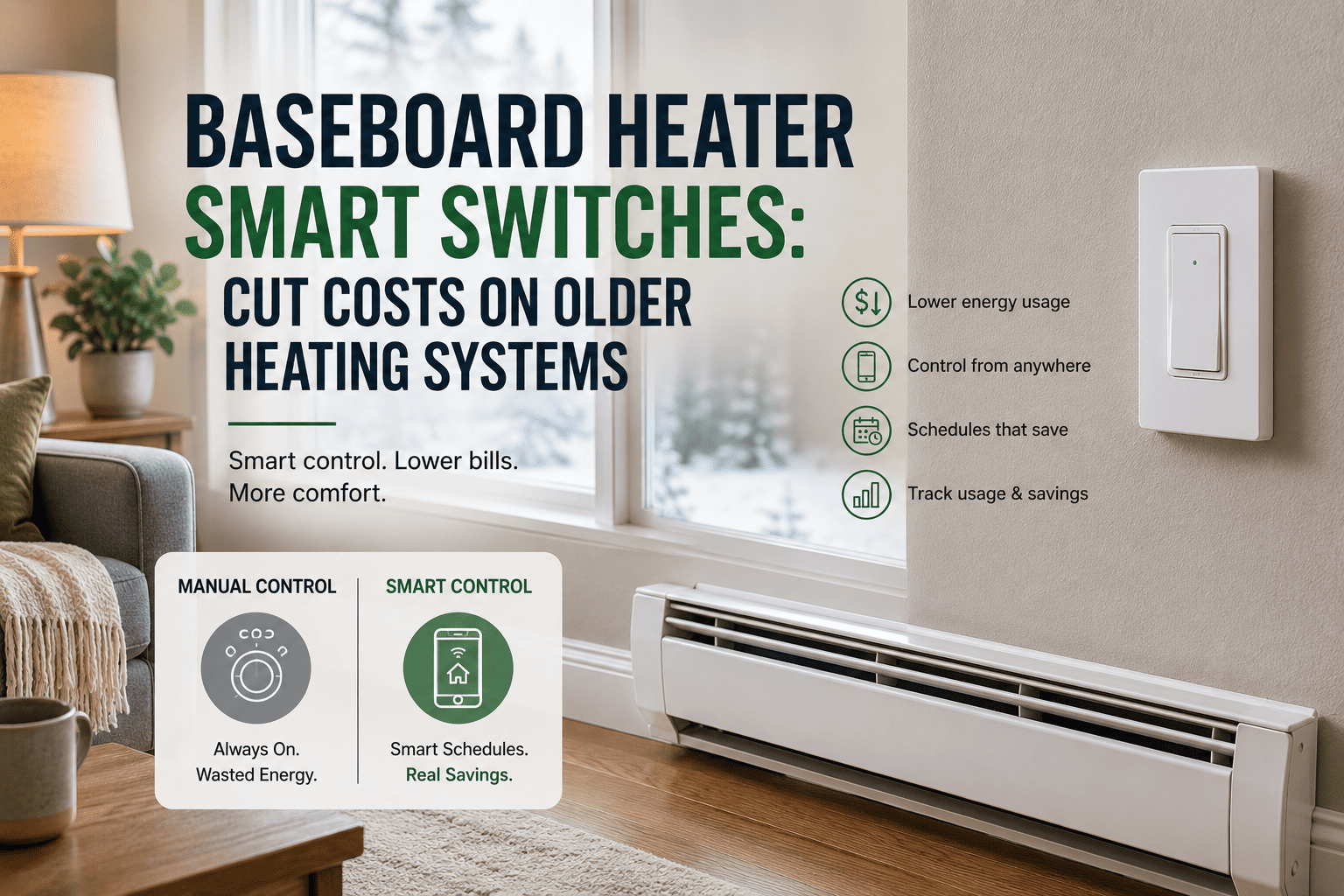
Smart controls can make old electric baseboard heating cheaper to run by scheduling setbacks and controlling rooms independently—but only with the right line-voltage hardware.
Quick answer
The safest and most useful way to add smart control to an older electric baseboard heating system is usually a properly rated 120V or 240V line-voltage smart thermostat, not a generic smart plug or light switch. It will not make resistance heat inherently more efficient, but schedules, setbacks, room-by-room control, and remote shutoff can reduce unnecessary runtime; U.S. Department of Energy guidance says thermostat setbacks of 7°F to 10°F for eight hours a day can save as much as about 10% per year on heating and cooling in suitable systems.
Table of contents
- First: A Smart Control Does Not Make the Heater More Efficient
- Why a Generic Smart Switch Is Usually the Wrong Product
- The correct product category
- 24V Smart Thermostat vs. Line-Voltage Thermostat
- Where Smart Controls Save the Most Money
- 1. Bedrooms that do not need daytime heat
- 2. Guest rooms
- 3. Home offices with predictable hours
- 4. Vacation homes and rentals
- 5. Homes with multiple independent thermostats
- A Simple Savings Calculation
- What Features Actually Matter
- Scheduling
- Per-room control
- Away mode or geofencing
- Energy monitoring
- Local control
- Compatibility Checklist Before You Buy
- What voltage is the circuit?
- How much heater wattage is connected to this thermostat?
- Is the heater resistive, fan-forced, hydronic-electric, or something else?
- Is there already a wall thermostat?
- How many wires are in the box?
- Is local code compatible with DIY installation?
- Safety: This Is Not Low-Voltage Thermostat Wiring
- Does It Make Sense to Upgrade Every Room?
- What About Mechanical Thermostats That Already Work?
- Smart Controls vs. a Heat Pump
- Smart controls make sense when:
- A heat pump deserves serious consideration when:
- A Practical Upgrade Plan
- Step 1: Record each heating zone
- Step 2: Find voltage and wattage
- Step 3: Fix obvious building-envelope problems
- Step 4: Choose a purpose-built line-voltage control
- Step 5: Start with high-impact rooms
- Step 6: Build conservative schedules
- Step 7: Compare energy use
- Common Mistakes
- Buying a normal smart thermostat
- Buying by amperage alone
- Assuming every heater has its own thermostat
- Expecting huge savings without changing setpoints
- Ignoring insulation and air sealing
- Treating a thermostat upgrade like a permanent solution to expensive resistance heat
- Conclusion
Key takeaways
- For electric baseboard heat, a line-voltage smart thermostat is usually the correct smart-control category—not a generic smart plug or light switch.
- Smart controls save energy mainly by reducing heating runtime through schedules, setbacks, and room-level control.
- Voltage, total heater wattage, amperage, wiring configuration, and local code must all match the thermostat.
- A smart thermostat can modernize an old but functional baseboard system without replacing the heaters themselves.
- For large long-term energy reductions, a heat pump can outperform any control-only upgrade to electric resistance heating.
Editorial transparency
Who worked on this article and how it was handled.
- Written by
- Maya Chen
- Creation method
- Editorial research
AI assistance: AI assisted with research organization and drafting. Sources, factual claims, and the final article should be reviewed by a human editor before publication.
Electric baseboard heat is common in older apartments, additions, bedrooms, and homes that never received a central forced-air system. The heaters themselves can last for decades, but the controls often feel stuck in another era: mechanical dials, one temperature all day, and no easy way to turn down unused rooms.
That makes a smart-control retrofit appealing. But the phrase “smart switch” can be misleading. Electric baseboard heat is usually a high-power, line-voltage load. A Wi-Fi light switch or plug that works perfectly for a lamp may be completely inappropriate for a 240V heater drawing thousands of watts.
The better approach is usually a line-voltage smart thermostat designed specifically for electric resistance heating. Used correctly, it can give an older system modern scheduling, app control, room-by-room setbacks, and energy monitoring without replacing the baseboard heaters themselves.
First: A Smart Control Does Not Make the Heater More Efficient
This distinction determines whether the upgrade will meet your expectations.
An electric baseboard heater uses electrical resistance to produce heat. Replacing an old mechanical thermostat with a digital smart thermostat does not suddenly make the heating element produce the same heat with dramatically less electricity.
The savings come from using the heater less often or at a lower setpoint when full heat is unnecessary.
That can happen through:
- scheduled temperature setbacks;
- automatically lowering unused bedrooms;
- turning down a rental unit or vacation property remotely;
- avoiding the classic “heater left at 72°F all day” problem;
- managing rooms independently instead of overheating the entire home.
DOE says households can save as much as about 10% a year on heating and cooling by turning the thermostat back 7°F to 10°F for eight hours a day, depending on the system and home.
That does not mean every smart baseboard thermostat will cut a specific bill by 10%. It means that temperature setback is a proven savings mechanism. The thermostat is the tool that makes that behavior automatic.
Why a Generic Smart Switch Is Usually the Wrong Product
A baseboard heater is not a smart bulb.
Most permanently installed electric baseboard heaters operate on 120V, 208V, or 240V line voltage. Many draw considerably more power than ordinary smart-home switches are designed to handle.
A typical smart light switch may only be intended to control lighting loads. A plug-in smart outlet may be rated for a 120V receptacle but not for continuous operation of a permanently wired baseboard heater. Neither should be assumed safe just because its advertised amperage looks high enough.
The correct product category
For a heater controlled by a wall thermostat, look for a device explicitly designed for:
- line-voltage electric heating;
- your exact circuit voltage;
- the total connected heater wattage;
- the appropriate resistive load;
- the existing wiring configuration.
Current products illustrate the difference. Mysa’s baseboard thermostat is designed for 120V to 240V electric heating and lists a maximum load of 16 amps, including 3,800 watts at 240V. Sinopé offers line-voltage models with different maximum ratings, including versions rated up to 4,000 watts at 240V.
Those numbers are product-specific limits, not universal rules.
If your heaters exceed the rating of the thermostat you are considering, you need a different control strategy designed by someone who understands the electrical load.
24V Smart Thermostat vs. Line-Voltage Thermostat
This is the compatibility mistake most likely to derail the project.
| Feature | Standard HVAC smart thermostat | Baseboard line-voltage smart thermostat |
|---|---|---|
| Typical voltage | 24V | 120V / 208V / 240V |
| Common use | Furnace, central AC, heat pump | Electric baseboard, convector, wall heater |
| Wiring | Thin control wires | Heavier line-voltage wiring |
| Powers heater directly | Usually no | Often yes |
| Can replace baseboard thermostat directly | Usually no | If rated and compatible |
A thermostat designed for a furnace sends low-voltage control signals to HVAC equipment. A line-voltage baseboard thermostat may directly switch the electrical power going to the heater.
They are not interchangeable.
ENERGY STAR’s general smart-thermostat buying guidance makes the same broader point: verify compatibility with the heating and cooling system before buying.
Where Smart Controls Save the Most Money
The strongest use cases are not households that already micromanage every thermostat perfectly. They are homes where baseboard heating is routinely left on longer or hotter than necessary.
1. Bedrooms that do not need daytime heat
A bedroom may need a comfortable temperature overnight but little heating during the workday.
A schedule can lower the setpoint after everyone leaves and restore it before bedtime.
2. Guest rooms
An unused guest room does not need to be maintained at the same temperature as an occupied living room.
With independent baseboard zones, a smart thermostat can keep the room at a lower safe temperature until guests arrive.
3. Home offices with predictable hours
Electric baseboard heating is naturally zonal. That becomes an advantage when the office needs comfort from 8 a.m. to 5 p.m. but almost no active heating overnight.
4. Vacation homes and rentals
Remote control helps prevent heaters from running at an unnecessarily high setting when nobody is there.
It also lets the owner raise the temperature before arrival rather than leaving the property at the occupied setpoint for days.
5. Homes with multiple independent thermostats
This is where baseboard heating can become surprisingly flexible.
Instead of one central thermostat controlling the whole building, individual rooms may already have separate circuits or thermostats. Replacing several old controls with smart line-voltage thermostats can create a practical form of room-by-room scheduling without installing ducts or a central HVAC zone system.
A Simple Savings Calculation
You do not need to believe a manufacturer’s headline percentage to estimate whether the retrofit makes sense.
Start with the heating portion of your annual electric bill.
Suppose an older all-electric home uses an estimated $1,800 per year for baseboard heating.
If smarter schedules and setbacks reduce heating energy by 8%, the annual savings would be:
$1,800 × 0.08 = $144 per year
Now compare that with the installed cost of the controls.
If four smart thermostats cost $150 each, the hardware cost would be:
4 × $150 = $600
Ignoring installation cost and future electricity-price changes:
$600 ÷ $144 ≈ 4.2 years
That is not a prediction. It is a framework.
Your actual result depends on:
- electricity price;
- climate;
- insulation and air leakage;
- how aggressively you use setbacks;
- how many rooms are heated;
- current thermostat behavior;
- occupancy pattern;
- installed thermostat cost.
The calculation is most favorable when the old system is poorly controlled today.
What Features Actually Matter
A long feature list does not automatically produce a lower electric bill.
For baseboard heat, prioritize features that change runtime.
Scheduling
This is the foundation. You want automatic lower setpoints during predictable unoccupied or sleeping periods.
Per-room control
Independent rooms are one of baseboard heating’s biggest advantages. A smart thermostat should let you keep little-used spaces cooler without changing occupied rooms.
Away mode or geofencing
These features are useful when your schedule changes frequently.
ENERGY STAR highlights geofencing as one method smart thermostats can use to apply setbacks when people leave and restore comfort as they return.
Energy monitoring
Some line-voltage thermostats measure or estimate heater consumption.
This is useful less as a gadget and more as a diagnostic tool. If one room consumes significantly more power than expected, investigate:
- an overly high setpoint;
- air leaks;
- poor insulation;
- an exterior wall with high heat loss;
- a heater that is undersized for the space and runs continuously.
Local control
Do not choose a thermostat that becomes unusable whenever Wi-Fi or a cloud service goes down.
Basic temperature adjustment should remain available at the wall.
Compatibility Checklist Before You Buy
Do not order a thermostat until you can answer these questions.
What voltage is the circuit?
Common electric baseboard circuits are 120V or 240V, with 208V also possible in some buildings.
Do not guess from the heater’s appearance.
How much heater wattage is connected to this thermostat?
One thermostat may control more than one baseboard heater.
Add the connected loads and compare the total with the thermostat’s permitted rating.
Is the heater resistive, fan-forced, hydronic-electric, or something else?
Products support different heating types and sometimes apply different minimum or maximum loads to fan-forced systems.
Is there already a wall thermostat?
Some smart line-voltage thermostats are designed as replacements for an existing wall-mounted thermostat. They may not work when the only control is a dial built directly into the heater.
How many wires are in the box?
Smart line-voltage thermostats can have specific wiring and power requirements. Mysa, for example, tells buyers to verify the wiring configuration before installation.
Is local code compatible with DIY installation?
Line-voltage thermostat rules differ by jurisdiction.
Some locations require a licensed electrician.
Safety: This Is Not Low-Voltage Thermostat Wiring
This upgrade may look like changing a normal thermostat, but electrically it can be a very different job.
A baseboard thermostat can carry 120V or 240V line voltage and may directly switch a substantial resistive load.
That means several rules are non-negotiable:
- Turn off the correct breaker before touching wiring.
- Verify power is off with an appropriate voltage tester.
- Confirm the thermostat’s voltage, amperage, and wattage ratings.
- Include the total load of every heater controlled by that thermostat.
- Follow the manufacturer’s wiring diagram and local electrical code.
- Hire a licensed electrician when required—or whenever the wiring or load calculation is uncertain.
This is not merely conservative advice. Historical CPSC recalls have documented baseboard thermostats overheating when connected above their real load capability, including fire incidents.
Do not improvise with an underrated smart relay, generic plug, or lighting switch.
Does It Make Sense to Upgrade Every Room?
Not necessarily.
A better strategy may be to start with the rooms where control can actually change behavior.
Prioritize:
- bedrooms;
- home offices;
- guest rooms;
- basement rooms;
- rental spaces;
- rooms used only at certain times.
A hallway or small utility room with almost no heating demand may not justify a premium smart control.
This also reduces upfront cost and gives you a chance to measure whether your habits actually change.
What About Mechanical Thermostats That Already Work?
An old thermostat does not have to be broken for a replacement to make sense.
The upgrade case is about control precision and automation.
A basic mechanical thermostat can still heat a room adequately, but it depends entirely on someone remembering to turn it down. A digital line-voltage thermostat can automate that behavior every day.
The economic question is therefore:
How many hours per week is this room currently being heated more than necessary?
If the answer is “almost none,” the smart thermostat may have a long payback.
If the answer is “every weekday while everyone is out,” it is a much stronger candidate.
Smart Controls vs. a Heat Pump
There is an important ceiling on what smart controls can accomplish.
A thermostat can reduce unnecessary resistance-heating runtime. It cannot change the underlying heating technology.
DOE says modern heat pumps can reduce electricity use for heating dramatically compared with electric resistance systems such as baseboards. Current DOE guidance cites reductions of roughly 65% in its Home Upgrades material, while its Heat Pump Systems guidance says up to 75% is possible depending on equipment and conditions.
That is a fundamentally different scale of improvement.
Smart controls make sense when:
- the baseboards are functional;
- you want a low-disruption retrofit;
- individual room control is valuable;
- replacing the heating system is not currently affordable;
- the property is a rental, condo, or older home where a larger HVAC project is difficult.
A heat pump deserves serious consideration when:
- baseboard electricity costs dominate the winter budget;
- you expect to stay in the home long term;
- you also need air conditioning;
- the home can accommodate ductless or ducted heat-pump equipment;
- you are planning a major renovation anyway.
The two approaches can also coexist. A home might use a heat pump for the primary living area while retaining smart-controlled baseboards for bedrooms or backup heat.
A Practical Upgrade Plan
If you want to modernize an older baseboard system without turning it into a major renovation, use this sequence.
Step 1: Record each heating zone
List every wall thermostat and the heaters it controls.
Step 2: Find voltage and wattage
Use equipment labels, circuit information, and—when necessary—an electrician to verify the load.
Step 3: Fix obvious building-envelope problems
If a room is expensive to heat because cold air pours under the door or through an unsealed window, fix the air leak too.
Smart scheduling cannot compensate for severe heat loss.
Step 4: Choose a purpose-built line-voltage control
Confirm voltage, load, heater type, wiring, and local code.
Step 5: Start with high-impact rooms
Upgrade the rooms where occupancy varies most.
Step 6: Build conservative schedules
Do not obsess over constant app adjustments. The value comes from repeatable automation.
Step 7: Compare energy use
Track at least one meaningful heating period and compare consumption with similar weather where possible.
Common Mistakes
Buying a normal smart thermostat
A 24V thermostat designed for central HVAC is generally not a drop-in replacement for a 240V baseboard thermostat.
Buying by amperage alone
Voltage, load type, wiring, total wattage, and code requirements all matter.
Assuming every heater has its own thermostat
One thermostat may control multiple heaters. That combined load determines compatibility.
Expecting huge savings without changing setpoints
Smart hardware cannot save much if it reproduces the same temperature schedule as the old thermostat.
Ignoring insulation and air sealing
If an older room loses heat rapidly, envelope improvements can be more valuable than smarter controls.
Treating a thermostat upgrade like a permanent solution to expensive resistance heat
Smart controls are an optimization. A heat pump is a technology change.
Conclusion
Smart controls can make an old electric baseboard system significantly easier to live with and, in the right home, cheaper to operate.
The key is choosing the correct type of device. For most permanently wired electric baseboards, that means a purpose-built line-voltage smart thermostat rated for the exact circuit and heater load, not a generic Wi-Fi smart switch.
The financial benefit comes from better control: lower temperatures while rooms are empty, predictable schedules, remote adjustments, and independent zones. If those behaviors eliminate hours of unnecessary heating every week, the retrofit can be worthwhile without replacing the baseboards.
But if electric resistance heating remains your largest winter expense after better controls and weatherization, treat the smart thermostat as an intermediate step. A properly selected heat pump can offer a much larger reduction in heating electricity use.
Common questions
Questions this guide answers
Can I use a smart switch with an electric baseboard heater?
Do not assume a normal smart switch or smart plug is suitable. Many electric baseboard heaters use 120V or 240V line-voltage circuits and can draw several thousand watts, so the control must be specifically rated for the heater voltage, resistive load, amperage, wiring configuration, and local electrical code.
Do smart thermostats actually lower baseboard heating bills?
They can lower bills when they reduce the amount of time rooms are kept at higher temperatures. The savings come from scheduling, setbacks, occupancy-aware control, and avoiding forgotten heaters—not from changing the electrical efficiency of the baseboard element itself.
What type of smart thermostat works with baseboard heaters?
For most electric baseboard systems with a wall thermostat, you need a line-voltage thermostat designed for 120V or 240V resistive heating. A conventional 24V smart thermostat for a furnace, central air conditioner, or heat pump cannot normally be connected directly to a line-voltage baseboard circuit.
Is it worth making old baseboard heaters smart?
It can be worthwhile when the heaters themselves still work well and the main problem is poor control. If heating costs remain very high even after better scheduling and weatherization, a heat pump may offer a much larger reduction in electricity use than smart controls alone.
Evidence & further reading
Sources & references
Primary and authoritative references used to support or contextualize this article. Links open the original source.
- 1Home Upgrades
U.S. Department of Energy · Accessed Aug 10, 2026
Supports thermostat setback savings guidance and DOE's comparison of heat pumps with electric resistance heating.
- 2Smart Thermostats
ENERGY STAR · Accessed Aug 10, 2026
Supports smart thermostat features such as geofencing, scheduling behavior, and the need to verify HVAC-system compatibility.
- 3Mysa for Baseboards Overview
Mysa · Accessed Aug 10, 2026
Supports current compatibility of a representative line-voltage smart thermostat with 120V and 240V electric baseboard and related resistance-heating systems.
- 4Smart Thermostat for Electric Baseboard Heaters
Mysa · Accessed Aug 10, 2026
Supports representative 120V/240V load limits and illustrates why voltage and wattage must be checked before installation.
- 5Smart Thermostat for Baseboard Heaters | Wi-Fi
Sinopé Technologies · Accessed Aug 10, 2026
Provides a second current example of line-voltage smart-thermostat voltage, amperage, and wattage limits for electric resistance heating.
- 6Installation Overview
Mysa · Accessed Aug 10, 2026
Supports safety guidance for high-voltage installation, breaker shutoff, voltage testing, and checking local electrical-code requirements.
- 7CPSC, Honeywell Announce Revised Rating and Recall of Electric Baseboard Heater Thermostats
U.S. Consumer Product Safety Commission · Accessed Aug 10, 2026
Historical safety example showing that exceeding a thermostat's actual wattage capability can cause overheating and fire risk.

About the author
Maya Chen
Maya covers residential energy, HVAC controls, and practical home automation, translating technical systems into useful decisions for homeowners and renters.
More from Maya →Make your home smarter without buying every gadget.
One useful idea, one product worth knowing, and one energy-saving action—delivered weekly.
No spam. Unsubscribe anytime.
Semantic recommendations
Related reading
Selected from topic cluster, entities, tags, search intent, and editorial relationships.

5 Smart Thermostat Placement Mistakes That Can Waste Hundreds on HVAC Bills
Wrong thermostat placement can distort temperature readings, increase HVAC runtime, and quietly undermine both comfort and energy savings.
Smart Window Contact Sensors: Preventing Open Window AC Energy Waste
Use window contact sensors to pause cooling only after a window stays open, then restore the previous HVAC state safely after every monitored window is closed.
How to Optimize Your Smart AC for Late-Summer Heatwaves
Use smarter cooling schedules, sensible setpoints, humidity control, room sensors, and maintenance checks to stay comfortable during late-summer heatwaves without wasting energy.

How to Stop Drafts Under Exterior Doors Without Replacing the Frame
Cold air under an exterior door usually comes from a worn sweep, misadjusted threshold, tired weatherstripping, or unsealed trim. Here is how to fix it without replacing the frame.