Solar Generator Backup Basics for Late-Summer Storm Outages
Learn how to size and safely use a portable battery power station with solar charging for storm outages, from watt-hours and surge loads to refrigerators and recharge planning.
Quick answer
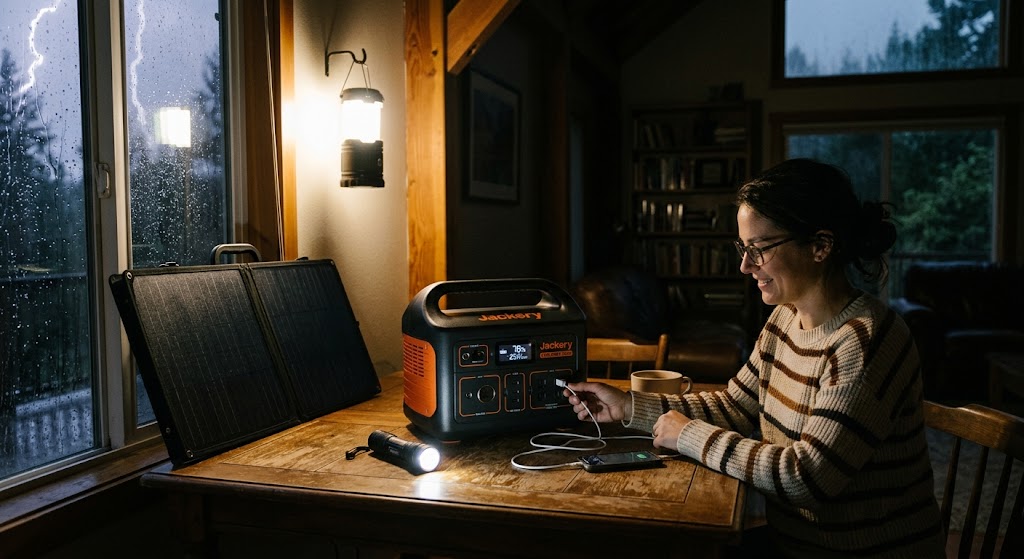
A so-called solar generator is usually a rechargeable battery power station with an inverter and optional solar-panel input. For storm backup, choose one by both battery capacity in watt-hours and inverter output in watts, then reserve it for priority loads such as communications, lighting, and compatible refrigeration or medical equipment. Charge it before severe weather, treat solar as a recharge source rather than guaranteed storm-time power, and never backfeed household wiring through an outlet or improvised cord.
Table of contents
- First, understand what a “solar generator” actually is
- Battery
- Inverter
- Charge controller
- Solar input
- Watts and watt-hours are different problems
- Watts: can the power station run it?
- Watt-hours: how long can it run?
- Do not size from appliance maximum wattage alone
- Can a portable power station run a refrigerator?
- Use an appliance thermometer during outages
- Prioritize loads instead of trying to run the whole apartment
- Priority 1: safety and communications
- Priority 2: critical health equipment
- Priority 3: refrigeration
- Priority 4: comfort and convenience
- High-wattage heat loads can destroy your runtime plan
- Air conditioning is a special case
- Solar recharge is valuable—but weather-dependent
- Solar-panel rating is an upper reference, not guaranteed field output
- The right storm strategy is pre-charge first
- Solar panels and lightning are a bad combination
- Battery power stations do not create carbon monoxide
- But “no exhaust” does not mean “no safety rules”
- Look for meaningful safety certification
- Never backfeed the house through a normal outlet
- Whole-home backup requires purpose-designed equipment
- Do not assume rooftop solar works during a blackout
- Size the battery from an outage load budget
- Measure real devices when possible
- Test the complete outage setup before the storm
- A useful test sequence
- Understand pass-through and UPS features before depending on them
- Plan around battery percentage, not just outage duration
- 100–70%: normal backup
- 70–40%: conserve
- Below 40%: critical-load mode
- Keep solar input within the power station limits
- Apartment users need a different outage plan
- Solar access may be poor
- Do not block egress
- Follow building rules
- A small backup system can be more useful than a huge one
- What to prepare 24–48 hours before a storm
- What to do when the power goes out
- First hour
- If the outage continues
- After the storm passes
- Common solar-generator outage mistakes
- Buying by inverter watts alone
- Buying by watt-hours alone
- Assuming solar equals unlimited runtime
- Testing for the first time during an outage
- Running electric heating loads unnecessarily
- Backfeeding a wall outlet
- Treating a portable battery as a permanent home ESS
- Ignoring the manufacturer’s solar limits
- Forgetting food-safety timing
- A practical starter specification checklist
- Conclusion
Key takeaways
- A 'solar generator' is usually a battery power station that can be recharged from solar; it does not create unlimited electricity simply because a panel is connected.
- Size backup power using both energy capacity in watt-hours and inverter output in watts, with extra margin for losses and startup surges.
- During an outage, prioritize communications, lighting, refrigeration, and medically necessary equipment before high-wattage heating or cooking loads.
- Never backfeed a home through a normal wall outlet; selected-circuit or whole-home backup requires purpose-designed isolation and installation.
Editorial transparency
Who worked on this article and how it was handled.
- Written by
- Maya Chen
- Creation method
- Editorial research
AI assistance: AI assisted with research organization and drafting. Sources, factual claims, and the final article should be reviewed by a human editor before publication.
Late-summer storms can turn an ordinary evening into an extended outage with almost no warning. Phones need charging, the refrigerator stops cycling, internet equipment goes dark, and the temptation is to plug every available appliance into the largest battery box in the house.
A portable “solar generator” can be extremely useful in that situation, but the name is misleading. Most products in this category are portable battery power stations: a rechargeable battery, inverter, charging electronics, and several outlets in one enclosure. Solar panels are an optional way to recharge the battery; they do not make the stored energy unlimited.
A good outage plan therefore starts with math and priorities rather than product marketing. You need enough watts to start and run the devices that matter, enough watt-hours to keep those devices operating long enough, and a realistic recharge plan for weather that may remain cloudy long after the grid fails.
First, understand what a “solar generator” actually is
The typical portable unit contains four important pieces.
Battery
The battery stores energy.
Its capacity is usually advertised in watt-hours (Wh) or kilowatt-hours (kWh).
A 1,024 Wh battery stores about 1.024 kWh of energy before accounting for conversion losses and operating limits.
Inverter
The inverter converts the battery’s DC electricity into AC electricity for normal household plugs.
Its rating is usually expressed in watts.
This rating determines how much electrical load the unit can support at one time.
Charge controller
The charging electronics manage input from:
- wall power;
- vehicle charging on supported products;
- solar panels;
- other manufacturer-approved sources.
Solar input
Compatible panels can recharge the battery when adequate sunlight is available.
That is the “solar” part of the system.
The Department of Energy makes the same broader distinction with solar-plus-storage systems: solar produces energy when sunlight is available, while storage lets that energy be used later.
Watts and watt-hours are different problems
This is the most important sizing concept.
Watts: can the power station run it?
Watts describe power at a moment in time.
If a power station has a 1,500 W continuous AC output, the combined active AC loads normally need to stay within that limit.
But motors complicate the calculation.
Devices such as:
- refrigerators;
- freezers;
- pumps;
- some air conditioners;
can draw significantly more power for a brief moment when a compressor or motor starts.
That is why many power stations also publish a surge or peak rating.
Do not treat the surge rating as power the unit can provide continuously.
Watt-hours: how long can it run?
Watt-hours describe stored energy.
A theoretical runtime calculation is:
Runtime (hours) =
Battery capacity (Wh) ÷ average load (W)
For example:
768 Wh ÷ 60 W = 12.8 hours theoreticalReal runtime will be lower because of:
- inverter conversion losses;
- battery-management overhead;
- display and electronics power;
- DC conversion;
- temperature;
- battery age;
- power-station reserve behavior.
Use the calculation for sizing, then add margin.
Do not size from appliance maximum wattage alone
A refrigerator is a good example.
The compressor does not normally run at full power every second of the day.
Instead, it cycles:
Compressor starts
-> higher startup demand

Compressor runs
-> normal operating draw

Target temperature reached
-> compressor stops

Temperature rises
-> cycle repeats
If the refrigerator consumes 100 W while the compressor is running, that does not mean it consumes exactly 100 Wh every hour.
Its average energy use depends on its duty cycle.
During an outage, that duty cycle can change with:
- room temperature;
- how often the door opens;
- food load;
- refrigerator condition;
- thermostat setting;
- ventilation around the appliance.
So you need to check both startup compatibility and total energy consumption.
Can a portable power station run a refrigerator?
Many can.
But do not rely on the statement:
“The AC outlet is rated for 1,000 watts, so my refrigerator must be fine.”
The compressor may have a startup surge that exceeds the steady running power.
Before storm season:
- Find the refrigerator’s electrical specifications.
- Check the power station’s continuous AC rating.
- Check its surge/peak rating and manufacturer guidance for compressor loads.
- Plug the refrigerator directly into the power station using the approved connection method.
- Observe several compressor starts.
- Let the test run long enough to see realistic battery consumption.
Testing before an emergency gives you far better information than a generic online runtime estimate.
Use an appliance thermometer during outages
Backup power does not replace food-safety monitoring.
USDA advises keeping appliance thermometers in refrigerators and freezers.
During an outage, keep the doors closed as much as possible.
USDA states that an unopened refrigerator can keep food safely cold for about four hours without power. A full freezer can maintain temperature much longer when kept closed.
That means you do not necessarily have to transfer refrigerator load to the power station in the first second of every outage.
Your strategy can be:
- keep the refrigerator closed;
- preserve battery for critical communications;
- assess outage duration;
- power refrigeration when the situation requires it.
The correct choice depends on weather, food temperature, available ice, battery capacity, and expected restoration time.
Prioritize loads instead of trying to run the whole apartment
Portable battery capacity disappears quickly when you treat it like the utility grid.
Build a priority list before the storm.
Priority 1: safety and communications
Examples:
- phone;
- emergency radio;
- essential lighting;
- router/modem if internet service remains available;
- rechargeable flashlights.
These are usually relatively modest loads.
Priority 2: critical health equipment
If someone depends on a powered medical device, do not improvise.
FDA recommends checking the device instructions or contacting the manufacturer/distributor to determine whether it can be used with batteries or a generator.
For medically necessary equipment, calculate:
- required voltage;
- AC or DC power;
- normal wattage;
- startup power where relevant;
- required runtime;
- backup battery behavior.
Then test the exact backup setup in advance.
A consumer power station should not be assumed to be medically suitable simply because the plug fits.
Priority 3: refrigeration
Food protection may become increasingly important as the outage continues.
Priority 4: comfort and convenience
Examples:
- laptop;
- TV;
- fan;
- task lighting;
- entertainment devices.
These can be added when battery reserves are healthy.
High-wattage heat loads can destroy your runtime plan
Some appliances turn electricity directly into heat.
Examples include:
- electric kettles;
- toaster ovens;
- hot plates;
- hair dryers;
- space heaters;
- many coffee makers.
A battery that can keep lights, phones, and communications running for a long time may drain rapidly when asked to produce 1,000–1,500 W continuously.
The problem is not only battery capacity.
The inverter also has to support the load.
Before plugging in any heating appliance, verify:
- continuous output rating;
- appliance wattage;
- cable and outlet limitations;
- expected battery consumption.
For storm backup, energy conservation usually matters more than recreating normal grid-powered life.
Air conditioning is a special case
Late-summer outages can occur during extreme heat, which makes cooling more than a comfort question.
But room air conditioners are demanding backup loads.
A power station may need to handle:
- compressor startup;
- sustained cooling power;
- fan power;
- long runtime.
Even if the inverter can start the AC, the battery may not contain enough energy to run it for very long.
If heat conditions are unsafe and your battery system cannot provide adequate cooling, follow local emergency guidance and consider a cooling center or another location with reliable power rather than assuming a portable battery can support whole-room cooling indefinitely.
Solar recharge is valuable—but weather-dependent
Solar panels are the feature that can turn a finite battery into a longer-duration backup resource.
But storm conditions are exactly when solar production can be unreliable.
DOE notes that solar production varies with:
- clouds;
- shade;
- rain;
- time of day;
- panel orientation;
- other environmental conditions.
So a panel labeled “200 W” does not mean it will feed 200 W into your battery every hour of the day.
Solar-panel rating is an upper reference, not guaranteed field output
Actual input can be lower because of:
- cloud cover;
- low sun angle;
- panel temperature;
- partial shade;
- window glass;
- cable losses;
- charge-controller limits;
- battery state of charge.
During a dark thunderstorm, output can fall dramatically.
The right storm strategy is pre-charge first
When severe weather is forecast:
- charge the power station from the grid;
- charge phones and rechargeable lights;
- cool the refrigerator/freezer normally;
- prepare solar panels for use after conditions are safe;
- treat sunlight after the storm as a way to extend reserves.
Do not start an outage with a half-empty battery because you assume tomorrow’s solar panel will refill it.
Solar panels and lightning are a bad combination
Do not deploy portable panels outdoors while severe weather, lightning, high winds, flooding, or unsafe debris conditions are ongoing.
Wait until conditions are safe.
Keep the power station itself dry.
Do not place it:
- in standing water;
- below a leaking window;
- on a wet balcony;
- where wind-driven rain can reach the outlets;
- beneath damaged roofing.
Water and electrical equipment are a dangerous combination.
If the power station or its cables become wet or damaged, follow manufacturer instructions rather than energizing them “to see if they still work.”
Battery power stations do not create carbon monoxide
This is one of their major emergency advantages.
A battery power station has no gasoline, propane, or diesel engine producing exhaust while it operates.
That is fundamentally different from a portable fuel generator.
CDC warns that combustion generators must never be operated inside a home or garage and recommends placing them outdoors more than 20 feet from windows, doors, and vents.
A battery power station avoids that specific carbon-monoxide hazard.
But “no exhaust” does not mean “no safety rules”
The enclosure still contains:
- high-energy battery cells;
- power electronics;
- an inverter;
- high-current connections.
Use it according to the manufacturer instructions.
Keep it:
- dry;
- away from excessive heat;
- physically protected from impact;
- clear of blocked ventilation openings;
- away from combustible clutter;
- away from escape paths where appropriate.
Stop using a unit that shows serious damage, unusual swelling, smoke, leaking, or other behavior identified as unsafe by the manufacturer.
Look for meaningful safety certification
UL Solutions describes UL 2743 as a standard covering portable power packs intended to provide power when normal grid electricity is unavailable.
Certification is more meaningful than a vague product listing that says:
“Built with safe battery technology.”
When comparing a unit, verify:
- the exact standard;
- the exact model;
- the certification organization;
- whether the listing applies to the complete product rather than only one internal component.
UL also emphasizes an important distinction: a portable power pack certified for portable use is not automatically the same thing as a permanently installed residential energy-storage system.
That distinction becomes critical when people start trying to connect portable units to household wiring.
Never backfeed the house through a normal outlet
Do not connect a power station to a household receptacle with an improvised cable so that electricity flows “backwards” into the apartment or home’s circuits.
This is often called backfeeding.
It can create:
- shock hazards;
- fire hazards;
- energized wiring where power is assumed to be off;
- danger to utility workers;
- equipment damage.
Never use a male-to-male “suicide cord.”
Whole-home backup requires purpose-designed equipment
Some modern power stations are sold with:
- transfer equipment;
- dedicated home panels;
- inlet systems;
- manufacturer-specific backup hardware.
That is different from plugging the battery into a random wall outlet.
If you want selected circuits or the entire home to operate from battery backup, the system must safely isolate the home from the utility and be compatible with the power source.
Use the manufacturer’s approved architecture and a qualified electrician where required.
Do not assume rooftop solar works during a blackout
This surprises many homeowners.
DOE explains that ordinary grid-connected solar systems generally shut down when the utility grid fails for safety reasons.
Having panels on the roof therefore does not automatically mean your outlets stay energized.
Outage operation typically requires:
- an appropriately configured inverter;
- battery storage or another compatible forming source;
- equipment designed to isolate from the grid.
A portable solar power station is separate from that architecture.
Its foldable panels charge the portable battery directly through the power station’s solar input.
Size the battery from an outage load budget
The cleanest planning method is a table.
Create one before buying anything.
| Device | Average or measured watts | Hours needed | Estimated Wh |
|---|---|---|---|
| Phone charging | Measure/estimate | Planned use | W × h |
| Router/modem | Measure | Planned use | W × h |
| LED lights | Measure | Planned use | W × h |
| Refrigerator | Measure over time | Based on duty cycle | Use measured energy |
| Medical equipment | Manufacturer data | Required runtime | W × h |
| Fan | Nameplate/measure | Planned use | W × h |
Then add the energy requirements.
Do not stop there.
Add reserve for:
- inverter losses;
- battery overhead;
- uncertain outage duration;
- unexpected phone charging;
- reduced battery performance;
- solar underperformance.
The exact margin should reflect how critical the load is.
A battery sized exactly to the theoretical number has no resilience.
Measure real devices when possible
Published wattage estimates are useful for early planning, but your actual appliances are better data.
For low-risk plug-in electronics, a suitable power meter can show:
- instantaneous watts;
- cumulative kWh;
- changing load over time.
For a refrigerator, measure long enough to capture multiple compressor cycles.
For a modem/router, measure normal operation rather than using only the power adapter’s maximum label.
For medical equipment, use manufacturer specifications and instructions rather than relying only on a generic consumer meter.
Test the complete outage setup before the storm
An emergency is a poor time to discover:
- the refrigerator trips the inverter;
- the solar connector does not fit;
- the panel cable is too short;
- the battery firmware needs setup;
- one AC outlet is disabled by a setting;
- the app requires an account you forgot;
- the unit cannot charge and discharge the way you expected.
Run a controlled test.
A useful test sequence
- Fully charge the power station.
- Disconnect it from grid charging.
- Connect only the devices on your priority list.
- Observe total watts.
- Confirm motor loads start reliably.
- Run the setup for several hours.
- Record battery percentage or remaining Wh.
- Calculate realistic runtime from the observed depletion.
- Test solar charging on a clear day.
- Repeat a short solar test under mediocre conditions.
Your measured system is more valuable than a marketing runtime claim.
Understand pass-through and UPS features before depending on them
Some portable power stations advertise:
- UPS mode;
- EPS mode;
- pass-through charging;
- backup switchover.
These terms are not interchangeable across manufacturers.
If you want a power station permanently sitting between the wall and a critical device, verify:
- whether the manufacturer permits that use;
- transfer time;
- continuous load limit;
- battery-management behavior;
- whether the output is actually uninterrupted enough for the connected device.
A product marketed as “backup power” is not automatically a certified UPS for every sensitive load.
For critical IT or medical equipment, use a solution appropriate to the equipment requirements.
Plan around battery percentage, not just outage duration
A practical storm strategy uses reserve thresholds.
Example:
100–70%: normal backup
Run:
- communications;
- essential lights;
- refrigeration as needed;
- critical equipment.
70–40%: conserve
Reduce:
- entertainment;
- unnecessary lighting;
- laptop charging;
- convenience loads.
Below 40%: critical-load mode
Reserve energy for:
- medical needs;
- phone;
- emergency communications;
- minimum refrigeration strategy.
These percentages are examples, not universal rules.
The point is to decide your priorities before battery anxiety sets in.
Keep solar input within the power station limits
Portable solar panels are not universally interchangeable.
The power station may specify:
- maximum input voltage;
- maximum input current;
- maximum solar wattage;
- connector type;
- acceptable open-circuit voltage range.
Connecting panels beyond the supported electrical limits can damage equipment or create a hazard.
If combining multiple panels in series or parallel, follow the manufacturer’s approved configuration.
Do not design a DIY solar array from connector shape alone.
Apartment users need a different outage plan
Portable power stations are especially attractive in apartments because residents usually cannot install:
- permanent batteries;
- transfer switches;
- fuel-generator connections.
They also avoid the carbon-monoxide exhaust problem of combustion generators.
But apartment residents face their own constraints.
Solar access may be poor
A balcony can be:
- shaded;
- north-facing;
- obstructed by another building;
- unsafe during high winds;
- prohibited from displaying panels externally.
A portable panel behind window glass can also perform differently from an unobstructed outdoor setup.
Do not block egress
Keep the battery and cables out of:
- exit paths;
- shared hallways;
- stairwells;
- fire doors.
Follow building rules
Do not mount solar panels to railings, façades, roofs, or common areas without permission.
For many apartments, the realistic plan is:
pre-charged battery first, portable solar second.
A small backup system can be more useful than a huge one
The largest battery is not automatically the best emergency system.
A smaller unit may be:
- easier to carry;
- easier to recharge;
- easier to store;
- sufficient for phones, lights, networking, and a fan.
A larger unit becomes useful when you need:
- refrigeration for long periods;
- medical loads;
- larger inverter capacity;
- longer outage endurance.
The right size is based on your critical-load budget.
Buying capacity you cannot lift, safely store, or recharge may reduce the practical value of the system.
What to prepare 24–48 hours before a storm
When a credible severe-weather forecast arrives:
- Charge the power station according to manufacturer instructions.
- Charge phones, flashlights, power banks, and radios.
- Test the refrigerator/freezer thermometer.
- Freeze gel packs and containers of water where appropriate.
- Keep the freezer organized and full enough to retain cold effectively.
- Download any power-station app updates while internet is available.
- Verify charging cables and solar adapters.
- Bring portable panels inside before high winds arrive.
- Put the battery somewhere dry and accessible.
- Write down the load-priority plan.
The goal is to enter the outage with maximum optionality.
What to do when the power goes out
Start conservatively.
First hour
- Confirm whether the outage is local or widespread.
- Keep refrigerator/freezer doors closed.
- Use battery-powered lighting instead of opening the refrigerator repeatedly.
- Charge phones only as needed.
- Check utility outage information if communications remain available.
If the outage continues
- Move critical devices to the power station.
- Monitor total watts.
- Watch battery state of charge.
- Start refrigeration backup according to your food-safety and battery plan.
- Reduce unnecessary loads.
After the storm passes
If conditions are safe:
- deploy solar panels;
- optimize orientation;
- keep them out of shade;
- monitor real input wattage;
- adjust consumption to the recharge rate.
If the battery is consuming 500 Wh per day but solar is adding only 150 Wh, you are still running a deficit.
Solar extends the runway only when generation meaningfully offsets consumption.
Common solar-generator outage mistakes
Buying by inverter watts alone
A 2,000 W inverter attached to a small battery can run a large appliance briefly but may have poor endurance.
Buying by watt-hours alone
A huge battery with an undersized inverter may not start the compressor or appliance you bought it for.
Assuming solar equals unlimited runtime
Clouds and rain can make solar recharge too slow to keep up with load.
Testing for the first time during an outage
Compressor surge compatibility should be known in advance.
Running electric heating loads unnecessarily
They can consume stored energy extremely quickly.
Backfeeding a wall outlet
Never improvise household electrical backup.
Treating a portable battery as a permanent home ESS
Portable certification and stationary installation requirements are not the same.
Ignoring the manufacturer’s solar limits
Panel voltage and current compatibility matter.
Forgetting food-safety timing
Battery management and refrigerator temperature management need to work together.
A practical starter specification checklist
Before buying, record these fields for every candidate:
| Specification | Why it matters |
|---|---|
| Battery capacity (Wh) | Determines stored energy |
| Continuous AC output (W) | Determines normal simultaneous load |
| Surge/peak rating | Helps with motor/compressor startup |
| Battery chemistry | Influences product design, weight, and cycle characteristics |
| AC recharge time | Determines storm-prep convenience |
| Maximum solar input | Determines recharge potential |
| Solar voltage/current range | Determines panel compatibility |
| DC/USB outputs | Can avoid unnecessary AC conversion for some devices |
| Safety certification | Provides a more meaningful safety signal |
| Weight | Determines whether you can actually move it |
| Warranty/support | Matters for a high-energy battery product |
Do not let app control or decorative lighting distract from these fundamentals.
Conclusion
A portable solar generator is best understood as a finite battery first and a solar-recharge system second.
For late-summer storm outages, size it with two numbers: enough inverter watts to support the devices and startup surges you actually need, and enough watt-hours to keep those priority loads running for the expected outage. Test refrigerators and other motor loads before storm season, pre-charge from the grid when severe weather is approaching, and assume solar production may be limited until the storm has passed.
Most importantly, use the power station as a portable appliance unless the manufacturer provides a purpose-designed home-backup system. Never backfeed household wiring through a normal receptacle, keep the equipment dry, and follow appropriate guidance for refrigeration, medical devices, and electrical safety. A modest, well-tested backup plan will outperform a much larger battery that you have never actually used.
Common questions
Questions this guide answers
What size solar generator do I need for a power outage?
Add the average wattage of the devices you need to run and estimate how many hours each device must operate. Battery capacity is measured in watt-hours, while the inverter's watt rating determines how much load can run at one time. Leave margin for conversion losses, standby use, and motor startup surges rather than sizing exactly to the theoretical calculation.
Can a portable power station run a refrigerator during an outage?
Often, if the power station's continuous and surge ratings are compatible with the refrigerator. Refrigerators cycle instead of drawing their nameplate maximum continuously, but their compressor can require a much higher startup surge. Check the refrigerator and power-station specifications and test the combination before storm season instead of discovering incompatibility during an outage.
Will solar panels keep a power station charged during a storm?
Not reliably. Solar output depends on panel size, orientation, shade, clouds, rain, temperature, and the power station's solar-input limits. Charge the battery from the grid before severe weather and consider solar a way to extend an outage rather than a guaranteed substitute for a full battery.
Can I plug a solar generator into a wall outlet to power my house?
Not through a normal outlet or improvised male-to-male cord. Backfeeding household wiring can create shock, fire, and utility-worker hazards. Whole-home or selected-circuit backup requires equipment specifically designed and installed for safe isolation from the utility, following the power-station manufacturer's instructions and applicable electrical requirements.
Is a battery power station safer indoors than a gasoline generator?
A battery power station does not produce carbon monoxide from an engine, unlike a fuel-burning generator. It still contains high-energy batteries and power electronics, so it should be kept dry, used within the manufacturer's temperature and ventilation limits, protected from damage, and operated only with compatible loads and cables.
Evidence & further reading
Sources & references
Primary and authoritative references used to support or contextualize this article. Links open the original source.
- 1Solar and Resilience Basics
U.S. Department of Energy · Accessed Aug 30, 2026
Supports solar-plus-storage resilience, the need for storage and properly configured inverters during outages, and the limitation of ordinary grid-tied solar when utility power fails.
- 2Solar Integration: Solar Energy and Storage Basics
U.S. Department of Energy · Accessed Aug 30, 2026
Supports the distinction between energy capacity and power capacity, the role of battery storage, and solar production variability due to clouds, shade, rain, and other conditions.
- 3Solar Integration: Inverters and Grid Services Basics
U.S. Department of Energy · Accessed Aug 30, 2026
Supports the role of inverters and the requirement for properly designed solar-plus-storage systems to operate independently during outages.
- 4Q&A: Portable Power Packs
UL Solutions · Accessed Aug 30, 2026
Supports the purpose and limits of portable power packs, UL 2743, and the distinction between portable products and permanently installed residential energy-storage systems.
- 5Portable Power Pack Testing
UL Solutions · Accessed Aug 30, 2026
Supports UL 2743 as a safety standard covering portable power sources intended for situations when normal grid power is unavailable.
- 6What to Do to Protect Yourself During a Power Outage
Centers for Disease Control and Prevention · Accessed Aug 30, 2026
Supports power-outage safety guidance and the critical distinction between battery power stations and fuel-burning generators that create carbon monoxide hazards.
- 7Keep Your Food Safe During Emergencies: Power Outages, Floods & Fires
USDA Food Safety and Inspection Service · Accessed Aug 30, 2026
Supports refrigerator and freezer food-safety planning during power outages, including the four-hour refrigerator guidance when the door remains closed.
- 8FDA Offers Tips about Medical Devices and Natural Disasters
U.S. Food and Drug Administration · Accessed Aug 30, 2026
Supports checking medical-device instructions and manufacturer guidance for battery or generator use and preparing in advance for medically necessary powered equipment.

About the author
Maya Chen
Maya covers residential energy, HVAC controls, and practical home automation, translating technical systems into useful decisions for homeowners and renters.
More from Maya →Make your home smarter without buying every gadget.
One useful idea, one product worth knowing, and one energy-saving action—delivered weekly.
No spam. Unsubscribe anytime.
Semantic recommendations
Related reading
Selected from topic cluster, entities, tags, search intent, and editorial relationships.
Portable Power Stations for Late-Summer Outdoor Patio Movie Nights
Plan a reliable patio movie night by sizing a portable power station for your projector, speakers, streaming gear, and late-summer heat.
Baseboard Heater Smart Switches: Cut Costs on Older Heating Systems
Smart controls can make old electric baseboard heating cheaper to run by scheduling setbacks and controlling rooms independently—but only with the right line-voltage hardware.

How to Calculate the Real Payback Period of a Whole-House Solar Battery
A realistic solar-battery payback calculation must include export rates, time-of-use savings, efficiency losses, degradation, incentives, financing, and the value you place on backup power.

How to Stop Drafts Under Exterior Doors Without Replacing the Frame
Cold air under an exterior door usually comes from a worn sweep, misadjusted threshold, tired weatherstripping, or unsealed trim. Here is how to fix it without replacing the frame.