
Portable Power Stations for Late-Summer Outdoor Patio Movie Nights
Plan a reliable patio movie night by sizing a portable power station for your projector, speakers, streaming gear, and late-summer heat.
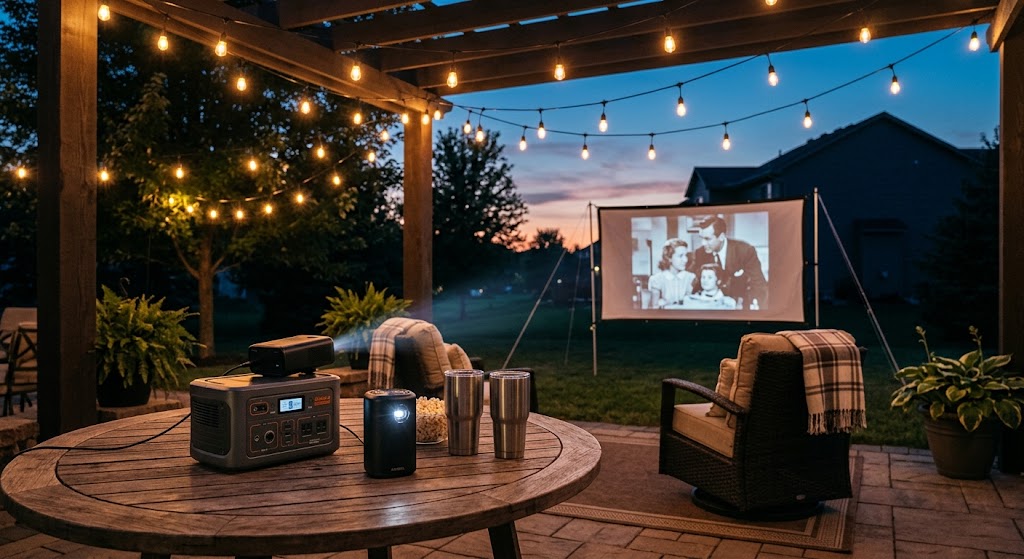
Quick answer
For a patio movie night, choose a portable power station by adding the real wattage of your projector, speakers, streaming device, and lights, then multiplying that load by the number of hours you expect to run them. The station's continuous AC output must exceed the combined load, while its watt-hour capacity should include extra headroom because actual runtime is lower than the simple nameplate-capacity calculation.
Table of contents
- First, understand watts versus watt-hours
- The basic runtime calculation
- Build your patio movie-night power budget
- A hypothetical example
- Check continuous output before battery capacity
- Why peak wattage can be misleading
- Choose the right capacity class for the way you watch
- Small setup: projector plus minimal audio
- Medium setup: projector, better audio, lights, and streaming gear
- Larger setup: bright projector, substantial audio, multiple devices
- Late-summer heat changes how you should use the battery
- Good patio placement
- Do not assume your portable power station is weatherproof
- LiFePO4 or NCM: should chemistry influence the choice?
- Look for legitimate safety certification, not just battery features
- Check recalls before buying—or before using an older unit
- Ports matter more than people expect
- Pre-charge before the sun goes down
- A simple pre-show checklist
- Use the station’s live watt display as your runtime reality check
- Eight ways to stretch runtime without making the movie worse
- What size reserve should you leave?
- A decision framework for choosing the right station
- Common patio power-station mistakes
- Buying by peak watts alone
- Ignoring the projector’s real consumption
- Leaving the station in afternoon sun
- Blocking the cooling vents
- Assuming “portable” means waterproof
- Skipping the recall check
- When a long outdoor extension cord is still the better choice
- Conclusion
Key takeaways
- Calculate the total load in watts first, then size watt-hour capacity for the full movie plus a practical reserve.
- Keep the power station shaded, dry, ventilated, and within the operating-temperature limits listed by the manufacturer.
- Prioritize verified safety certification, sufficient continuous AC output, useful port selection, and realistic battery capacity over headline peak-watt claims.
Editorial transparency
Who worked on this article and how it was handled.
- Written by
- Maya Chen
- Creation method
- Editorial research
AI assistance: AI assisted with research organization and drafting. Sources, factual claims, and the final article should be reviewed by a human editor before publication.
A late-summer patio movie night can be wonderfully simple right up until the projector shuts off halfway through the film. Portable power stations solve the extension-cord problem, but choosing one by the biggest watt number on the box is an easy way to overspend—or run out of battery before the credits.
The important trade-off is between power and energy. Your projector and speakers need enough instantaneous output to run safely, while the battery needs enough stored energy to keep everything running for two or three hours. Heat, inverter overhead, screen brightness, extra lighting, and device charging can all shorten real-world runtime.
This guide shows how to build a realistic power budget for a patio movie setup, how much reserve to leave, which specifications matter, and how to protect the battery during hot late-summer evenings. It is intentionally product-neutral so you can apply the same logic to any reputable portable power station.
First, understand watts versus watt-hours
Portable power station listings usually emphasize two numbers that sound similar but answer different questions.
Watts (W) describe how much power the station can supply at one moment. Your projector, speakers, streaming device, and lights all contribute to this load.
Watt-hours (Wh) describe how much energy the battery stores. This is the number that determines approximate runtime.
A 500 Wh station is not “500 watts of power.” It may have a 500 Wh battery and a separate inverter rating such as 500 W, 700 W, or something else entirely. You need both specifications.
The basic runtime calculation
Start with this simple formula:
Estimated theoretical runtime = battery capacity in Wh ÷ total device load in W
If your complete setup draws 160 W and the station stores 512 Wh:
512 Wh ÷ 160 W = 3.2 hours theoretical runtime
That is not a promise of 3.2 hours. The AC inverter consumes energy, battery-management electronics use some power, loads fluctuate, and temperature can affect performance. The formula is best used as a first sizing step.
For an actual purchase, leave a reserve rather than planning to drain the unit to zero exactly as the movie ends.
Build your patio movie-night power budget
Do not estimate from product category alone. Read the power label, manual, or measured consumption of the exact equipment you plan to use.
Your load may include:
- projector;
- powered speaker or soundbar;
- streaming stick or small media player;
- Wi-Fi hotspot or travel router;
- string lights or pathway lights;
- phone charging;
- USB fan;
- any HDMI accessory that needs separate power.
A hypothetical example
The numbers below are an illustration, not typical specifications for every product.
| Device | Example draw |
|---|---|
| Projector | 120 W |
| Powered speaker | 20 W |
| Streaming device | 10 W |
| Patio lights | 15 W |
| Total | 165 W |
If the movie and setup time will take three hours:
165 W × 3 hours = 495 Wh of energy
A 500 Wh station would be too close for comfort because that calculation leaves virtually no room for inverter losses, variable loads, or the fact that you may keep the system running before and after the film.
A more conservative plan is to choose enough nameplate capacity that your expected session uses only part of the battery, not all of it. That extra headroom is especially useful outdoors, where late-summer heat can make conditions less predictable.
Check continuous output before battery capacity
A large battery is useless if its inverter cannot run the load.
Look for the station’s continuous AC output, not just a headline “peak” or “surge” number. Add the wattage of everything you expect to power at the same time and make sure that combined load stays comfortably below the continuous rating.
For a movie setup, the projector is usually the most important device to check. Some equipment may also have startup or transient demand that is higher than its steady operating draw.
Why peak wattage can be misleading
Peak or surge output describes what a station can deliver briefly under certain conditions. It is not the same as the power it can supply throughout a two-hour movie.
For patio use, prioritize this order:
- continuous AC output;
- battery capacity in Wh;
- port mix;
- charging speed;
- weight and portability;
- surge rating.
A station that comfortably runs your actual setup is more useful than one with an impressive peak-watt number you never need.
Choose the right capacity class for the way you watch
Instead of starting with a specific product, start with the kind of evening you are planning.
Small setup: projector plus minimal audio
If you are using a relatively low-draw projector, a small powered speaker, and little else, a compact station may be sufficient. These setups are easier to carry and recharge and are less intrusive on a small patio.
The important thing is to verify the real load rather than assuming “small projector” means low power consumption.
Medium setup: projector, better audio, lights, and streaming gear
This is where many backyard and patio movie nights land. The total load may still be modest, but three hours of runtime plus pre-show setup and phone charging can push the energy requirement beyond what a small battery comfortably handles.
A medium-capacity station often provides more useful headroom without becoming difficult to move.
Larger setup: bright projector, substantial audio, multiple devices
If your movie night includes a high-brightness projector, powered speakers, decorative lighting, multiple chargers, or a long double-feature, calculate the load carefully before moving into a larger battery class.
At this point, size and weight become part of the decision. A battery that lives in a garage and rolls onto the patio has different requirements from one you carry through an apartment stairwell.
Late-summer heat changes how you should use the battery
Outdoor movie nights often begin before sunset, which means the power station may sit outside during the hottest part of the day.
That is a bad time to ignore thermal limits.
Jackery’s current support guidance is a good example of why you should read the manual for your own model: it lists different output, charging, and storage ranges depending on whether the pack uses NCM or LiFePO4 cells. The exact limits vary by product.
The general rule is simpler:
Keep the power station out of direct sun, give its vents room to breathe, and stay inside the manufacturer’s stated operating-temperature range.
Good patio placement
Put the station:
- in shade;
- on a dry, stable surface;
- where air can circulate around the vents;
- away from the projector’s hot exhaust;
- away from drinks, sprinklers, pools, or wet grass;
- somewhere cables will not become a trip hazard.
Do not hide it inside a closed storage box just to make the patio look cleaner. A battery pack and inverter need ventilation.
Do not assume your portable power station is weatherproof
“Outdoor power” does not automatically mean rainproof.
Some models have specific ingress-protection ratings; others do not. Treat the unit according to its documented rating, not according to a marketing photo showing it at a campsite.
For a patio movie, plan a dry location before the weather changes. If there is any chance of rain or heavy condensation, do not improvise a plastic-bag cover over a running power station because that can interfere with ventilation.
The same logic applies to extension cords and adapters. Use equipment rated for the environment and keep electrical connections dry and protected from foot traffic.
LiFePO4 or NCM: should chemistry influence the choice?
Battery chemistry matters, but it should not become a shortcut for evaluating the whole power station.
LiFePO4, also called LFP, is increasingly common in portable power products and can be attractive for frequent cycling. NREL research and broader battery-industry data also emphasize that thermal management and chemistry influence battery performance and lifetime.
For a buyer, however, the more useful comparison is the product’s complete specification sheet:
- rated cycle life and the capacity-retention condition attached to that rating;
- warranty length;
- usable output range;
- charge and discharge temperature limits;
- battery-management protections;
- safety certification;
- capacity and inverter size;
- weight.
A well-engineered product with transparent specifications is preferable to choosing by chemistry name alone.
Look for legitimate safety certification, not just battery features
Portable power stations store a substantial amount of energy. That makes safety certification more important than cosmetic features such as a large display or app animations.
UL Solutions describes UL 2743 as a standard for portable power packs, and the U.S. Consumer Product Safety Commission also lists UL 2743 among relevant voluntary standards for high-energy-density battery products.
That does not mean every product must carry a literal UL Solutions logo. Products can be evaluated by recognized testing laboratories to applicable standards. The useful habit is to verify that any certification claim is legitimate and traceable.
Check recalls before buying—or before using an older unit
CPSC has issued recalls and safety warnings involving portable power stations and other lithium-ion power products because of overheating, fire, and burn hazards.
Before buying an unfamiliar model or pulling an older battery station out of storage, search the CPSC recall and warning database by brand and model number.
A discounted battery is not a bargain if it has a documented safety problem.
Ports matter more than people expect
UL Solutions notes that portable power packs may provide AC receptacles, USB connections, DC outputs, induction power, and vehicle sockets.
For a movie-night setup, map your cables before buying:
- Does the projector need AC power?
- Can the speaker run from USB-C instead of the inverter?
- Can the streaming device share a USB port?
- Are there enough AC outlets to avoid an unnecessary power strip?
- Does the unit keep USB and AC outputs active at the same time?
Using native DC or USB outputs where appropriate can simplify the setup. More importantly, it prevents you from discovering five minutes before showtime that the station has enough energy but the wrong connectors.
Pre-charge before the sun goes down
A patio movie night is not the ideal moment to discover that the battery was left at 42% after the last camping trip.
Charge the station early enough that it is full before the setup begins. If you use a compatible solar panel, late afternoon can be useful for topping up before sunset, but do not assume the panel’s nameplate wattage will be delivered continuously. Sun angle, shade, cloud cover, panel temperature, and charging limits all affect actual input.
For a one-evening event, grid charging is usually the most predictable option.
A simple pre-show checklist
- Charge the power station fully.
- Confirm the projector and speaker power draw.
- Check that every cable and adapter is packed.
- Test the complete setup for at least 10–15 minutes.
- Verify the station’s estimated remaining runtime under the real load.
- Place the battery in shade before guests arrive.
A full rehearsal is more reliable than a spreadsheet alone because the station’s display can show how your actual equipment behaves together.
Use the station’s live watt display as your runtime reality check
Most modern portable power stations provide some form of input/output information. Treat that display as a diagnostic tool.
After everything is running, compare the actual output to your planning estimate. If the load is much higher than expected, look for the cause before the movie starts.
Common surprises include:
- projector brightness or performance mode increasing power draw;
- speakers charging their internal batteries while playing;
- decorative lights consuming more than expected;
- multiple phones charging at once;
- an accessory that was forgotten in the original calculation.
The point is not to obsess over every watt. It is to catch a 30% or 40% planning error before it ruins the evening.
Eight ways to stretch runtime without making the movie worse
If your projected runtime is marginal, reduce demand before immediately buying a bigger battery.
- Turn off decorative lights once the movie begins. They matter most before seating, not during the film.
- Charge phones before the event. The battery station should not become everyone’s emergency charger unless you planned for it.
- Use an efficient speaker setup. If a battery-powered speaker can run from its own battery, it may not need to stay plugged in all night.
- Avoid maximum projector brightness if the image remains watchable. Only reduce it if the projector’s own settings and image quality still work for your screen.
- Start the movie after ambient light drops. A darker patio can reduce the brightness you need from the projector.
- Disable unused AC outlets or inverter output after the film. Follow the station’s own controls and manual.
- Use USB-C or DC directly where the equipment supports it. This can simplify the setup and may avoid unnecessary conversions.
- Keep the station cool. Thermal protection or excessive heat is the opposite of a reliable runtime plan.
What size reserve should you leave?
There is no universal percentage that guarantees success because inverter efficiency, battery management, device load, and temperature vary.
For planning purposes, do not size the battery so your theoretical calculation ends at 0% exactly when the credits roll. A practical reserve should cover:
- 20–30 minutes of setup;
- pauses or a late start;
- inverter and system overhead;
- fluctuating device load;
- lower-than-expected battery performance;
- charging one or two small devices in an emergency.
If your calculation says the movie requires almost the station’s entire nameplate capacity, choose more capacity or reduce the load.
A decision framework for choosing the right station
Use this order rather than shopping by brand first.
| Question | What to verify |
|---|---|
| Can it run my setup? | Continuous AC output exceeds the combined live load |
| Will it last through the film? | Wh capacity covers runtime with meaningful reserve |
| Is it safe to use outside? | Manufacturer temperature limits, ventilation, weather guidance, verified certification |
| Does it have the right connections? | Enough AC, USB-C, USB-A, or DC ports for your gear |
| Can I move it easily? | Weight, handle design, distance from storage to patio |
| Will it age well? | Cycle-life rating, battery chemistry, warranty, replacement/support policy |
| Can I recharge it conveniently? | AC charge time and optional solar input that match your routine |
This process prevents two common mistakes: buying far more battery than your patio setup needs, or choosing a compact unit that looks portable but cannot actually finish the movie.
Common patio power-station mistakes
Buying by peak watts alone
Peak output is not runtime. It also is not the same as continuous output.
Ignoring the projector’s real consumption
Use the specification or actual measured load of your exact projector. Do not size the battery from another owner’s setup unless the hardware is identical.
Leaving the station in afternoon sun
Late-summer patios can get much hotter than the evening air temperature suggests. Shade the battery from the start.
Blocking the cooling vents
Do not surround the unit with blankets, bags, cushions, or a closed decorative box.
Assuming “portable” means waterproof
Follow the actual ingress-protection and weather-use guidance for the product.
Skipping the recall check
Battery products can be subject to safety warnings after purchase. Checking a model before the season starts takes minutes.
When a long outdoor extension cord is still the better choice
A portable power station is convenient, but it is not automatically the most efficient answer for every patio.
If you have a properly installed outdoor receptacle near the seating area, a code-compliant outdoor-rated power setup may be simpler for frequent movie nights. A battery makes more sense when:
- the outlet is too far away;
- running a cord would create a trip hazard;
- the patio is detached from the house;
- you also want the station for camping or outage backup;
- you value a quieter, self-contained setup with no cable back to the building.
Do not buy battery capacity simply to avoid using an outlet that is already safe and convenient.
Conclusion
The right portable power station for a late-summer patio movie night is the one that comfortably handles your combined watt load and stores enough watt-hours to run the entire event with reserve. Start by measuring or verifying the projector and audio load, calculate the energy required for the full session, then choose enough continuous output and capacity without paying for unused excess.
Once the numbers work, treat heat and battery safety as part of the setup: keep the station shaded, ventilated, dry, and within its documented temperature limits, and verify safety certification and recall history. Do that before movie night, run a short full-system test, and the power station becomes something you stop thinking about once the opening credits begin.
Common questions
Questions this guide answers
How big of a portable power station do I need for an outdoor projector?
Add the projector's actual power draw to every other device you will run, multiply the total watts by your planned runtime, and choose a power station with additional capacity headroom. Also confirm that the station's continuous AC output is higher than the combined load and that any startup surge stays within the unit's limits.
What is the difference between watts and watt-hours on a portable power station?
Watts measure how much power your equipment is drawing at a moment in time, while watt-hours measure how much energy the battery can store. For movie-night planning, watts determine whether the station can run your gear, and watt-hours determine roughly how long it can run it.
Can I leave a portable power station in direct sun during a patio movie night?
No. Operating-temperature limits vary by model, and manufacturers warn against extreme heat and direct sunlight. Keep the station shaded, dry, ventilated, and within the temperature range listed in its manual.
Is LiFePO4 better for a portable power station used often?
LiFePO4 is commonly used in newer portable power stations and can be attractive for frequent cycling, but chemistry alone should not decide the purchase. Compare the manufacturer's rated cycle life, warranty, capacity, output limits, weight, safety certification, and operating-temperature range.
What safety certification should I look for on a portable power station?
UL 2743 is a relevant safety standard for portable power packs in the United States. Check that any safety certification is legitimate and traceable to a recognized testing organization rather than relying only on a logo printed on the product page.
Evidence & further reading
Sources & references
Primary and authoritative references used to support or contextualize this article. Links open the original source.
- 1Q&A: Portable Power Packs
UL Solutions · Accessed Aug 22, 2026
Supports the definition of portable power packs and the types of AC, USB, DC, and vehicle outputs they may provide.
- 2Portable Power Pack Testing
UL Solutions · Accessed Aug 22, 2026
Supports UL 2743 as a safety standard covering portable battery power sources.
- 3Batteries, Fire (High-Energy Density)
U.S. Consumer Product Safety Commission · Accessed Aug 22, 2026
Supports UL 2743 as a relevant voluntary safety standard and the broader fire hazards associated with high-energy-density batteries.
- 4CPSC Warns Consumers to Immediately Stop Using Aeiusny Power Stations Due to Risk of Serious Injury or Death from Fire; Sold on Amazon
U.S. Consumer Product Safety Commission · Accessed Aug 22, 2026
Supports the recommendation to check recall and safety-warning history when buying or continuing to use a portable power station.
- 5What temperature range is safe for using my Jackery portable power station?
Jackery Support · Accessed Aug 22, 2026
Supports the point that charging, discharging, and storage temperature limits vary by battery type and model.
- 6User Guide
Jackery · Accessed Aug 22, 2026
Supports avoiding extremely hot environments, direct sunlight, and hot vehicles when using or storing portable power stations.
- 7Li-Ion Battery Thermal Characterization for Thermal Management Design
National Renewable Energy Laboratory · Accessed Aug 22, 2026
Supports the importance of thermal management to lithium-ion battery performance and lifetime.

About the author
Maya Chen
Maya covers residential energy, HVAC controls, and practical home automation, translating technical systems into useful decisions for homeowners and renters.
More from Maya →Make your home smarter without buying every gadget.
One useful idea, one product worth knowing, and one energy-saving action—delivered weekly.
No spam. Unsubscribe anytime.
Semantic recommendations
Related reading
Selected from topic cluster, entities, tags, search intent, and editorial relationships.
Solar Generator Backup Basics for Late-Summer Storm Outages
Learn how to size and safely use a portable battery power station with solar charging for storm outages, from watt-hours and surge loads to refrigerators and recharge planning.

How to Calculate the Real Payback Period of a Whole-House Solar Battery
A realistic solar-battery payback calculation must include export rates, time-of-use savings, efficiency losses, degradation, incentives, financing, and the value you place on backup power.
End-of-Summer HVAC Maintenance Checklist for Smart Thermostat Owners
Use your smart thermostat's runtime, filter reminders, temperature sensors, and system alerts to close out cooling season and prepare HVAC equipment for fall.
Smart Window Contact Sensors: Preventing Open Window AC Energy Waste
Use window contact sensors to pause cooling only after a window stays open, then restore the previous HVAC state safely after every monitored window is closed.