
Is Solar Attic Fan Installation Worth It for Summer Cooling?
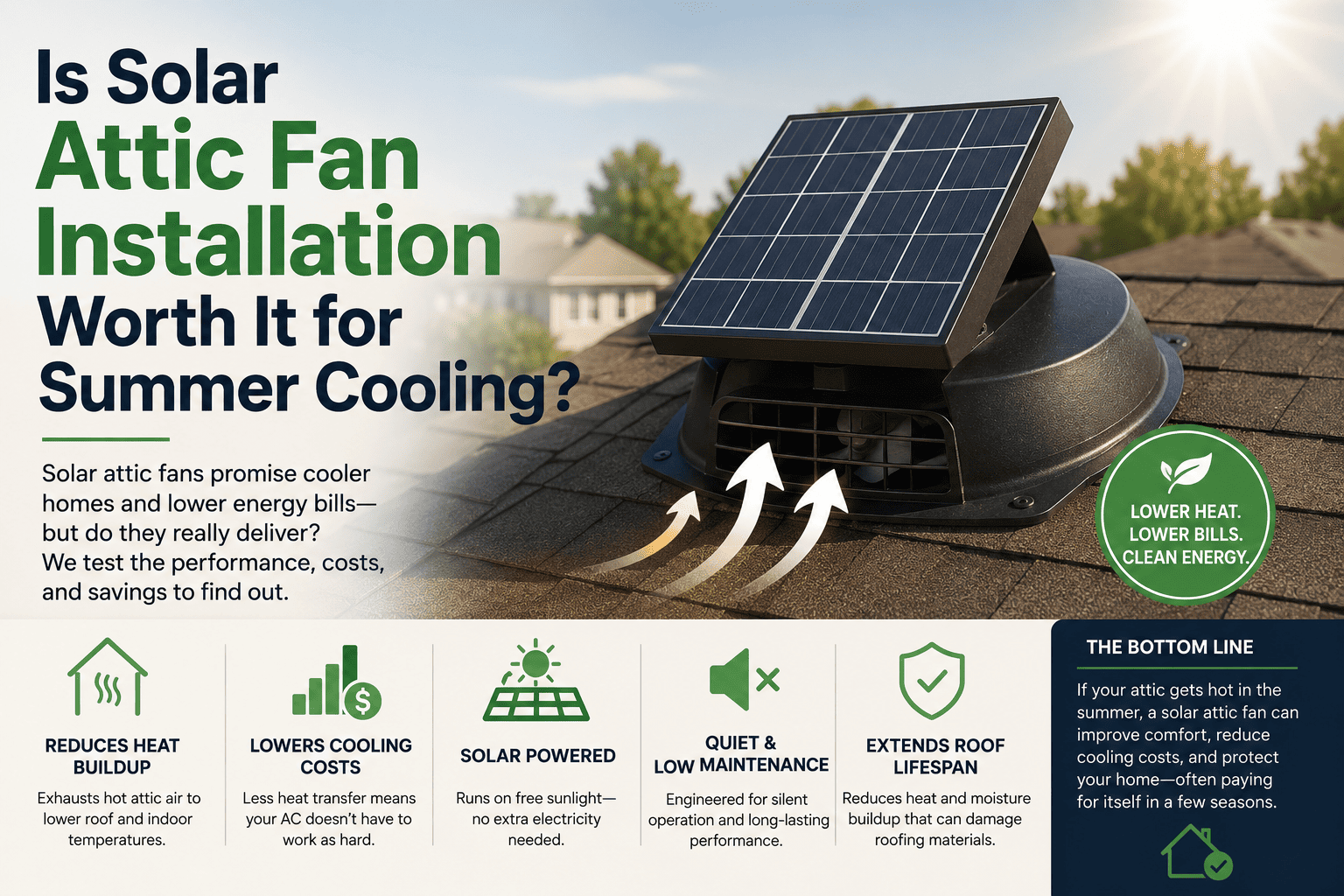
Solar attic fans can lower attic temperatures, but the cooling-bill payoff is often smaller than expected. Here is when they help, when they can backfire, and what to fix first.
Quick answer
A solar attic fan can be worth installing in a hot, sunny climate when the attic is vented, the ceiling plane is well air-sealed, there is enough soffit or other intake ventilation, and significant cooling loads or HVAC ducts are exposed to attic heat. It is usually not the first or best energy upgrade for a well-insulated home, because research shows that lowering attic air temperature does not always translate into large air-conditioning savings, and powered attic ventilation can pull conditioned air from the house if the attic floor leaks.
Table of contents
- What a Solar Attic Fan Actually Does
- Yes, It Can Lower Attic Temperature
- Why the savings are smaller than the temperature change
- The House Characteristics That Make a Solar Fan More Useful
- HVAC equipment in the attic changes the equation
- The Biggest Risk: Negative Pressure
- The bad summer scenario
- Air Sealing Comes Before the Fan
- Do not blindly seal everything yourself
- Insulation Usually Has a Stronger Energy Case
- The order matters
- Passive Ventilation Should Be Checked Too
- What About Roof Color and Radiant Barriers?
- When a Solar Attic Fan Is Most Likely Worth It
- You live in a hot, sunny climate
- The attic is conventionally vented
- The ceiling plane is already well air-sealed
- There is ample intake ventilation
- Significant HVAC infrastructure is in the attic
- The roof is dark and heavily exposed
- Your goal includes attic heat reduction, not only fast payback
- When It Is Probably Not Worth It
- Your attic is already well sealed and heavily insulated
- Your HVAC system is inside conditioned space
- Your passive ventilation already works well
- The attic floor is leaky
- You have combustion equipment in the attic
- You expect the fan to fix an uncomfortable second floor
- Solar vs. Grid-Powered Attic Fans
- A Better Way to Calculate Whether It Is Worth It
- Step 1: Determine installed cost
- Step 2: Estimate annual AC savings conservatively
- Step 3: Calculate simple payback
- The FSEC Study: Useful Evidence, Not a Universal Promise
- Safety and Installation Checklist
- A Better Upgrade Order for a Hot Attic
- 1. Air-seal the attic floor
- 2. Check and improve insulation
- 3. Seal and insulate attic ductwork
- 4. Restore passive ventilation
- 5. Address solar gain when practical
- 6. Evaluate solar attic ventilation
- Conclusion
Key takeaways
- Solar attic fans can lower attic temperature, but the reduction in whole-home cooling energy is usually much smaller than the attic-temperature change suggests.
- A solar fan eliminates the fan motor's grid-electricity use, but it does not eliminate the negative-pressure risk created by powered attic ventilation.
- Air sealing the ceiling and improving insulation should usually come before adding a powered attic fan.
- Solar attic ventilation has a stronger case in hot sunny climates with low roof reflectivity, weak attic insulation, or HVAC ducts and equipment located in the attic.
- Adequate intake ventilation and combustion-safety checks are essential before installation.
Editorial transparency
Who worked on this article and how it was handled.
- Written by
- Maya Chen
- Creation method
- Editorial research
AI assistance: AI assisted with research organization and drafting. Sources, factual claims, and the final article should be reviewed by a human editor before publication.
A roof can become brutally hot in summer, and the attic below it may feel like an oven. That makes a solar attic fan sound like an obvious energy upgrade: use free sunlight to exhaust hot attic air, lower the attic temperature, and make the air conditioner work less.
The physics are real, but the savings story is more complicated. A solar attic fan can move a lot of hot air without drawing electricity from the house, yet the temperature of the attic is only one part of the home’s cooling load. Insulation, air leakage, roof reflectivity, duct location, outdoor humidity, and attic pressure all affect whether a cooler attic actually produces a meaningful drop in the electric bill.
The practical question, then, is not whether a solar attic fan can cool an attic. It can. The question is whether your house is one of the houses where that attic cooling is worth paying for.
What a Solar Attic Fan Actually Does
A solar attic fan is a type of powered attic ventilator.
It is normally mounted high on the roof or in a gable wall. When sunlight reaches its photovoltaic panel, the motor drives an exhaust fan that pulls hot attic air outside. Replacement air is supposed to enter through passive intake vents—usually soffit or eave vents.
That is different from a whole-house fan.
A whole-house fan intentionally pulls outdoor air through open windows and through the living space before exhausting it into the attic. Its purpose is to cool the occupied house when outdoor conditions are favorable.
A solar attic fan, by contrast, is intended to ventilate the unconditioned attic without intentionally moving indoor air.
That difference is critical because a correctly operating attic fan should get its replacement air from the outside—not from the air-conditioned rooms below.
Yes, It Can Lower Attic Temperature
This part is not controversial.
The Florida Solar Energy Center studied photovoltaic attic ventilators in an occupied Central Florida home and found that the fans reduced measured peak attic air temperature by more than 20°F under the test conditions.
That sounds dramatic because it is dramatic at the attic sensor.
But the same field study is also a useful warning against translating attic temperature directly into energy savings.
The measured reduction in air-conditioning electricity was about 6% in that particular home.
That is still a real reduction. It is simply much smaller than the percentage change someone might imagine after hearing that the attic itself became more than 20°F cooler.
Why the savings are smaller than the temperature change
The ceiling separating the attic from the house should already have insulation.
A large part of the solar heat transfer inside an attic is also radiative—from the hot roof deck toward insulation and other attic surfaces—not simply hot attic air blowing heat downward.
If the ceiling insulation is already strong, lowering attic air temperature may only modestly change the amount of heat that reaches the rooms below.
That is why a solar fan can produce an impressive attic thermometer reading without creating an equally impressive utility-bill change.
The House Characteristics That Make a Solar Fan More Useful
DOE-funded Building America guidance says powered attic ventilation tends to have a larger cooling effect when one or more of these conditions exist:
- attic insulation is weak;
- the roof has low solar reflectivity;
- the roof receives heavy sun exposure;
- there is no radiant barrier;
- HVAC ducts or equipment are located in the attic.
Those factors all increase the amount of attic heat that can affect the cooling system.
HVAC equipment in the attic changes the equation
This is an especially important case.
In many hot-climate homes, supply ducts and sometimes the air handler sit in a vented attic. Hot surroundings can increase heat gain into supply ducts, while duct leakage can waste conditioned air directly into the attic.
Florida Solar Energy Center research has shown that attic thermal conditions can significantly affect attic-mounted distribution systems.
In a house like that, reducing attic heat can potentially help in more ways than simply reducing heat transfer through the ceiling.
But it also makes duct sealing and duct insulation particularly important. Cooling the attic while leaving leaky ducts untouched is not a sensible order of operations.
The Biggest Risk: Negative Pressure
A solar attic fan gets its power from sunlight, but it still behaves like an exhaust fan.
When it pushes air out of the attic, the attic pressure drops.
Ideally, outdoor replacement air flows through dedicated soffit, eave, or gable intakes.
But air takes the easiest available path.
If the attic floor has gaps around:
- recessed lights;
- plumbing penetrations;
- wiring;
- duct boots;
- top plates;
- attic hatches;
- dropped ceilings;
- bath-fan penetrations;
the fan can pull conditioned air from the house into the attic.
Building America guidance identifies this negative-pressure effect as the primary reason powered attic ventilation can increase energy use or create moisture problems.
The bad summer scenario
Imagine this sequence:
- the solar fan turns on during the hottest part of the day;
- soffit intake area is insufficient or partially blocked;
- the attic becomes negatively pressurized;
- cool indoor air leaks upward through the ceiling;
- the house becomes slightly depressurized;
- hot, humid outdoor air leaks into the occupied space elsewhere;
- the air conditioner must replace the lost cooling and remove the added moisture.
The attic may be cooler while the AC does more work.
This is why a solar power source does not automatically make powered attic ventilation energy-efficient.
It solves the fan’s electricity consumption. It does not solve the building-pressure problem.
Air Sealing Comes Before the Fan
If you are considering a solar attic fan, first inspect the air boundary between the house and attic.
ENERGY STAR describes attic air sealing as one of the major opportunities for improving comfort and reducing energy waste.
Common leakage points include:
- plumbing and electrical penetrations;
- open wall cavities;
- attic hatches;
- dropped soffits;
- kneewalls;
- recessed fixtures;
- duct and register penetrations.
A good attic air-sealing job keeps conditioned air in the house whether you install a fan or not.
It also makes a future attic fan safer and more predictable because the fan is less likely to use the living space as its makeup-air source.
Do not blindly seal everything yourself
Attics can contain hazards.
ENERGY STAR specifically flags conditions such as:
- vermiculite insulation that may contain asbestos;
- knob-and-tube wiring;
- wet or moldy insulation;
- damaged framing;
- exhaust fans terminating inside the attic;
- combustion and flue penetrations requiring fire-safe sealing methods.
If you are unsure what you are looking at, an attic or home-energy professional is the better choice.
Insulation Usually Has a Stronger Energy Case
If the insulation on the attic floor is shallow, uneven, compressed, or missing near the eaves, improving it is usually a higher-priority project than powered ventilation.
ENERGY STAR says a well-sealed and properly insulated attic is one of the most important upgrades for reducing energy waste and improving comfort.
Its broader modeling estimates that homeowners can save an average of about 15% on heating and cooling costs through cost-effective air sealing and added insulation in attics, floors over crawl spaces, and accessible basement rim joists.
That figure should not be interpreted as an attic-only guarantee.
It does, however, illustrate why insulation and air sealing are core building-envelope upgrades while an attic fan is a more situational add-on.
The order matters
ENERGY STAR recommends:
- air seal first;
- then add insulation.
If a solar attic fan is still justified after those two steps, it is operating on a much better foundation.
Passive Ventilation Should Be Checked Too
A vented attic does not require a fan to exchange air.
Properly located soffit and ridge vents use wind and stack effect to create passive airflow. They have no motor, no controls, and much weaker pressure forces than powered exhaust.
Building America notes that passive ventilation is generally preferred because the incremental cooling benefit of powered attic ventilation is often not large enough to outweigh the additional risks.
Before adding a solar fan, check whether the existing passive system is actually functioning.
Common problems include:
- soffit vents blocked by insulation;
- too little intake area;
- disconnected or poorly placed vents;
- roof geometry that creates dead zones;
- exhaust area added without adequate low intake area.
A fan cannot compensate elegantly for a poorly designed intake path.
What About Roof Color and Radiant Barriers?
The roof itself determines how much solar heat enters the attic.
Florida Solar Energy Center side-by-side home research found large differences in attic temperature and AC energy use among roofing systems with different solar reflectance.
That does not mean replacing a functional roof simply to cool the attic is automatically economical.
It means that if roof replacement is already planned, cool-roof characteristics deserve consideration because they reduce the heat before it enters the roof assembly.
A radiant barrier installed in an appropriate attic can also reduce radiant heat transfer from the roof deck toward the attic floor.
These strategies attack a different part of the problem than an exhaust fan.
- A solar fan removes heated attic air.
- A radiant barrier limits radiant heat transfer.
- A reflective roof reduces solar absorption.
- Insulation limits heat transfer into the house.
- Air sealing limits uncontrolled air exchange.
The best solution depends on where the dominant heat gain is occurring.
When a Solar Attic Fan Is Most Likely Worth It
A solar attic fan has its strongest case when most of the following are true.
You live in a hot, sunny climate
The fan output naturally tracks solar availability, which means it tends to operate when solar roof gain is high.
The attic is conventionally vented
This advice is for a traditional unconditioned vented attic.
A sealed or conditioned attic is a different building assembly and should not simply have an exhaust fan added to it.
The ceiling plane is already well air-sealed
This reduces the chance of pulling conditioned air out of the house.
There is ample intake ventilation
The fan needs a low-resistance outside-air source.
Soffit and eave vents should be open, distributed, and correctly sized for the system.
Significant HVAC infrastructure is in the attic
A cooler attic can reduce the thermal penalty around ductwork and equipment, although sealing and insulating that equipment should still be a priority.
The roof is dark and heavily exposed
A roof with low solar reflectance and little shade can produce very high attic temperatures.
Your goal includes attic heat reduction, not only fast payback
A solar fan can be valuable for a specific attic-temperature or equipment-exposure problem even when the pure utility-bill payback is not spectacular.
When It Is Probably Not Worth It
The case is weaker when:
Your attic is already well sealed and heavily insulated
The better the thermal boundary between attic and house, the less attic air temperature affects indoor cooling demand.
Your HVAC system is inside conditioned space
If the ducts and air handler are not exposed to attic heat, one major potential benefit disappears.
Your passive ventilation already works well
Adding mechanical exhaust may produce only a modest incremental improvement.
The attic floor is leaky
Fix that first. Otherwise the fan may pull expensive conditioned air into the attic.
You have combustion equipment in the attic
Building America specifically warns that negative pressure can interfere with draft and can potentially backdraft non-sealed-combustion equipment.
This requires professional evaluation.
You expect the fan to fix an uncomfortable second floor
A hot upper floor may be caused by:
- insufficient insulation;
- air leakage;
- poor duct airflow;
- duct leakage;
- solar gain through windows;
- undersized HVAC;
- thermostat location.
A cooler attic may help, but it is not a universal cure.
Solar vs. Grid-Powered Attic Fans
If a powered attic fan is appropriate, solar does solve one real disadvantage of conventional units: fan electricity use.
Older research found situations where the electricity used by a conventional powered ventilator could exceed the cooling-energy savings it created.
A photovoltaic fan avoids that specific problem because it runs on its own solar panel.
Building America also notes two practical characteristics of solar units:
- they naturally operate when the sun is shining;
- they often have lower airflow ratings, which can reduce negative pressure compared with aggressive high-CFM units.
But again, solar does not eliminate the need for:
- air sealing;
- intake ventilation;
- moisture awareness;
- combustion safety;
- proper roof flashing.
A Better Way to Calculate Whether It Is Worth It
Do not estimate payback from attic temperature alone.
Use actual cooling-energy savings.
Step 1: Determine installed cost
Include:
- fan;
- roof or gable installation;
- flashing and waterproofing;
- any intake-vent improvements;
- any required air-sealing work.
Step 2: Estimate annual AC savings conservatively
Use your actual cooling electricity consumption if available.
Then model several scenarios rather than one optimistic assumption.
For example, if annual cooling electricity costs $900:
| Assumed cooling reduction | Annual savings |
|---|---|
| 2% | $18 |
| 4% | $36 |
| 6% | $54 |
| 10% | $90 |
The 6% row is useful because it matches the reduction measured in the FSEC case study—but it should not be treated as a typical-home forecast.
Step 3: Calculate simple payback
If the installed project cost were $700 and annual savings were $54:
$700 ÷ $54 ≈ 13 years
If the same project saved $90 annually:
$700 ÷ $90 ≈ 7.8 years
Those numbers demonstrate why the answer changes dramatically by house.
The product may still be worthwhile for attic-temperature reduction or comfort, but the pure energy payback can be long.
The FSEC Study: Useful Evidence, Not a Universal Promise
The Florida Solar Energy Center field test is often cited because it measured a real house rather than relying only on theory.
Its key result is nuanced:
- peak attic temperatures dropped by more than 20°F;
- measured cooling electricity fell about 6%;
- the researchers described the cooling-season impact as fairly modest for a well-insulated attic.
The house also had characteristics that make it inappropriate to copy the percentage directly to another home.
For example, its air conditioner was operated with a relatively low thermostat setpoint, producing higher-than-average cooling consumption. The house also had an attic radiant barrier.
The correct takeaway is:
A photovoltaic attic fan can measurably reduce attic heat and may reduce AC use, but the cooling-energy benefit is house-specific and can be much smaller than the attic-temperature change suggests.
Safety and Installation Checklist
A roof-mounted solar attic fan is not just a plug-and-play appliance.
Before installation, verify:
- the attic is vented rather than sealed/conditioned;
- the ceiling plane has been air-sealed;
- soffit or other intake vents provide adequate makeup air;
- insulation is not blocking the intake path;
- bath and kitchen exhaust ducts terminate outdoors, not in the attic;
- HVAC ducts in the attic are sealed and insulated;
- there is no combustion equipment that could be affected by depressurization;
- roof flashing will be integrated correctly to prevent leaks;
- local wildfire requirements are considered where relevant;
- roof work can be performed safely and in accordance with local code and manufacturer instructions.
Building America also recommends lower airflow where powered ventilation is used because excessive airflow increases negative pressure.
Roof work carries fall and water-intrusion risk. If the installation involves cutting roofing, flashing penetrations, or evaluating combustion appliances, a qualified professional is often the safer route.
A Better Upgrade Order for a Hot Attic
For most homeowners trying to reduce summer cooling costs, this is the more rational sequence:
1. Air-seal the attic floor
Stop conditioned air from leaking into the attic.
2. Check and improve insulation
Make sure coverage is adequate and even.
3. Seal and insulate attic ductwork
Especially if the HVAC system is located above the ceiling.
4. Restore passive ventilation
Clear blocked soffit vents and correct obvious intake/exhaust problems.
5. Address solar gain when practical
Consider a radiant barrier where appropriate and cool-roof options when the roof eventually needs replacement.
6. Evaluate solar attic ventilation
Only now ask whether additional powered airflow solves a remaining problem.
This order prevents you from installing a fan to compensate for a problem that should have been fixed somewhere else.
Conclusion
A solar attic fan is not automatically a bad investment, but it is rarely the first summer-cooling upgrade a homeowner should make.
It can noticeably lower attic temperature, and research shows that it can reduce air-conditioning use in the right house. Its strongest case is a hot, sunny home with a vented attic, strong solar roof gain, properly sealed ceiling, adequate intake ventilation, and heat-sensitive HVAC equipment or ducts in the attic.
But if your attic is leaky, under-insulated, or poorly vented, fix those fundamentals first. A powered fan installed on top of an air-leakage problem can pull conditioned air out of the house and erase the savings you were trying to create.
So the practical decision is simple: air seal, insulate, verify passive airflow, then evaluate the fan. If the attic is still creating a meaningful cooling penalty after those steps, a properly sized solar attic fan becomes a much more defensible upgrade.
Common questions
Questions this guide answers
Do solar attic fans actually lower attic temperature?
Yes. A Florida Solar Energy Center field study found that photovoltaic attic ventilators reduced peak attic air temperature by more than 20°F in the test home. However, attic temperature reduction and whole-home cooling savings are not the same thing.
How much can a solar attic fan save on air conditioning?
There is no reliable universal percentage. In one Central Florida case study, cooling electricity use fell by about 6%, but DOE-funded Building America guidance says the incremental cooling benefit of powered attic ventilation is usually small to moderate and depends strongly on insulation, roof reflectivity, attic ductwork, climate, and air leakage.
Can a solar attic fan make cooling costs worse?
It can. Any powered attic fan creates negative pressure in the attic. If the ceiling below is leaky or intake vent area is inadequate, the fan can pull conditioned air out of the living space and draw hot, humid outdoor air into the building, increasing AC demand.
What should I do before installing a solar attic fan?
Check attic air sealing, insulation depth, duct leakage, soffit and other intake ventilation, and whether combustion equipment is located in the attic. ENERGY STAR and Building America guidance generally prioritize air sealing, insulation, duct improvements, and adequate passive ventilation before powered attic ventilation.
Evidence & further reading
Sources & references
Primary and authoritative references used to support or contextualize this article. Links open the original source.
- 1Attic Ventilation Fans
Building America Solution Center · Accessed Aug 10, 2026
Supports how powered and solar attic ventilators work, their negative-pressure risks, recommended alternatives, and installation precautions.
- 2Performance Assessment of Photovoltaic Attic Ventilator Fans
Florida Solar Energy Center · Accessed Aug 10, 2026
Supports the measured Central Florida case study showing a large attic-temperature reduction but a more modest reduction in space-cooling electricity.
- 3Well-Insulated and Sealed Attic
ENERGY STAR · Accessed Aug 10, 2026
Supports prioritizing attic air sealing and adequate insulation to reduce cooling and heating waste.
- 4Attic Air Sealing Project
ENERGY STAR · Accessed Aug 10, 2026
Supports attic air sealing as a major energy-saving opportunity and provides safety considerations for attic work.
- 5Rule Your Attic! For Comfort and Savings
ENERGY STAR · Accessed Aug 10, 2026
Supports EPA's modeled savings context for combined air sealing and insulation and the importance of a well-sealed, insulated attic.
- 6Comparative Evaluation of the Impact of Roofing Systems on Residential Cooling Energy Demand in Florida
Florida Solar Energy Center · Accessed Aug 10, 2026
Supports the role of roof solar gain, reflective roofing, attic duct heat gain, and other roof/attic strategies in hot-climate cooling performance.

About the author
Maya Chen
Maya covers residential energy, HVAC controls, and practical home automation, translating technical systems into useful decisions for homeowners and renters.
More from Maya →Make your home smarter without buying every gadget.
One useful idea, one product worth knowing, and one energy-saving action—delivered weekly.
No spam. Unsubscribe anytime.
Semantic recommendations
Related reading
Selected from topic cluster, entities, tags, search intent, and editorial relationships.

Window AC Energy Hacks: Saving Money in Peak August Temperatures
Lower your August cooling bill with practical window AC fixes, smarter settings, and airflow tricks that reduce waste without sacrificing comfort.

How to Stop Drafts Under Exterior Doors Without Replacing the Frame
Cold air under an exterior door usually comes from a worn sweep, misadjusted threshold, tired weatherstripping, or unsealed trim. Here is how to fix it without replacing the frame.
How to Optimize Your Smart AC for Late-Summer Heatwaves
Use smarter cooling schedules, sensible setpoints, humidity control, room sensors, and maintenance checks to stay comfortable during late-summer heatwaves without wasting energy.

5 Smart Thermostat Placement Mistakes That Can Waste Hundreds on HVAC Bills
Wrong thermostat placement can distort temperature readings, increase HVAC runtime, and quietly undermine both comfort and energy savings.