
Portable Smart Air Conditioners vs Window Units: Noise & Power Test
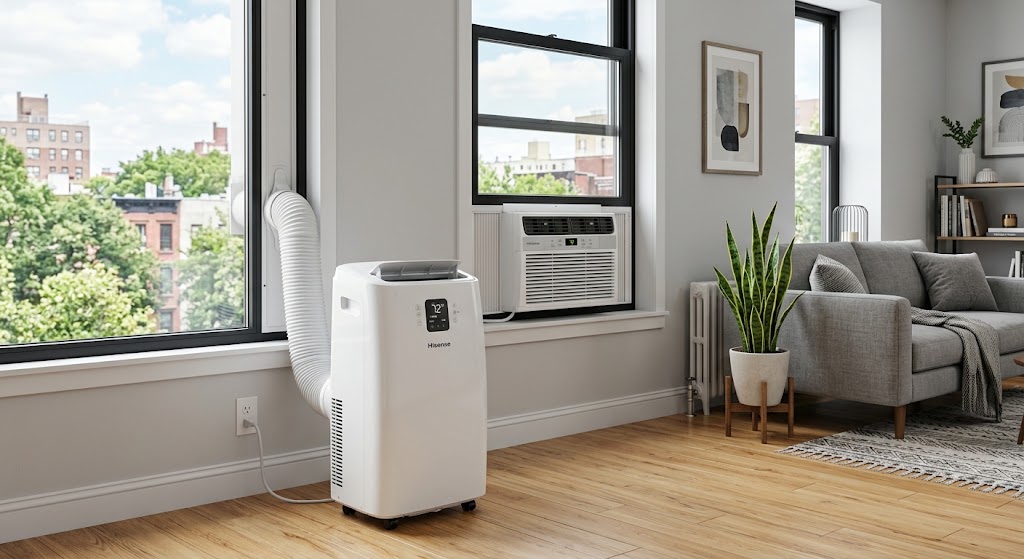
Window ACs usually win on cooling efficiency, while portable smart ACs win on installation flexibility; noise depends heavily on compressor and airflow design.
Quick answer
For most rooms where installation is allowed, a well-sized window air conditioner is usually the more energy-efficient choice because it rejects heat outdoors without keeping the compressor and hot exhaust duct inside the room. Portable smart ACs are easier to install and move, and modern dual-hose inverter models can be impressively quiet, but their DOE rating method accounts for duct and infiltration losses that make direct headline-BTU comparisons with window units misleading.
Table of contents
- The short answer: window AC wins efficiency, portable wins flexibility
- Why portable and window BTU ratings are not apples to apples
- Window and room AC capacity
- Portable AC capacity
- Use SACC when comparing portable ACs
- Why a single-hose portable AC can lose efficiency
- Why dual-hose and hose-in-hose portable ACs are better
- Noise test: why portable ACs often sound louder indoors
- Current minimum ratings can overlap
- Minimum dBA is not the whole noise story
- How to run a fair noise comparison at home
- Use the same room
- Use the same measurement position
- Record operating state
- Measure the background first
- Power test: measure energy, not just one watt reading
- A safe power-test hierarchy
- 1. Use built-in energy monitoring when available
- 2. Use circuit-level monitoring
- 3. Use a plug-in power meter only when explicitly suitable
- Representative rated power: what one window unit tells us
- Representative efficiency: modern window inverters can be much stronger
- Do not compare portable CEER directly with window CEER without context
- A better real-world power test
- Test conditions
- Record
- Compare cooling delivered, not only electricity consumed
- Why inverter compressors change both noise and power
- Lower steady-state power
- Lower steady-state noise
- Smart features: useful, but not thermodynamic magic
- Scheduling
- Remote control
- Energy monitoring
- Geofencing
- Installation quality can erase the advantage of either design
- Portable AC advantages that power charts miss
- They preserve more window use
- They work with some windows that cannot carry a conventional window AC
- They are easier to move
- Installation may be more acceptable to landlords
- Window AC advantages that app features cannot replace
- Better thermodynamic layout
- No long hot exhaust hose inside
- Less mechanical hardware beside the occupant
- Stronger efficiency certification options
- More usable floor space
- Which is better for renters?
- Choose a window unit when:
- Choose a portable AC when:
- Noise vs power: which matters more?
- What the spec sheet should show before you buy
- Common comparison mistakes
- Comparing portable ASHRAE BTU with window BTU
- Comparing only minimum dBA
- Measuring watts for five minutes
- Using a generic smart plug as an AC power meter
- Oversizing because “bigger cools faster”
- Ignoring the window seal
- Treating smart features as efficiency ratings
- The 2026 buying recommendation
- Conclusion
Key takeaways
- Window air conditioners usually offer better cooling efficiency when the window and lease allow proper installation.
- Do not compare a portable AC's larger marketing BTU figure directly with a window unit; use the DOE portable rating such as SACC and the correct category-specific efficiency metric.
- Noise ratings can overlap in the low-40-dBA range on modern inverter models, but a portable unit keeps the compressor and exhaust system inside the room.
- If a window unit is not practical, a dual-hose or hose-in-hose inverter portable AC is generally a stronger efficiency choice than a conventional single-hose portable design.
Editorial transparency
Who worked on this article and how it was handled.
- Written by
- Daniel Reed
- Creation method
- Editorial research
AI assistance: AI assisted with research organization and drafting. Sources, factual claims, and the final article should be reviewed by a human editor before publication.
A portable smart air conditioner and a window AC can both cool one room, connect to an app, and advertise quiet operation. That makes them look interchangeable on a shopping page even though their refrigeration layout—and therefore their real-world efficiency and sound profile—is very different.
The most misleading comparison is usually the biggest number on the box. Portable AC capacity has its own DOE test method because the exhaust hose, room-pressure effects, duct heat, and cycling behavior change how much useful cooling reaches the room. Window units use a different federal room-air-conditioner test procedure, so a shopper should not compare two headline BTU values as if they were measured the same way.
This article does not claim hands-on laboratory testing. Instead, it builds a repeatable noise and power test framework from current DOE rules, ENERGY STAR criteria, and representative manufacturer specifications so you can compare the two formats without inventing a fake benchmark result.
The short answer: window AC wins efficiency, portable wins flexibility
If your window, building rules, and installation conditions allow it, a modern window air conditioner is usually the better efficiency choice.
Why?
A window unit puts the hot side of the refrigeration system at or outside the building envelope. The condenser can reject heat outdoors directly, without routing that heat through a long flexible exhaust duct sitting inside the room.
A portable AC keeps most of the appliance indoors. It must move condenser heat outside through one or more ducts, and the airflow design can affect room pressure and infiltration.
That does not make every portable AC bad.
Modern inverter portable units—especially dual-hose or hose-in-hose models—are significantly more sophisticated than the basic single-hose boxes many people associate with the category. They can also be the only realistic option when:
- the lease prohibits a window unit;
- the window shape is incompatible;
- the AC must move between rooms;
- exterior appearance rules restrict window hardware;
- you need temporary seasonal cooling rather than a semi-permanent installation.
The trade-off is therefore not simply “good AC vs bad AC.”
It is installation flexibility vs cooling-system efficiency.
Why portable and window BTU ratings are not apples to apples
Before comparing power, understand the ratings.
Window and room AC capacity
Window air conditioners fall under DOE’s consumer room-air-conditioner rules and test procedure.
ENERGY STAR then uses Combined Energy Efficiency Ratio, or CEER, as a central efficiency metric for qualifying room ACs.
Higher CEER means more cooling for the energy consumed under the applicable test procedure.
Portable AC capacity
Portable air conditioners have a separate DOE test procedure.
The current procedure accounts for effects that are unusually important to a portable design, including:
- heat transfer through the exhaust duct;
- infiltration;
- cycling losses;
- single-duct vs dual-duct configuration.
The resulting adjusted capacity is more useful than comparing a portable unit’s older or larger marketing capacity directly with a window unit’s rated room-AC capacity.
Use SACC when comparing portable ACs
Portable units commonly list SACC, or Seasonally Adjusted Cooling Capacity.
That number is intended to represent useful portable-AC cooling more realistically than the older headline capacity that did not fully account for portable-specific losses.
So if a listing shows something like:
- 12,000 Btu/h traditional/ASHRAE-style capacity;
- 10,000 Btu/h SACC;
the lower SACC number is the one that belongs in a serious portable-AC comparison.
Do not assume the product “lost” capacity. The numbers are based on different methods.
Why a single-hose portable AC can lose efficiency
A conventional single-hose portable AC uses indoor air to cool the condenser and then exhausts that heated air outside.
Removing air from the room creates a mass-balance problem: replacement air has to come from somewhere.
That replacement air can enter through:
- door gaps;
- window leakage;
- wall penetrations;
- adjacent rooms;
- other parts of the building envelope.
If the replacement air is hot and humid, the AC has created extra cooling work.
DOE’s portable-AC test procedure explicitly includes infiltration terms and treats single-duct and dual-duct designs differently.
That is important because the efficiency disadvantage is not just a theoretical complaint from reviewers—it is important enough to be represented in the federal test methodology.
Why dual-hose and hose-in-hose portable ACs are better
A dual-hose portable design uses a separate outdoor-air path for the condenser side.
Conceptually:
Single hose:

Room air -> condenser -> hot exhaust outside
     ^
     |
replacement outdoor air leaks into room


Dual hose:

Outdoor air -> condenser -> hot exhaust outside

Room air -> evaporator -> cooled air back to room
The actual airflow of a specific model can be more complex, but the design goal is to reduce the pressure imbalance of the single-hose architecture.
Midea’s current DUO portable inverter line uses a hose-in-hose configuration that performs the intake and exhaust functions in one combined assembly.
If you need a portable AC and power consumption matters, dual-hose or hose-in-hose inverter should be high on the shortlist.
Noise test: why portable ACs often sound louder indoors
The sound difference begins with component placement.
A portable unit keeps:
- compressor;
- condenser fan;
- evaporator fan;
- much of the refrigerant system;
- high-velocity exhaust airflow;
inside the room.
A conventional window unit moves a significant portion of the mechanical system to the window opening and outside the indoor space.
That gives window AC designers an architectural noise advantage.
However, modern inverter technology complicates the old rule that “portable is always loud.”
Current minimum ratings can overlap
Representative current manufacturer claims show how close minimum sound specifications can be:
| Example product | Form factor | Manufacturer minimum noise claim |
|---|---|---|
| Midea DUO inverter portable | Portable, hose-in-hose | 42 dBA |
| LG LW8022IVSM Dual Inverter | Window | 44 dB |
| GE Profile ClearView AHTT06BC | Window | 41 dBA in Quiet Mode |
These figures are manufacturer specifications, not a SmartAbodeLab lab test.
They also should not be treated as directly interchangeable because:
- test conditions can differ;
- one number may represent sleep/quiet mode;
- compressor speed may be very low at the stated condition;
- fan speed may differ;
- distance and measurement environment matter.
The useful conclusion is not that portable and window ACs are equally quiet.
It is that premium inverter portable units can now reach the same low-40-dBA marketing range as quiet window products at their lowest operating condition.
Minimum dBA is not the whole noise story
Two units can both measure 44 dBA and still sound very different.
Human perception is affected by:
- low-frequency compressor hum;
- fan pitch;
- airflow turbulence;
- vibration through the floor or window frame;
- compressor ramping;
- rattles;
- cycling on and off.
A portable AC may produce more mechanical sound in the occupied space because the compressor sits a few feet from the listener.
A window AC can transfer vibration into:
- glass;
- sash;
- frame;
- mounting bracket.
Installation quality therefore matters almost as much as the rated dBA number.
How to run a fair noise comparison at home
If you want your own practical noise test, keep the conditions controlled.
Use the same room
Room acoustics can change a measurement dramatically.
Do not compare:
- a portable AC in a carpeted bedroom;
- a window AC in a reflective kitchen.
Use the same measurement position
A reasonable personal comparison is to place a sound meter at:
- seated or sleeping-ear height;
- a fixed distance from the AC;
- the same location for every test.
A calibrated sound-level meter is preferable.
A phone app can still be useful for relative A/B comparisons, but do not present its number as a laboratory-grade measurement unless the phone and app have been calibrated.
Record operating state
Log whether the unit is:
- fan-only;
- compressor at low inverter speed;
- compressor at high output;
- quiet/sleep mode;
- maximum fan.
Otherwise a “42 dB vs 50 dB” result may simply compare two completely different cooling loads.
Measure the background first
If the empty room already measures close to your AC’s low-noise rating, the result becomes difficult to interpret.
Measure ambient noise before turning the AC on.
Power test: measure energy, not just one watt reading
Air conditioners cycle and modulate.
That means a single instantaneous watt reading tells only part of the story.
A non-inverter AC may behave roughly like:
Compressor ON  -> high, relatively fixed draw
Compressor OFF -> much lower fan/standby draw
An inverter AC can look more like:
Warm room -> compressor ramps high
Approaching setpoint -> compressor slows
Steady state -> lower variable draw
So the meaningful metric is usually:
kilowatt-hours consumed over a controlled period while maintaining the same room condition.
A safe power-test hierarchy
Air conditioners are high-current compressor appliances. Do not place one on an ordinary smart plug just because that plug says “15 A.”
Some plugs are intended primarily for resistive household loads and may have different motor, compressor, or inrush-current limitations.
A safer hierarchy is:
1. Use built-in energy monitoring when available
LG’s current ThinQ-enabled LW8022IVSM advertises energy-use monitoring from the app.
Built-in monitoring avoids adding an unknown inline device to the AC power path.
It is useful for:
- daily kWh;
- runtime patterns;
- changes after adjusting the setpoint;
- comparing weekday and weekend cooling.
2. Use circuit-level monitoring
A properly installed electrical energy monitor can track the circuit serving the AC without placing a consumer smart relay between the AC and wall receptacle.
Any panel-level current-transformer installation should follow the manufacturer’s instructions and local electrical requirements, and work inside an electrical panel should be handled by a qualified person when appropriate.
3. Use a plug-in power meter only when explicitly suitable
If you use an inline meter, verify that:
- its voltage and continuous-current rating exceed the AC requirement;
- it is explicitly appropriate for motor/compressor loads and startup current;
- the air-conditioner manufacturer does not prohibit the connection method;
- the meter and receptacle are undamaged;
- no extension cord, improvised adapter, or power strip is introduced.
If you cannot verify those conditions, use another measurement method.
Representative rated power: what one window unit tells us
GE lists its 6,100-Btu Profile ClearView AHTT06BC window AC at:
- 510 cooling watts;
- 4.6 rated cooling amps;
- 115 V;
- 11.5 CEER;
- 41 dBA in Quiet Mode.
Those are official rated specifications for one particular model—not a universal number for window ACs.
They are useful because they show how a product sheet can connect cooling capacity, electrical input, and noise in one place.
When shopping, look for the same fields rather than relying on “cools up to X square feet” alone.
Representative efficiency: modern window inverters can be much stronger
ENERGY STAR’s current certified room-AC database includes inverter window models with CEER values well above minimum federal requirements.
For example, ENERGY STAR lists LG’s LW8022IVSM 8,000-Btu window unit at a CEER around the mid-15 range, while LG markets the product as a Dual Inverter smart AC with energy monitoring and operation as low as 44 dB.
Again, do not translate that into a claim that every inverter window unit beats every portable unit by a fixed percentage.
The correct conclusion is:
Efficient inverter window ACs currently have a strong certification pathway and high CEER options that are difficult for portable designs to match on equivalent room cooling.
Do not compare portable CEER directly with window CEER without context
Both product categories can expose efficiency numbers that look similar.
The problem is that DOE defines and tests portable air conditioners separately from consumer room air conditioners.
The portable test accounts for portable-specific losses such as:
- exhaust-duct heat;
- infiltration;
- seasonal operating adjustments.
Window ACs use the room-air-conditioner test method.
So use efficiency ratings primarily to rank products within the same category.
A cross-category buying decision should consider:
- useful rated cooling capacity;
- expected runtime;
- installation losses;
- room size;
- noise;
- annual or measured energy consumption.
A better real-world power test
If you have access to two candidate units, a meaningful comparison would control as many variables as possible.
Test conditions
Use:
- same room;
- same outdoor weather window when practical;
- same starting indoor temperature;
- same thermostat target;
- same door/window state;
- same blinds and solar exposure;
- same test duration.
Record
For each unit, log:
- starting room temperature;
- temperature after 30, 60, and 120 minutes;
- total kWh;
- average room temperature after reaching setpoint;
- maximum observed noise;
- steady-state noise near setpoint;
- humidity if available.
Compare cooling delivered, not only electricity consumed
A unit that consumes 0.8 kWh but barely cools the room is not “more efficient” than a unit that uses 1.0 kWh and reaches the target quickly.
A basic consumer comparison should ask:
How much electricity did each unit use to produce a similar comfort outcome?
Without equal comfort conditions, the power result is incomplete.
Why inverter compressors change both noise and power
Traditional fixed-speed room ACs often cycle the compressor fully on and off.
Inverter ACs vary compressor speed.
That can improve the experience in two ways.
Lower steady-state power
After the room approaches the target temperature, the compressor can reduce output rather than shutting off and later restarting at full capacity.
Lower steady-state noise
Lower compressor speed and fan speed can reduce sound when cooling demand is modest.
This is why the lowest advertised dBA figure often occurs after the room is already near setpoint—not when the AC is first attacking a 90°F room.
For bedrooms, offices, and studios, the steady-state acoustic behavior can matter more than the first 20 minutes of cooldown.
Smart features: useful, but not thermodynamic magic
A “smart AC” usually adds some combination of:
- Wi-Fi;
- mobile app;
- remote temperature adjustment;
- schedule;
- energy-use monitoring;
- voice assistants;
- geofencing or location routines;
- filter reminders.
These features do not change the basic refrigeration efficiency unless they are paired with better hardware such as an inverter compressor.
But they can reduce total energy consumption.
Scheduling
The AC does not need to maintain an occupied setpoint all afternoon if nobody is home.
Remote control
You can verify that the AC is off rather than leaving it running accidentally.
Energy monitoring
Runtime and kWh history can show whether a lower thermostat setting is materially increasing consumption.
Geofencing
Some connected AC platforms can change behavior based on whether residents are away or returning.
The savings come from less unnecessary runtime, not from Wi-Fi itself.
Installation quality can erase the advantage of either design
A poorly installed window AC can leak hot outdoor air around the side panels.
A badly installed portable exhaust kit can do the same thing around:
- sliding-window adapters;
- hose connections;
- gaps around the sash;
- poorly seated panels.
ENERGY STAR notes that improper room-AC installation can create significant air leakage.
So whichever form factor you choose:
- follow the installation instructions;
- seal only where the manufacturer specifies;
- keep the unit level when required;
- avoid crushing or unnecessarily lengthening portable exhaust ducts;
- keep outdoor airflow unobstructed.
A high-efficiency compressor cannot compensate for a large open gap around the window.
Portable AC advantages that power charts miss
Window AC efficiency is compelling, but portable units still solve real problems.
They preserve more window use
A portable kit can sometimes occupy less of the window opening and may be easier to remove seasonally.
They work with some windows that cannot carry a conventional window AC
Sliding windows and certain rental configurations can make a portable unit easier to adapt.
They are easier to move
Casters make relocation possible, though “portable” should not be confused with lightweight—many inverter units weigh well over 60 pounds.
Installation may be more acceptable to landlords
A portable kit often places less structural load on the window opening.
That does not guarantee lease approval, but it can be easier to negotiate than a heavy unit projecting outside the building.
Window AC advantages that app features cannot replace
Better thermodynamic layout
The condenser is effectively outdoors rather than inside the occupied room.
No long hot exhaust hose inside
A portable exhaust hose can radiate some heat back into the room.
Less mechanical hardware beside the occupant
Much of the compressor/condenser assembly is farther from the listener.
Stronger efficiency certification options
ENERGY STAR maintains a large current database of efficient room/window air conditioners.
More usable floor space
A window unit does not consume several square feet of floor area plus clearance for a hose.
For a 300-square-foot studio apartment, that space can matter.
Which is better for renters?
The answer depends on the lease and the window.
Choose a window unit when:
- the lease explicitly allows it;
- the window fits the model;
- exterior support and safety requirements can be met;
- you expect to cool the same room all season;
- power efficiency is the priority.
Choose a portable AC when:
- window units are prohibited;
- the window cannot safely support one;
- you need to move the AC between rooms;
- temporary installation matters;
- exterior appearance rules are strict.
If choosing portable, prioritize:
- DOE/SACC capacity appropriate to the room;
- dual-hose or hose-in-hose architecture;
- inverter compressor;
- credible noise specifications;
- smart scheduling or energy monitoring if useful.
Noise vs power: which matters more?
For a bedroom, a slightly less efficient unit that allows you to sleep may be the better purchase.
For a home office running eight hours every hot weekday, power consumption may dominate the decision.
For an apartment where the AC sits three feet from the bed, compressor location matters more than it would in a large living room.
Use this decision matrix:
| Priority | Better starting point |
|---|---|
| Lowest likely electricity use | Efficient inverter window AC |
| Lowest indoor mechanical noise | Quiet window/U-shaped or saddle-style design |
| No permanent/heavy window installation | Portable AC |
| Rental flexibility | Portable AC |
| Maximum floor-space efficiency | Window AC |
| Smart scheduling | Available in both categories |
| Built-in energy monitoring | Model-specific in both categories |
| Best portable efficiency architecture | Dual-hose/hose-in-hose inverter |
What the spec sheet should show before you buy
Do not buy from a product title alone.
For a portable AC, look for:
- SACC / DOE cooling capacity;
- hose configuration;
- CEER or applicable efficiency information;
- rated current;
- voltage;
- minimum and maximum noise where disclosed;
- inverter vs fixed-speed compressor;
- room-size recommendation;
- drainage requirements;
- window-kit dimensions.
For a window AC, look for:
- rated cooling capacity;
- CEER;
- ENERGY STAR certification where applicable;
- annual energy use;
- rated watts/current;
- sound level;
- inverter compressor;
- window opening dimensions;
- installation requirements.
If one product page shows only an enormous BTU claim and vague “ultra quiet” language, while another gives certified capacity, CEER, current, and sound data, the second listing is easier to evaluate responsibly.
Common comparison mistakes
Comparing portable ASHRAE BTU with window BTU
Use portable SACC/DOE capacity instead.
Comparing only minimum dBA
Check whether it is sleep mode, fan-only, or low-load operation.
Measuring watts for five minutes
Cooling systems cycle. Measure kWh over a meaningful operating period.
Using a generic smart plug as an AC power meter
Compressor loads can have requirements different from lamps and electronics. Verify motor/compressor suitability or use another monitoring method.
Oversizing because “bigger cools faster”
Oversizing can produce short cycling, noise, poor humidity control, and unnecessary cost. Size the unit for the space and conditions.
Ignoring the window seal
Both portable and window ACs depend on a good envelope seal.
Treating smart features as efficiency ratings
Wi-Fi is a control feature. CEER, SACC, compressor design, and total kWh are performance metrics.
The 2026 buying recommendation
For most people who can legally and safely install one, the first option to evaluate should be a high-efficiency inverter window air conditioner.
Look for:
- correct room sizing;
- strong CEER;
- ENERGY STAR certification where applicable;
- low-noise inverter operation;
- smart scheduling if you will actually use it.
If a window AC is not viable, skip the cheapest single-hose portable model and start with a dual-hose or hose-in-hose inverter portable AC with a clear DOE/SACC rating.
That will usually give you a better balance of:
- usable cooling;
- noise;
- power consumption;
- room pressure;
- smart control.
The portable option may still cost more in electricity for the same comfort outcome, but it solves installation problems that a window unit cannot.
Conclusion
A window AC is usually the better noise-and-power starting point when the installation is allowed, especially if you choose a modern inverter model. Its physical layout keeps the hot condenser side and more of the mechanical system outside the occupied room, and current ENERGY STAR window models can achieve strong CEER ratings.
Portable smart ACs trade some of that efficiency for flexibility. The best current designs narrow the gap with inverter compressors and dual-hose or hose-in-hose airflow, and representative premium models now advertise minimum sound levels in the low-40-dBA range.
The most important shopping rule is to compare the right numbers: use SACC for portable cooling capacity, category-appropriate efficiency metrics, total kWh rather than one watt reading, and noise measured under comparable operating conditions. If you cannot install a window unit, buy the best-designed portable architecture you can—not simply the model with the largest BTU number on the box.
Common questions
Questions this guide answers
Is a portable AC louder than a window AC?
Often, but not always. Portable ACs keep the compressor, condenser fan, and exhaust airflow inside the room, while a window unit places much of that hardware at or outside the window. Current inverter models in both categories advertise minimum sound levels in the low-40-dBA range, so compare like-for-like operating modes rather than assuming form factor alone determines noise.
Does a portable AC use more electricity than a window unit?
A portable AC often needs more electrical energy to deliver comparable room cooling because exhaust-duct heat and infiltration reduce net cooling performance. DOE therefore uses a portable-specific test procedure and Seasonally Adjusted Cooling Capacity, while room/window ACs use a different federal test procedure. Compare certified efficiency within each category, not just the largest BTU number printed on the carton.
What does SACC mean on a portable air conditioner?
SACC means Seasonally Adjusted Cooling Capacity. It is the DOE-rated cooling capacity used for portable air conditioners after accounting for operating effects such as duct heat transfer, infiltration, and cycling behavior. For shopping, SACC is more useful than an older or larger ASHRAE-style headline capacity when estimating actual room cooling.
Are dual-hose portable ACs better than single-hose units?
Dual-hose designs can reduce the room-pressure imbalance associated with single-hose units because they provide a separate outdoor-air path for the condenser side. DOE's portable-AC test procedure explicitly treats infiltration differently for single-duct and dual-duct designs, so dual-hose or hose-in-hose inverter models are generally the portable format to prioritize when efficiency matters.
Do smart features make an air conditioner more efficient?
Wi-Fi, app control, schedules, geofencing, and energy monitoring do not improve the refrigeration cycle by themselves. They can still reduce total energy use if they prevent unnecessary runtime, raise the setpoint while the room is empty, or help users see when the AC is consuming more energy than expected.
Evidence & further reading
Sources & references
Primary and authoritative references used to support or contextualize this article. Links open the original source.
- 1Portable Air Conditioners
U.S. Department of Energy · Accessed Aug 29, 2026
Supports the federal definition, current efficiency standards, and DOE test-procedure requirements for portable air conditioners.
- 2Energy Conservation Program: Test Procedure for Portable Air Conditioners
U.S. Department of Energy · Accessed Aug 29, 2026
Supports portable-AC calculations for adjusted cooling capacity, duct heat transfer, cycling losses, and different infiltration treatment for single-duct and dual-duct designs.
- 3Consumer Room Air Conditioners
U.S. Department of Energy · Accessed Aug 29, 2026
Supports the separate federal test procedure and efficiency standards used for room/window air conditioners.
- 4Room Air Conditioners Key Product Criteria
ENERGY STAR · Accessed Aug 29, 2026
Supports CEER-based ENERGY STAR criteria for room air conditioners and connected room-AC functionality.
- 5Purchasing Energy-Efficient Room Air Conditioners
U.S. Department of Energy · Accessed Aug 29, 2026
Supports the distinction between ENERGY STAR room/window AC coverage and portable air conditioners, which are treated as a separate product category.
- 6Midea 10,000 BTU DOE DUO Smart Inverter Portable Air Conditioner
Midea · Accessed Aug 29, 2026
Supports current smart-control, inverter, hose-in-hose, room-size, and 42-dBA minimum-noise claims for a representative dual-hose portable smart AC.
- 78,000 BTU Dual Inverter Smart Wi-Fi Enabled Window Air Conditioner
LG · Accessed Aug 29, 2026
Supports representative window-AC smart controls, energy monitoring, inverter operation, 8,000-BTU capacity, and a 44-dBA minimum-noise claim.
- 8GE Profile ClearView 6,100 BTU Smart Ultra Quiet Window Air Conditioner
GE Appliances · Accessed Aug 29, 2026
Supports a representative window-AC specification of 6,100 Btu/h, 510 cooling watts, Wi-Fi connectivity, and a 41-dBA quiet-mode rating.

About the author
Daniel Reed
Daniel writes about connected-home standards, small-space technology, device interoperability, and privacy-conscious urban living.
More from Daniel →Make your home smarter without buying every gadget.
One useful idea, one product worth knowing, and one energy-saving action—delivered weekly.
No spam. Unsubscribe anytime.
Semantic recommendations
Related reading
Selected from topic cluster, entities, tags, search intent, and editorial relationships.
Portable Smart AC Units for Apartments: Quietest & Most Efficient Models
The best portable smart ACs for apartments combine inverter compressors, low published noise, DOE SACC capacity, efficient dual-hose airflow, and useful app controls. Here are the strongest 2026 picks.
Compact Hydroponic Indoor Gardens for Small Apartment Kitchens
Compact hydroponic gardens can grow herbs and greens year-round without soil. These are the strongest 2026 options for small apartment kitchens, from 3-pod countertop units to vertical 16-plant systems.
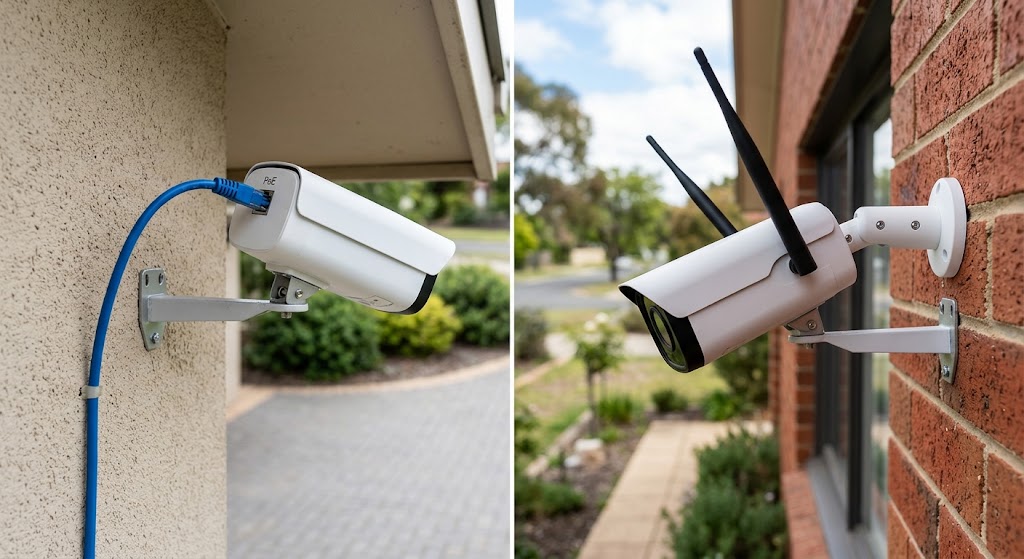
PoE Cameras vs. Wi-Fi Security Cameras: Installation & Reliability Comparison
PoE cameras usually deliver the most predictable always-on connection, while Wi-Fi cameras are faster and less invasive to install. Here is how the two approaches compare.
Apple HomeKit vs. Google Home vs. Amazon Alexa: 2026 Ecosystem Review
Apple Home is the privacy and Apple-integration winner, Google Home has the strongest AI-first smart-home experience with Gemini, and Amazon Alexa remains the broadest hub and device-integration ecosystem. Here is the 2026 breakdown.