
Portable Smart AC Units for Apartments: Quietest & Most Efficient Models
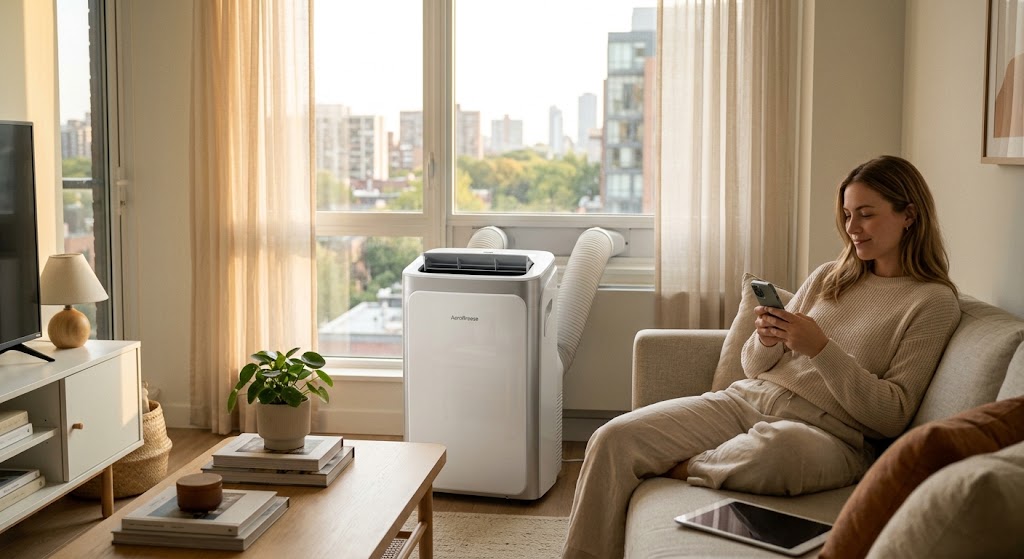
The best portable smart ACs for apartments combine inverter compressors, low published noise, DOE SACC capacity, efficient dual-hose airflow, and useful app controls. Here are the strongest 2026 picks.
Quick answer
For U.S. apartments in 2026, the strongest portable smart AC choices are the Midea DUO MAP14S1TBL-A for the lowest published operating noise among the leading models reviewed here, the Whynter ARC-1230WN for the best documented combination of 12,000-BTU SACC cooling, 13.8 CEER efficiency, dual-hose inverter design, and low-speed noise below 42.5 dBA, and the LG LP1419IVSM for quiet 44-dBA sleep operation plus LG ThinQ controls. Hisense AP1022TW1GD is another dual-hose inverter smart option, although its current official product page does not publish a numeric dBA figure.
Table of contents
- Top Picks at a Glance
- Why SACC Matters More Than the Big BTU Number
- What should appear in your comparison spreadsheet?
- 1. Midea DUO MAP14S1TBL-A — Best Quiet Overall Pick
- Why it ranks first for quiet apartments
- Energy case
- Smart-home value
- 2. Whynter ARC-1230WN — Best Efficiency + Cooling Combination
- Quiet on low, powerful on high
- Why the CEER matters
- Apartment downside: size and weight
- 3. LG LP1419IVSM — Best for Bedrooms and ThinQ Users
- Why it still makes sense in 2026
- Noise
- Energy story
- ThinQ is genuinely useful
- 4. Hisense AP1022TW1GD — Best Alternative Dual-Hose Inverter
- Why it ranks fourth instead of higher
- Quietest Ranking: What the Numbers Actually Say
- Most Efficient Ranking
- Best documented efficiency: Whynter ARC-1230WN
- Strong inverter alternative: Midea DUO
- Proven inverter design: LG LP1419IVSM
- Promising but less quantified: Hisense AP1022TW1GD
- Why Dual-Hose Architecture Matters
- Portable AC vs. Window AC: The Efficiency Reality
- Choose portable when:
- Choose window or mini-split when possible if:
- The Apartment Installation Matters More Than Most Smart Features
- Seal the panel perimeter
- Keep the hose short
- Keep the hot hose away from the thermostat sensor
- Do not hide the unit behind furniture
- Condensate: The Humidity Question Apartment Buyers Forget
- Smart Features That Actually Matter
- Remote start
- Scheduling
- Mode changes
- Filter reminders
- Energy monitoring
- What Size Should You Buy?
- Avoid blindly oversizing
- Electrical Reality in Apartments
- Best Pick by Apartment Type
- Studio apartment: Midea DUO
- One-bedroom apartment living room: Whynter ARC-1230WN
- Bedroom-only cooling: LG LP1419IVSM
- Deal-driven purchase: Hisense AP1022TW1GD
- Final Buying Checklist
- Conclusion
Key takeaways
- Compare U.S. portable ACs using DOE SACC capacity rather than the larger legacy ASHRAE BTU headline.
- Midea DUO MAP14S1TBL-A has the lowest manufacturer-published minimum noise in this shortlist at 42 dBA.
- Whynter ARC-1230WN publishes an unusually strong combination of 12,000 SACC, 13.8 CEER, dual-hose inverter operation, and sub-42.5-dBA low-speed noise.
- LG LP1419IVSM remains a strong bedroom and smart-home option with 10,000 SACC, 44-dBA sleep operation, and ThinQ Wi-Fi control.
- For apartment efficiency, inverter operation, sealed window installation, dual-hose airflow, correct SACC sizing, and clean filters matter more than app features alone.
Editorial transparency
Who worked on this article and how it was handled.
- Written by
- Daniel Reed
- Creation method
- Editorial research
AI assistance: AI assisted with research organization and drafting. Sources, product specifications, current availability, and the final article should be reviewed by a human editor before publication.
Portable air conditioners are often treated as a compromise appliance: louder than a window unit, less efficient than a mini-split, and only worth buying when the lease or window makes every other option impossible.
That reputation is increasingly outdated.
The best current portable ACs use variable-speed inverter compressors, smarter airflow management, Wi-Fi scheduling, and dual-hose or hose-in-hose designs that reduce some of the penalties associated with older single-hose units. Several leading models also publish minimum operating noise in the low-40-dBA range, which makes them far more realistic for bedrooms, studios, and work-from-home apartments.
But shopping this category is confusing because product pages may show two very different cooling-capacity numbers. A unit can be advertised as “14,000 BTU” in one place and “10,000 or 12,000 BTU” somewhere else without either number necessarily being a typo.
The key is knowing which rating matters.
This guide compares the strongest smart portable AC models for U.S. apartments in 2026 using DOE SACC cooling capacity, published noise, inverter technology, dual-hose design, efficiency data, smart controls, and apartment usability.
Top Picks at a Glance
| Model | Best for | DOE / SACC capacity | Published minimum noise | Efficiency highlight | Smart control |
|---|---|---|---|---|---|
| Midea DUO MAP14S1TBL-A | Quietest overall pick | 12,000 BTU DOE | 42 dBA | Inverter; Midea claims 40% energy savings vs. DOE CEER minimum requirements | Midea SmartHome, voice assistants |
| Whynter ARC-1230WN | Best efficiency + power combination | 12,000 BTU SACC | <42.5 dBA low | 13.8 CEER, inverter, hose-in-hose | NetHome Plus, Alexa, Google |
| LG LP1419IVSM | Best bedroom / established smart ecosystem | 10,000 BTU SACC | 44 dBA sleep | Dual Inverter; LG claims up to 40% savings vs. its non-inverter comparison model | LG ThinQ, Alexa, Google |
| Hisense AP1022TW1GD | Best alternative dual-hose inverter | Current product positioned for 550 sq. ft. | Manufacturer says ultra-quiet; no numeric dBA on current page | Dual-hose inverter | ConnectLife, Alexa, Google |
Important: manufacturer coverage claims are not interchangeable with guaranteed room performance. Sun exposure, top-floor heat, ceiling height, window leakage, occupancy, cooking loads, and outdoor climate can all change what a portable AC can realistically handle.
Why SACC Matters More Than the Big BTU Number
If you remember one buying rule, make it this:
Compare portable ACs using SACC-to-SACC, not the biggest BTU headline on the box.
The U.S. Department of Energy test procedure for portable air conditioners measures Seasonally Adjusted Cooling Capacity (SACC) and Combined Energy Efficiency Ratio (CEER).
SACC attempts to represent the effective cooling delivered to the room under the portable-AC test method. It accounts for performance characteristics that can make a portable unit deliver less useful room cooling than the older headline capacity suggests.
That is why one model may legitimately appear as:
- 14,000 BTU ASHRAE
- 10,000 or 12,000 BTU SACC / DOE
for the same machine.
LG explicitly explains this difference on its current portable-AC page and notes that the DOE number can be substantially lower than the older ASHRAE rating for the same product.
What should appear in your comparison spreadsheet?
Use:
- SACC / DOE cooling capacity;
- CEER when published;
- minimum and normal operating noise;
- maximum power draw;
- hose configuration;
- window-kit compatibility.
Treat ASHRAE BTU as secondary context.
1. Midea DUO MAP14S1TBL-A — Best Quiet Overall Pick
Best for: bedrooms, studios, open-plan apartments, renters sensitive to compressor cycling
DOE cooling: 12,000 BTU
Manufacturer room claim: up to 550 sq. ft.
Published minimum noise: 42 dBA
Design: hose-in-hose dual-airflow system
Compressor: variable-speed inverter
Smart features: SmartHome app, smart-watch control, voice assistants
Midea’s DUO design is one of the clearest examples of how much portable AC architecture has changed.
Instead of the conventional single exhaust hose found on cheap portable units, the DUO uses a hose-in-hose assembly. Midea describes the design as forcing hot air outside while helping keep cool air inside.
The second major upgrade is the inverter compressor.
Rather than constantly switching the compressor fully on and fully off, variable-speed operation can reduce output as the room approaches the target temperature. That generally produces smaller temperature swings and less abrupt compressor noise.
Why it ranks first for quiet apartments
Midea currently publishes operation as low as 42 dBA.
That is the lowest numeric manufacturer rating among the main models in this comparison, narrowly ahead of Whynter’s sub-42.5-dBA low-speed figure and LG’s 44-dBA sleep-mode rating.
A few caveats matter:
- 42 dBA is a minimum-condition figure, not the sound level at maximum cooling.
- The exhaust airflow is still audible.
- Window-kit vibration and floor resonance can make a quiet compressor sound louder in a real apartment.
- Published dBA figures from different manufacturers are not guaranteed to use identical measurement conditions.
Still, for a bedroom or studio where low-speed nighttime operation matters, the DUO is one of the strongest documented options available.
Energy case
Midea says the model’s inverter technology provides 40% energy savings compared with DOE CEER minimum requirements.
That is a manufacturer claim rather than a universal household savings guarantee. The actual bill reduction depends on runtime, setpoint, weather, window sealing, and room load.
What matters technically is that the Midea combines:
- inverter modulation;
- dual-airflow hose design;
- 12,000-BTU DOE capacity;
- low published noise.
That is a much stronger efficiency foundation than a basic fixed-speed single-hose model.
Smart-home value
The SmartHome app can manage:
- temperature;
- operating mode;
- schedules;
- remote control.
Midea also advertises voice-assistant and smart-watch control.
Those features do not make the refrigeration cycle more efficient by themselves, but scheduling can prevent the unit from running at full comfort settings when nobody is home.
Verdict: The best first choice for an apartment where noise matters just as much as cooling power.
2. Whynter ARC-1230WN — Best Efficiency + Cooling Combination
Best for: larger apartment living rooms, hot rooms, buyers who want published efficiency data
SACC cooling: 12,000 BTU
Manufacturer room claim: up to 600 sq. ft.
Published noise: below 42.5 dBA low / 49.5 medium / 56.5 high
CEER: 13.8
Maximum cooling power: 1,293 W
Design: dual hose / hose-in-hose
Smart features: Wi-Fi, NetHome Plus, Alexa, Google
If you care about measurable efficiency more than brand familiarity, the Whynter ARC-1230WN is arguably the most interesting unit in this group.
Whynter publishes a 13.8 CEER, which gives it a concrete efficiency figure that is easier to compare than a percentage marketing claim.
It also combines that rating with:
- 12,000-BTU SACC cooling;
- inverter operation;
- dual-hose airflow;
- very low low-speed noise.
Quiet on low, powerful on high
Whynter publishes three useful sound figures:
- <42.5 dBA on low
- 49.5 dBA on medium
- 56.5 dBA on high
That is more informative than one ultra-low marketing number because it shows the trade-off as the unit works harder.
For a bedroom, low-speed operation can be impressively quiet for a portable unit.
For a sun-baked living room during the hottest afternoon hour, expect the machine to become much more noticeable as airflow and compressor output rise.
Why the CEER matters
CEER is not the same thing as an electricity-bill percentage.
It is an efficiency rating under the DOE portable-air-conditioner framework. Higher is better when comparing like-for-like portable ACs.
Whynter’s published 13.8 CEER makes this model particularly attractive if you expect the unit to run many hours per day.
Apartment downside: size and weight
Efficiency does not mean tiny.
Whynter lists the ARC-1230WN at roughly:
- 19.5 inches wide;
- 16.75 inches deep;
- 32.5 inches high;
- over 77 pounds.
It has casters, but this is not something most people will happily carry between floors.
For a small studio, measure the floor footprint and the hose bend radius, not just the unit dimensions.
Verdict: The strongest pick if your priority is documented efficiency, 12,000-SACC cooling, and quiet low-speed operation.
3. LG LP1419IVSM — Best for Bedrooms and ThinQ Users
Best for: bedrooms, one-bedroom apartments, existing LG smart-home households
SACC cooling: 10,000 BTU
ASHRAE rating: 14,000 BTU
Manufacturer room claim: up to 500 sq. ft.
Published minimum noise: 44 dBA in sleep mode
Compressor: DUAL Inverter
Smart features: LG ThinQ, Alexa, Google
LG’s LP1419IVSM has been around longer than some newer inverter competitors, but it remains relevant because the core design still checks the important apartment boxes.
It offers:
- variable-speed Dual Inverter operation;
- Wi-Fi control;
- 10,000-BTU SACC capacity;
- a published 44-dBA sleep-mode figure.
Why it still makes sense in 2026
LG’s current U.S. product page remains active, and the company’s support documentation was updated in 2025.
That matters for a smart appliance. An old portable AC can cool perfectly well, but app support, documentation, replacement parts, and software ecosystem longevity matter once Wi-Fi control is part of the purchase.
Noise
LG states that portable operation can reach 44 dBA in sleep mode.
That is slightly higher than the minimum figures published by Midea and Whynter, but still notably quiet for this product category.
The key is the same as with every portable AC:
- low or sleep mode is not max-cooling mode;
- compressor and fan noise rise when the room needs more capacity.
Energy story
LG says its inverter portable model can save up to 40% more energy than its LP1417GSR non-inverter comparison model.
That comparison is useful for understanding why inverter architecture matters, but it should not be converted into a promise that your electricity bill will fall 40%.
Your result depends heavily on:
- how inefficient the old unit was;
- runtime;
- climate;
- temperature setpoint;
- air leakage at the window kit.
ThinQ is genuinely useful
LG ThinQ lets you:
- adjust temperature remotely;
- change modes;
- create schedules;
- monitor operation;
- integrate with Alexa and Google Assistant.
For an apartment renter, the best use is often simple scheduling:
- start cooling before arriving home;
- avoid leaving the unit at a low setpoint all day;
- shut it off remotely if you forgot.
Verdict: A strong, mature option for renters who value quiet nighttime use and an established smart-appliance ecosystem.
4. Hisense AP1022TW1GD — Best Alternative Dual-Hose Inverter
Best for: shoppers who find a strong local deal on Hisense and want dual-hose inverter operation
Manufacturer room claim: 550 sq. ft.
Design: dual-hose inverter
Smart features: ConnectLife, Google, Alexa
Published numeric noise on current U.S. product page: not listed
Hisense’s AP1022TW1GD deserves a place in the shortlist because it uses the right underlying architecture:
- dual-hose design;
- inverter compressor;
- Wi-Fi app control;
- condensate evaporation through the exhaust system;
- apartment-friendly window kit.
Hisense describes the inverter system as providing ultra-quiet operation and improved energy efficiency.
Why it ranks fourth instead of higher
The current official U.S. product page does not publish a numeric dBA rating in the product copy available for this article.
That makes it difficult to rank honestly against:
- Midea’s 42 dBA;
- Whynter’s <42.5 dBA;
- LG’s 44 dBA.
“Ultra-quiet” is useful positioning, but it is not a measurement.
This does not mean the Hisense is noisy. It means the evidence available on the current manufacturer page is less precise.
Verdict: A technically appealing dual-hose inverter alternative, but not the model I would label “quietest” without a manufacturer-published comparable dBA figure.
Quietest Ranking: What the Numbers Actually Say
Based strictly on the lowest manufacturer-published figures used in this article:
- Midea DUO MAP14S1TBL-A — 42 dBA
- Whynter ARC-1230WN — <42.5 dBA on low
- LG LP1419IVSM — 44 dBA in sleep mode
- Hisense AP1022TW1GD — manufacturer says ultra-quiet, numeric figure not published on current U.S. page
Do not over-interpret a 0.5 or 2 dB difference.
A portable AC’s real acoustic experience is affected by:
- fan speed;
- compressor speed;
- distance from the bed;
- floor type;
- wall reflections;
- exhaust-hose turbulence;
- vibration at the window panel.
A poorly installed 42-dBA unit can be more annoying than a well-isolated 44-dBA unit.
Most Efficient Ranking
Efficiency is harder to rank because manufacturers do not all publish the same metrics in the same place.
Best documented efficiency: Whynter ARC-1230WN
Whynter publishes 13.8 CEER, making it the clearest efficiency winner on directly stated current specifications.
Strong inverter alternative: Midea DUO
Midea publishes a 40% energy-savings claim relative to DOE CEER minimum requirements and combines it with a hose-in-hose design.
Proven inverter design: LG LP1419IVSM
LG publishes an up-to-40% energy-saving claim versus a specific older LG non-inverter portable model.
Promising but less quantified: Hisense AP1022TW1GD
Hisense states that inverter operation improves energy efficiency but does not provide the same level of numeric efficiency detail on its current consumer product page.
Why Dual-Hose Architecture Matters
A conventional single-hose portable AC has one major design compromise.
The unit:
- takes indoor air;
- uses some of that air to cool the condenser;
- exhausts the hot condenser air outside.
That exhaust flow can create negative room pressure, encouraging replacement air to enter the apartment through cracks and openings.
If the replacement air is hot and humid, the AC must cool that new air too.
A dual-hose system instead has a dedicated outdoor-air path for the condenser side and a separate exhaust path.
Modern “hose-in-hose” designs package both flows inside one physical-looking hose assembly.
For apartments, this can mean:
- less sacrifice of conditioned room air;
- better effective cooling;
- more stable pressure behavior.
It does not make window sealing optional. A badly sealed dual-hose unit can still waste substantial cooling.
Portable AC vs. Window AC: The Efficiency Reality
A portable unit is not automatically the most efficient solution simply because it has an inverter.
If your lease and window allow a high-efficiency window air conditioner, that architecture can often avoid some of the duct and condenser-air penalties of an indoor portable unit.
DOE’s Federal Energy Management Program also treats portable ACs separately from ENERGY STAR room air conditioners; its room-air-conditioner purchasing guidance explicitly excludes portable models from that product category.
That is an important shopping distinction.
Choose portable when:
- the lease prohibits window units protruding outside;
- the window geometry does not support a conventional window AC;
- you need seasonal removal;
- you need the cooling appliance entirely inside the apartment;
- portability between rooms has genuine value.
Choose window or mini-split when possible if:
- maximum efficiency is the primary goal;
- installation is allowed;
- the room needs cooling for many hours every day;
- you plan to stay in the apartment long term.
A portable AC is often the best feasible solution, not the theoretical best cooling architecture.
The Apartment Installation Matters More Than Most Smart Features
A premium inverter portable AC can perform badly if the window kit leaks.
Seal the panel perimeter
The window insert should fit tightly against:
- sash;
- frame;
- side gaps;
- extension joints.
Use removable renter-safe sealing materials appropriate for the surface.
Keep the hose short
Do not stretch the exhaust assembly farther than necessary.
Long, sharply bent hose runs:
- add airflow resistance;
- radiate heat back into the room;
- consume floor space.
Keep the hot hose away from the thermostat sensor
If the unit’s room-temperature sensor is influenced by its own hot exhaust hose, temperature control can become less representative.
Do not hide the unit behind furniture
Portable ACs need clear airflow around:
- intake;
- outlet;
- exhaust connection.
A visually perfect corner can be a terrible cooling location.
Condensate: The Humidity Question Apartment Buyers Forget
Portable ACs remove moisture while cooling.
Many modern units evaporate much of that condensate into the exhaust stream under normal conditions, but high-humidity environments can still require:
- manual draining;
- a gravity drain;
- or a model-specific continuous-drain setup.
Whynter, for example, publishes both self-evaporative operation and drain-port options.
LG also uses an auto-evaporation system.
Before buying, check:
- whether your climate is humid;
- where the drain port sits;
- whether a gravity drain is practical in your apartment;
- what happens when the internal tank fills.
A unit that stops at 3 a.m. because the tank is full is not a great bedroom AC, no matter how quiet its compressor is.
Smart Features That Actually Matter
Wi-Fi can be useful, but only a few features have real apartment value.
Remote start
Start cooling before you get home instead of running the AC all day.
Scheduling
Automate occupied and sleeping periods.
Mode changes
Switch between cooling, fan, and dehumidification without walking over to the unit.
Filter reminders
Portable AC efficiency falls when airflow is restricted.
Energy monitoring
LG specifically promotes monitoring through ThinQ. When a platform provides usable consumption data, it can help you test whether:
- a higher setpoint;
- sleep mode;
- closing blinds;
- sealing window gaps
actually changes runtime.
Voice control is convenient. Scheduling and remote shutoff are usually more valuable.
What Size Should You Buy?
Do not size by ASHRAE BTU.
Start with the DOE / SACC rating and then consider room load.
A small bedroom with one shaded window may need far less capacity than an equally sized:
- top-floor room;
- west-facing room;
- loft with high ceiling;
- kitchen-living open plan.
Manufacturer coverage numbers are useful as broad guides, not guarantees.
Avoid blindly oversizing
Bigger is not always better.
A physically larger unit can mean:
- more floor space;
- more noise on high;
- higher maximum power;
- a heavier appliance;
- a more difficult window connection.
Inverter units are more tolerant of varying load because they can reduce output, but you should still buy for the actual space rather than the biggest model that fits the outlet.
Electrical Reality in Apartments
The leading U.S. models in this article are designed around standard residential 115V service, but that does not mean the circuit has unlimited capacity.
Portable ACs are high-load appliances.
Do not:
- run them through a cheap extension cord;
- share a marginal circuit with another high-power appliance;
- defeat an LCDI or safety plug;
- use a smart plug unless it is specifically rated and permitted for the AC load.
Follow the manufacturer’s electrical instructions.
If the breaker repeatedly trips, treat that as an electrical problem—not a reason to install a larger power strip.
Best Pick by Apartment Type
Studio apartment: Midea DUO
Why:
- 12,000 DOE capacity;
- low 42-dBA published minimum;
- inverter modulation;
- efficient hose-in-hose design.
It is powerful enough for a demanding studio while still being realistic for sleeping in the same room.
One-bedroom apartment living room: Whynter ARC-1230WN
Why:
- 12,000 SACC;
- 13.8 CEER;
- strong low-speed noise figure;
- detailed smart scheduling.
It is the best choice when the AC will run many hours and efficiency matters.
Bedroom-only cooling: LG LP1419IVSM
Why:
- 44-dBA sleep mode;
- 10,000 SACC;
- established ThinQ ecosystem;
- remote scheduling.
Deal-driven purchase: Hisense AP1022TW1GD
Why:
- dual-hose;
- inverter;
- smart app;
- 550-square-foot positioning.
Buy it when local price and availability are compelling, but do not assume its “ultra-quiet” label beats a model with published dBA data.
Final Buying Checklist
Before ordering a portable smart AC:
- Compare SACC, not just ASHRAE BTU.
- Look for inverter technology.
- Prefer dual-hose or hose-in-hose architecture when efficiency matters.
- Check the manufacturer’s numeric dBA rating.
- Measure the window opening.
- Confirm the included panel fits the window type.
- Measure floor space plus hose clearance.
- Check unit weight if you plan to move it.
- Confirm condensate drainage options.
- Verify outlet and circuit requirements.
- Check whether schedules work if Wi-Fi is temporarily unavailable.
- Look at replacement filters, hoses, and parts availability.
- Confirm your lease permits a vented portable AC window kit.
Conclusion
Portable air conditioners still involve compromises, but the best inverter models are dramatically better suited to apartment living than the old fixed-speed single-hose boxes many renters remember.
For the strongest combination of quiet operation and cooling capacity, start with the Midea DUO MAP14S1TBL-A. If you want the best directly published efficiency specification, the Whynter ARC-1230WN stands out with its 13.8 CEER, 12,000-BTU SACC capacity, and low-speed noise below 42.5 dBA. The LG LP1419IVSM remains an excellent bedroom-oriented option with 44-dBA sleep operation and mature ThinQ controls. Hisense AP1022TW1GD is a credible dual-hose inverter alternative when local availability or price is better, but its current official page is less specific about numeric noise performance.
Whichever model you choose, the smartest feature is not Wi-Fi. It is the combination of correct SACC sizing, inverter operation, dual-hose airflow, a well-sealed window kit, and a schedule that only cools the apartment when you actually need it.
Common questions
Questions this guide answers
What is the quietest portable smart AC for an apartment?
Among the leading current models with manufacturer-published figures reviewed here, Midea lists the DUO MAP14S1TBL-A as low as 42 dBA, while Whynter lists the ARC-1230WN below 42.5 dBA on low and LG lists the LP1419IVSM at 44 dBA in sleep mode. These figures are useful but are not guaranteed to be directly comparable because manufacturers can use different test conditions.
Which portable AC is the most energy efficient?
Whynter publishes the strongest directly comparable efficiency figure in this shortlist: a 13.8 CEER for the ARC-1230WN. Midea and LG also use variable-speed inverter technology and publish substantial energy-saving claims relative to less-efficient baselines, but their current consumer pages do not present a directly comparable CEER figure as clearly as Whynter does.
Should I compare portable ACs using ASHRAE BTU or SACC?
Use the DOE SACC rating for U.S. shopping. Federal portable-AC test procedures measure Seasonally Adjusted Cooling Capacity and CEER, while older ASHRAE ratings can look much higher for the same physical unit. Comparing SACC to SACC gives a more meaningful view of real portable-AC cooling performance.
Is a dual-hose portable AC better for an apartment?
It is usually the better portable design when efficiency matters. A dual-hose or hose-in-hose system separates condenser intake and exhaust airflow rather than relying entirely on room air for the hot side of the refrigeration cycle, which can reduce the amount of conditioned indoor air sacrificed during operation.
Evidence & further reading
Sources & references
Primary and authoritative references used to support or contextualize this article. Links open the original source.
- 1Portable Air Conditioners
U.S. Department of Energy · Accessed Aug 10, 2026
Supports the current federal portable-air-conditioner standards and DOE test procedure framework.
- 210 CFR Part 430 Subpart B — Test Procedures
Electronic Code of Federal Regulations · Accessed Aug 10, 2026
Supports SACC and CEER as the federal measured ratings for portable air conditioners.
- 3Midea 12,000 BTU DOE DUO Smart Inverter Portable Air Conditioner MAP14S1TBL-A
Midea · Accessed Aug 10, 2026
Supports 12,000-BTU DOE capacity, 550-square-foot coverage claim, inverter technology, hose-in-hose design, smart controls, and published noise as low as 42 dB.
- 4ARC-1230WN Portable Air Conditioner with WiFi
Whynter · Accessed Aug 10, 2026
Supports 12,000-BTU SACC, 13.8 CEER, dual-hose inverter design, 600-square-foot coverage claim, Wi-Fi controls, and published noise below 42.5 dBA on low.
- 510,000 BTU DUAL Inverter Portable AC - LP1419IVSM
LG Electronics USA · Accessed Aug 10, 2026
Supports 10,000-BTU SACC, 500-square-foot coverage claim, Dual Inverter technology, ThinQ smart controls, and current U.S. product availability.
- 6Aire Acondicionado Portátil 14,000 BTU LG LP1419IVSM
LG Electronics · Accessed Aug 10, 2026
Supports LG's published minimum operating noise of 44 dBA in sleep mode.
- 7Hisense 550 SF Dual-Hose Inverter Portable AC
Hisense USA · Accessed Aug 10, 2026
Supports dual-hose inverter design, ConnectLife app control, Alexa and Google integration, 550-square-foot coverage claim, and the manufacturer's current ultra-quiet positioning.

About the author
Daniel Reed
Daniel writes about connected-home standards, small-space technology, device interoperability, and privacy-conscious urban living.
More from Daniel →Make your home smarter without buying every gadget.
One useful idea, one product worth knowing, and one energy-saving action—delivered weekly.
No spam. Unsubscribe anytime.
Semantic recommendations
Related reading
Selected from topic cluster, entities, tags, search intent, and editorial relationships.
Portable Smart Air Conditioners vs Window Units: Noise & Power Test
Window ACs usually win on cooling efficiency, while portable smart ACs win on installation flexibility; noise depends heavily on compressor and airflow design.
Compact Hydroponic Indoor Gardens for Small Apartment Kitchens
Compact hydroponic gardens can grow herbs and greens year-round without soil. These are the strongest 2026 options for small apartment kitchens, from 3-pod countertop units to vertical 16-plant systems.
The Best Renter-Friendly Smart Locks That Keep Your Landlord’s Key Working
The best renter smart locks retrofit the inside of your existing lock so the exterior cylinder and landlord’s physical key can keep working. Here are the strongest US and EU options.
Local Storage Security Cameras vs. Cloud Subscriptions: Cost Breakdown
Local security cameras cost more upfront but can eliminate years of cloud fees. Here is the real 2026 cost breakdown for local NVR, HomeBase, microSD, Ring, Arlo, and eufy cloud plans.