Compact Hydroponic Indoor Gardens for Small Apartment Kitchens
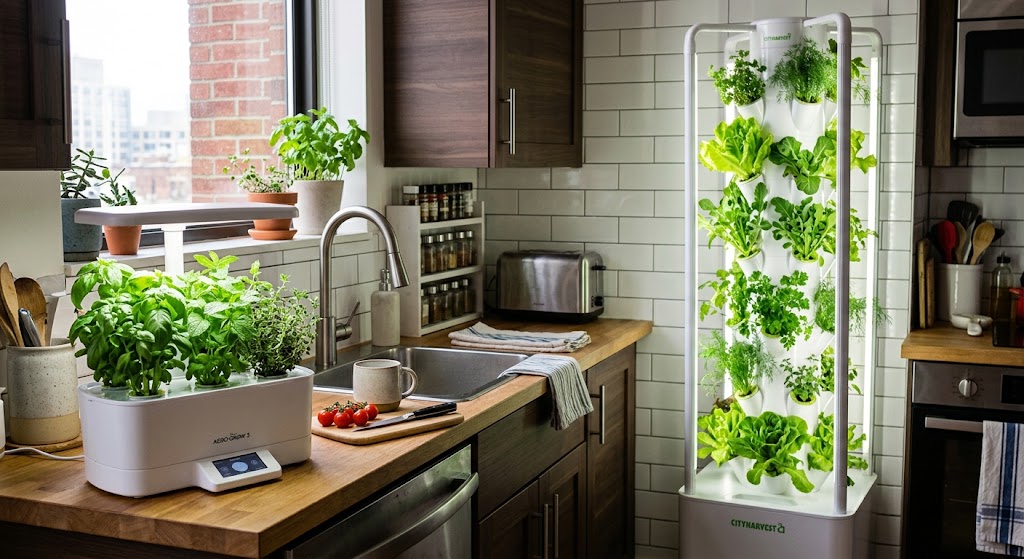
Compact hydroponic gardens can grow herbs and greens year-round without soil. These are the strongest 2026 options for small apartment kitchens, from 3-pod countertop units to vertical 16-plant systems.
Quick answer
For a small apartment kitchen, the best hydroponic garden depends on whether counter width or total growing capacity matters more. LetPot Air is the strongest all-around countertop pick because it fits 10 pods into a narrow footprint with a 4-liter reservoir, 24-watt grow light, pump, and app control. AeroGarden Harvest 2.0 is simpler and easier for beginners, while AeroGarden Sprout is one of the smallest true hydroponic systems for extremely limited counters. Personal Rise Garden offers higher countertop capacity, and Gardyn Studio 2 provides 16 plants in a 1.4-square-foot vertical footprint when you have a spare kitchen corner instead of counter space.
Table of contents
- Top Picks at a Glance
- What Counts as Hydroponic?
- A note about Click & Grow
- 1. LetPot Air — Best Overall for a Small Countertop
- Why it wins the compact category
- The app is useful rather than essential
- Apartment downside
- 2. AeroGarden Harvest 2.0 — Best Simple Countertop Choice
- Why simpler can be better in a kitchen
- Six pods are not really six mature basil plants
- Current price positioning
- 3. AeroGarden Sprout — Best for Extremely Small Kitchens
- Who should buy this
- The main limitation is not pod count
- 4. Personal Rise Garden — Best High-Capacity Countertop Garden
- Why the extra width can be worth it
- Smart guidance
- Power and light
- 5. Gardyn Studio 2 — Best When You Have Floor Space but No Counter Space
- Why this can fit a small kitchen better than a countertop system
- It is a much more sophisticated system
- Privacy note
- Power use
- What About LetPot Mini?
- What About Click & Grow Smart Garden 3?
- What Should You Grow in a Compact System?
- Best crops
- More difficult crops
- Pod Count Is a Marketing Number, Not a Harvest Number
- Counter Space: Measure the Plants, Not Just the Machine
- Keep it away from cooking heat
- Does a Hydroponic Garden Need Sunlight?
- Noise: Pumps Matter in Studio Apartments
- What can make a pump sound louder?
- Electricity Cost: The Light Is the Main Load
- Proprietary Pods vs. Bring-Your-Own Seeds
- Closed ecosystem
- Open seed system
- Water and Nutrient Maintenance
- For beginner appliances
- For advanced growers
- Cleaning Is the Part Marketing Photos Skip
- The apartment buying question
- Best Pick by Apartment Type
- Tiny studio with almost no counter width
- Small kitchen, serious herb use
- Beginner who hates apps
- Home cook who uses herbs every day
- No spare counter, one open corner
- Final Buying Checklist
- Conclusion
Key takeaways
- LetPot Air offers the best balance of compact countertop dimensions, 10-pod capacity, 4-liter reservoir, pump circulation, and app control.
- AeroGarden Harvest 2.0 is the easiest mainstream six-pod option for cooks who want herbs and greens without a large smart-home setup.
- AeroGarden Sprout is the most space-conservative pick in this shortlist for extremely narrow counters.
- Personal Rise Garden is better when harvest volume matters more than minimizing counter width, with 8 plants out of the box and optional capacity up to 12.
- Gardyn Studio 2 uses vertical space instead of counter space, fitting 16 plants into a 17-by-12-inch floor footprint.
Editorial transparency
Who worked on this article and how it was handled.
- Written by
- Daniel Reed
- Creation method
- Editorial research
AI assistance: AI assisted with research organization and drafting. Sources, product specifications, current availability, and the final article should be reviewed by a human editor before publication.
A compact indoor garden can make more sense in an apartment kitchen than another countertop appliance—provided it actually fits the counter, does not blast the room with unnecessary light, and grows enough useful food to justify the maintenance.
Modern countertop hydroponic systems combine a water reservoir, nutrient solution, pump or passive water delivery, plant holders, and full-spectrum LED lighting. Some add Wi-Fi, app reminders, cameras, automated nutrient dosing, or water-level sensors.
The result is a controlled growing environment that can produce basil, lettuce, chives, cilantro, mint, bok choy, and other compact crops regardless of the weather outside.
But the word compact is misleading.
A 10-pod system may occupy very little counter width while still needing 14 inches of vertical plant space. A system marketed for tomatoes may need far more headroom once the crop matures. A vertical 16-plant garden can use less floor area than a countertop garden uses work surface, yet it stands more than four feet tall.
This guide compares current 2026 systems by the measurements that matter in an apartment:
- real footprint;
- plant capacity;
- grow-light power;
- maximum plant height;
- water reservoir;
- automation;
- maintenance;
- and how much kitchen space the garden consumes once the plants are mature.
Top Picks at a Glance
| Model | Best for | Plant capacity | Footprint / dimensions | Light | Smart features |
|---|---|---|---|---|---|
| LetPot Air | Best overall compact countertop garden | 10 pods | About 15 in. long × 5-7 in. deep; 14-in. max light height | 24W | Wi-Fi app, custom light schedule, water reminder |
| AeroGarden Harvest 2.0 | Best simple six-pod system | 6 pods | Compact countertop design; up to 12 in. grow height | 15W | Auto light timer, nutrient reminder |
| AeroGarden Sprout | Best for extremely narrow counters | 3 pods | 3.5 in. W × 12 in. D × 10.5 in. H | 10W | Auto lights, water + nutrient reminders |
| Personal Rise Garden | Best high-capacity countertop system | 8 standard / up to 12 | 22 in. W × 10 in. D × 18 in. H | 30W | Wi-Fi app, water/nutrient/harvest reminders |
| Gardyn Studio 2 | Best vertical apartment garden | 16 plants | 17 in. W × 12 in. D × 54 in. H | 52W | Automated water/light, sensors, camera, app |
There is no single winner for every small kitchen.
If you have 15 inches of counter width but almost no depth, LetPot Air is extremely attractive.
If every inch of countertop is already occupied, Gardyn Studio 2 can make more sense because it uses a small patch of floor near a wall instead.
What Counts as Hydroponic?
Hydroponics means growing plants without soil while supplying nutrients through water.
University of Minnesota Extension describes home hydroponics as a space-efficient form of soilless gardening that can grow herbs, leafy greens, vegetables, and fruit year-round with artificial lighting.
Consumer appliances package that idea into a much easier format.
Most countertop systems use some variation of:
- a recirculating reservoir;
- net cups or seed-pod holders;
- a pump or aeration system;
- liquid nutrients;
- LED grow lighting.
A note about Click & Grow
Click & Grow’s Smart Garden line is often grouped into “hydroponic garden” shopping lists because it is similarly compact and automated.
Technically, it is different.
Click & Grow uses proprietary Smart Soil plant pods and passive watering rather than the circulating nutrient-water approach found in AeroGarden, LetPot, Rise, and Gardyn.
It can still be a good kitchen herb garden, but this comparison focuses on true or substantially water-based hydroponic systems.
1. LetPot Air — Best Overall for a Small Countertop
Best for: apartment cooks who want more than a few herbs without giving up much counter depth
Capacity: 10 pods
Reservoir: 4 liters
Light: 24W
Max light height: 14 inches
App: yes
Pump: cycling pump
LetPot Air has one of the strongest space-to-capacity ratios in the current countertop market.
LetPot’s official comparison data lists the system at roughly 15 inches long and about 5-7 inches deep, depending on which regional product listing is referenced. It holds 10 pods, uses a 4-liter reservoir, and includes a 24-watt LED.
The light height tops out around 14 inches.
That makes it a particularly good match for:
- basil;
- lettuce;
- baby greens;
- chives;
- parsley;
- cilantro;
- compact bok choy;
- smaller herbs.
Why it wins the compact category
Ten pods sound dramatically better than six.
In reality, you will not always want to fill all ten positions with mature plants. Basil and lettuce can quickly shade neighboring pods, while fruiting crops need even more room.
But the extra holes provide flexibility.
You can:
- grow six mature herbs with empty spaces between them;
- run several lettuce plants together;
- start seedlings while harvesting another crop;
- mix compact varieties.
The app is useful rather than essential
LetPot lets you customize exact grow-light start and stop times instead of relying only on a fixed preset.
The system can also provide water-level reminders through the app.
That is especially useful in a kitchen because you can schedule the bright grow light around your lifestyle.
For example:
- lights on at 6 a.m.;
- lights off before evening relaxation.
Plants need enough daily light; they do not care whether that light overlaps your movie night.
Apartment downside
The 14-inch maximum light height means this is not a great place for large tomato or pepper plants unless you choose very compact cultivars and prune aggressively.
Verdict: the best balance of capacity, narrow footprint, reservoir size, and smart scheduling.
2. AeroGarden Harvest 2.0 — Best Simple Countertop Choice
Best for: beginners who want reliable herbs and greens with minimal app dependence
Capacity: 6 pods
Grow height: up to 12 inches
Light: 15W
Controls: simple one-button interface
Smartphone app required: no
AeroGarden is one of the most recognizable names in consumer countertop hydroponics, and Harvest 2.0 is the practical middle ground.
The current official model grows up to six plants, uses a 15-watt full-spectrum LED, and provides up to 12 inches of grow height.
It also includes a nutrient reminder and automatic light timer.
Why simpler can be better in a kitchen
Not every appliance needs Wi-Fi.
The Harvest 2.0 gives you the useful automation:
- light timing;
- nutrient reminder;
- water-based growing.
without requiring another account and another app just to keep basil alive.
That makes it a good fit for:
- nontechnical households;
- a gift;
- a first hydroponic garden;
- a kitchen where reliability matters more than dashboards.
Six pods are not really six mature basil plants
This applies to nearly every pod-based garden.
Manufacturers advertise available planting positions, but mature plants occupy three-dimensional space.
If you fill every opening with vigorous basil, the plants compete for:
- light;
- airflow;
- canopy space.
For a better long-term kitchen setup, I would often use:
- 3-4 vigorous herbs;
- or 4-6 smaller leafy greens.
Current price positioning
AeroGarden’s current official page lists Harvest 2.0 around the $100 range.
Pricing changes, but that places it below the premium smart systems from Rise and Gardyn.
Verdict: the easiest recommendation for someone who wants real hydroponics without turning the herb garden into an IoT project.
3. AeroGarden Sprout — Best for Extremely Small Kitchens
Best for: narrow counters, studio kitchens, one-person herb use
Capacity: 3 pods
Size: 3.5 in. W × 12 in. D × 10.5 in. H
Grow height: 10 inches
Light: 10W
Wi-Fi: no
Sprout is almost absurdly narrow.
AeroGarden lists it at only 3.5 inches wide, with a 12-inch depth and 10.5-inch overall height.
It supports three pods under a 10-watt LED and includes:
- automatic lighting;
- low-water reminder;
- nutrient reminder.
The pump is described by AeroGarden as practically silent.
Who should buy this
The Sprout makes sense if you genuinely only need:
- basil;
- parsley;
- mint;
- lettuce;
- a tiny rotation of kitchen herbs.
It is not a miniature farm.
It is closer to an automated herb planter that happens to use hydroponics.
The main limitation is not pod count
It is canopy size.
Three mature plants can already crowd the light. Reviews on AeroGarden’s own page include users who feel the small geometry is limiting for larger plants.
That is expected.
A 3.5-inch-wide garden cannot escape plant biology.
If you can fit Harvest 2.0, the larger model provides more flexibility.
If you cannot, Sprout is one of the most space-efficient ways to keep fresh herbs on a counter.
Verdict: best when every inch of countertop matters more than harvest volume.
4. Personal Rise Garden — Best High-Capacity Countertop Garden
Best for: serious home cooks who can dedicate a 22-inch section of counter
Capacity: 8 plants out of the box; optional layouts up to 12
Size: 22 in. W × 10 in. D × 18 in. H
Light: 30W
Connectivity: Wi-Fi + app
Smart reminders: water, nutrients, harvest
The Personal Rise Garden sits between small countertop gadgets and floor-standing indoor farms.
It is much wider than LetPot Air or Sprout but still clearly kitchen-counter equipment.
Rise lists the unit at:
- 22 inches wide;
- 10 inches deep;
- 18 inches high;
- 30 watts of full-spectrum LED lighting.
The standard configuration grows eight plants, with optional tray configurations supporting up to 12 smaller plants.
Why the extra width can be worth it
Horizontal plant spacing is valuable.
A system with eight well-spaced herbs can be more useful than a smaller device advertising ten or twelve tightly packed pod holes.
Rise also has enough depth and structure to feel more like a permanent kitchen garden rather than a small seed-starting appliance.
Smart guidance
The Rise app provides:
- plant library;
- water reminders;
- nutrient reminders;
- harvest notifications.
Nutrient addition remains manual in the Personal model.
That is a good balance.
You get guidance without paying for a complex dosing mechanism.
Power and light
At 30W, the grow light uses more electricity than an AeroGarden Sprout or Harvest.
That is not inherently inefficient.
You are also lighting a larger plant canopy.
When comparing indoor gardens, watts should be evaluated against:
- usable growing area;
- plant count;
- light height.
Verdict: best for a renter willing to dedicate one meaningful section of countertop to regular herbs and greens.
5. Gardyn Studio 2 — Best When You Have Floor Space but No Counter Space
Best for: apartments with an empty wall or kitchen corner
Capacity: 16 plants
Footprint: 17 in. W × 12 in. D
Height: 54 inches
Floor area: 1.4 sq. ft.
Light: 52W
Water tank: 4 gallons
Smart features: sensors, camera, app, automated light and irrigation
Gardyn Studio 2 changes the apartment-space equation.
Instead of spreading plants across the counter, it grows vertically.
The official dimensions are:
- 17 inches wide;
- 12 inches deep;
- 54 inches tall.
That is a 1.4-square-foot floor footprint with 16 plant positions.
Why this can fit a small kitchen better than a countertop system
Countertop area is premium real estate.
If your kitchen has:
- only one food-prep surface;
- a narrow galley layout;
- no spare shelf;
a tall garden beside the refrigerator may be less intrusive than a 22-inch countertop device.
It is a much more sophisticated system
Gardyn Studio 2 includes:
- automated watering;
- automatic lighting;
- water-level sensing;
- humidity and temperature sensing;
- an internal 8MP camera;
- app-based monitoring.
Gardyn’s optional Kelby service uses camera and system data to help monitor plant conditions.
That makes Studio 2 more appliance-like—and more dependent on software—than a simple AeroGarden.
Privacy note
The camera points toward the plants, but it is still a camera inside your home.
Gardyn allows cameras to be disabled. Doing so limits some plant-monitoring features.
If camera-enabled IoT appliances make you uncomfortable, factor that into the decision rather than treating it as an afterthought.
Power use
Gardyn publishes an estimated 26 kWh per month for Studio.
That is far more electricity than a tiny 10W herb unit, but the Studio also supports 16 plants and much more illuminated canopy area.
Verdict: the best use of vertical space for a renter who wants a meaningful indoor harvest without surrendering the kitchen counter.
What About LetPot Mini?
LetPot Mini is mechanically almost ideal for a tiny apartment.
Official specifications show:
- five pods;
- 1.5-liter reservoir;
- app support;
- footprint around 8.7 × 5.3 inches;
- adjustable grow-light height.
The problem is availability.
The current official Mini product page shows it as sold out at the time of this article.
That is why LetPot Air is the main LetPot recommendation here.
If Mini returns to normal stock, it deserves consideration for spaces between AeroGarden Sprout and LetPot Air.
What About Click & Grow Smart Garden 3?
Click & Grow Smart Garden 3 is excellent for small kitchens.
It is:
- compact;
- silent;
- easy to maintain;
- only 8W;
- roughly 11.8 × 4.7 inches;
- designed for three plants.
But it uses proprietary Smart Soil pods and passive watering.
So if the goal is specifically to learn or use hydroponics, it is not the same thing.
If your real goal is simply “grow basil indoors with almost no work,” Click & Grow remains a compelling alternative.
What Should You Grow in a Compact System?
University of Minnesota Extension recommends herbs and leafy greens as particularly practical indoor hydroponic crops.
That aligns perfectly with small consumer systems.
Best crops
- basil;
- lettuce;
- arugula;
- cilantro;
- chives;
- parsley;
- mint;
- baby kale;
- mustard greens;
- bok choy;
- compact spinach varieties.
These plants:
- grow relatively quickly;
- tolerate repeated harvesting;
- stay manageable under short LED hoods.
More difficult crops
- full-size tomatoes;
- peppers;
- cucumbers;
- eggplant;
- large strawberries.
They can grow hydroponically, but a compact countertop system may struggle with:
- vertical height;
- root volume;
- flower pollination;
- fruit weight;
- canopy shading.
Use dwarf cultivars or move up to a taller system when fruiting vegetables are your priority.
Pod Count Is a Marketing Number, Not a Harvest Number
This deserves emphasis.
A 12-pod garden does not automatically produce twice as much useful food as a 6-pod garden.
Plant spacing matters.
Imagine ten basil plants growing three inches apart.
Within a few weeks:
- leaves overlap;
- the center gets less light;
- airflow decreases;
- aggressive plants dominate weaker seedlings.
For mature herbs, unused pod positions are often a feature.
A better comparison is:
How much healthy canopy can this light and reservoir support?
not:
How many holes are molded into the deck?
Counter Space: Measure the Plants, Not Just the Machine
Manufacturer dimensions describe the plastic appliance.
Plants do not respect those boundaries.
Basil can grow sideways.
Lettuce forms wide rosettes.
Mint sprawls.
Before buying, add clearance for:
- foliage;
- filling the reservoir;
- raising the light hood;
- pruning;
- removing the grow deck for cleaning.
Keep it away from cooking heat
Do not place the garden directly beside:
- stove burners;
- toaster oven exhaust;
- an oven vent;
- a kettle that blasts steam.
Heat can raise reservoir temperature and make the growing environment less stable.
A dedicated counter edge or shelf near an outlet is better.
Does a Hydroponic Garden Need Sunlight?
No.
These systems are built around artificial grow lights.
Gardyn explicitly states that Studio 2 does not require sunlight.
That makes indoor gardens particularly useful for:
- north-facing apartments;
- kitchens with small windows;
- winter growing;
- urban units shaded by neighboring buildings.
Direct sun is not necessarily helpful if it overheats the water or causes algae growth.
Let the integrated grow light do the job it was designed to do.
Noise: Pumps Matter in Studio Apartments
Most compact hydroponic gardens circulate water.
That means some pump noise is normal.
AeroGarden specifically describes Sprout’s circulation pump as practically silent.
Other manufacturers in this shortlist do not publish standardized dBA ratings for the models compared here.
So do not rank them from vague terms like “quiet” alone.
What can make a pump sound louder?
- reservoir running low;
- roots touching the pump;
- pump touching the tank wall;
- mineral buildup;
- air entering the intake;
- unit sitting on a resonant hollow counter.
If your kitchen opens directly into the sleeping area, look for:
- adjustable pump cycle;
- local reviews focused on nighttime sound;
- easy access to clean the pump.
Electricity Cost: The Light Is the Main Load
Compact systems use relatively modest LED power, but the lights run many hours per day.
Illustrative light ratings:
- AeroGarden Sprout: 10W
- AeroGarden Harvest 2.0: 15W
- LetPot Air: 24W
- Personal Rise Garden: 30W
- Gardyn Studio 2: 52W
A higher number does not automatically mean worse efficiency.
The larger garden lights more plants.
If you want to estimate electricity:
watts ÷ 1000 × light hours per day × 30 × electricity rate
For example, a 24W light running 16 hours per day uses roughly:
0.024 × 16 × 30 = 11.52 kWh/month
The pump and electronics add some consumption too.
For most countertop gardens, electricity is not the biggest ongoing cost.
Seed pods and nutrients can matter more.
Proprietary Pods vs. Bring-Your-Own Seeds
This is one of the biggest long-term cost differences.
Closed ecosystem
Some systems make it easiest to use manufacturer pods.
Advantages:
- simple;
- known germination media;
- app guidance;
- easy reordering.
Disadvantages:
- recurring cost;
- limited varieties;
- vendor dependence.
Open seed system
Other gardens let you use:
- generic grow sponges;
- your own seeds;
- compatible net cups.
This is cheaper and gives you far more variety.
Before buying, check:
- whether empty grow baskets are available;
- whether replacement sponges are proprietary;
- whether nutrients can be sourced generically;
- whether the garden locks useful app features behind a membership.
The cheapest appliance can become expensive if every harvest requires premium consumables.
Water and Nutrient Maintenance
Hydroponics is cleaner than potting soil, but it is not maintenance-free.
University of Minnesota Extension notes that hydroponic reservoirs eventually need:
- topping up;
- nutrient management;
- cleaning;
- periodic solution changes depending on crop and system.
Oklahoma State University also emphasizes pH and electrical conductivity because nutrient availability changes when the solution becomes too acidic, alkaline, weak, or concentrated.
For beginner appliances
Follow the manufacturer nutrient instructions first.
Do not start adding random pH chemicals because an online hydroponic forum says every system must run at exactly one number.
The consumer kit is designed around its own:
- nutrient formula;
- reservoir;
- crop guidance.
For advanced growers
If you switch to custom nutrients or seeds and want better control, learning pH and EC becomes useful.
OSU notes that hydroponic nutrient solutions are generally maintained slightly acidic, commonly around pH 5-6 depending on crop and system.
Cleaning Is the Part Marketing Photos Skip
Roots shed material.
Minerals accumulate.
Light can support algae where water is exposed.
The garden needs cleaning.
University of Minnesota Extension recommends sanitizing:
- tanks;
- net pots;
- boards;
- other water-contact parts
between crops or as needed.
AeroGarden likewise recommends cleaning and sanitizing the garden between plantings.
The apartment buying question
Ask:
Can I carry the reservoir to the sink without spilling it?
A 1.5-liter countertop bowl is easy.
A 4-gallon or 10-gallon reservoir is a different maintenance job.
This is why kitchen location matters.
Best Pick by Apartment Type
Tiny studio with almost no counter width
AeroGarden Sprout
Why:
- 3.5-inch width;
- three useful herb positions;
- low 10W light;
- simple maintenance.
Small kitchen, serious herb use
LetPot Air
Why:
- narrow depth;
- 10 positions;
- 4L reservoir;
- custom lighting schedules.
Beginner who hates apps
AeroGarden Harvest 2.0
Why:
- six positions;
- simple controls;
- automated light;
- nutrient reminder.
Home cook who uses herbs every day
Personal Rise Garden
Why:
- eight practical plant positions;
- enough surface area for a useful harvest;
- app reminders;
- moderate 22-inch counter width.
No spare counter, one open corner
Gardyn Studio 2
Why:
- 16 plants;
- vertical layout;
- 17-by-12-inch floor footprint;
- higher level of automation.
Final Buying Checklist
Before ordering an indoor hydroponic garden:
- Measure available counter width and depth.
- Measure vertical clearance under cabinets.
- Add space for mature leaves outside the machine footprint.
- Confirm an outlet is nearby.
- Check grow-light wattage and daily schedule.
- Compare usable grow height.
- Decide whether you want herbs, leafy greens, or fruiting plants.
- Check reservoir size.
- Verify whether the pump cycle can be controlled.
- Check whether seeds are proprietary.
- Price replacement sponges and nutrients.
- Check app or membership requirements.
- Understand reservoir-cleaning access.
- Confirm replacement pumps and lights are available.
- Check warranty and current manufacturer support.
Conclusion
The best compact hydroponic garden is the one that matches the actual empty space in your kitchen and the food you realistically cook with.
For most apartment counters, LetPot Air offers the strongest balance of capacity, narrow dimensions, reservoir size, and app control. AeroGarden Harvest 2.0 is the better choice if simplicity matters more than Wi-Fi, while AeroGarden Sprout is unusually easy to fit in a kitchen where even a standard herb garden feels too wide.
If you can sacrifice more counter width for a more useful harvest, Personal Rise Garden gives plants more room to grow. If the counter is completely unavailable but you have a small floor corner, Gardyn Studio 2 uses vertical space to support 16 plants in only 1.4 square feet.
Do not buy based on pod count alone.
Measure the counter, measure the cabinet height, decide what you will actually eat, and choose the smallest system that gives those plants enough light and physical room to mature. That approach produces a better apartment garden than simply buying the model with the most holes in the grow deck.
Common questions
Questions this guide answers
What is the best hydroponic garden for a small apartment kitchen?
LetPot Air is the strongest overall compact choice because its official specifications list a narrow countertop footprint, 10 plant pods, 4-liter reservoir, 24-watt light, cycling pump, Wi-Fi, and app scheduling. If you want simpler operation with fewer plants, AeroGarden Harvest 2.0 is easier to manage.
What is the smallest indoor hydroponic garden?
AeroGarden Sprout is one of the smallest established systems in this comparison at about 3.5 inches wide, 12 inches deep, and 10.5 inches high, with three plant pods and a 10-watt LED. LetPot Mini is physically compact too, but its current official product page shows the model as sold out, so it is not a primary 2026 recommendation here.
Can hydroponic gardens grow enough food to replace groceries?
Small countertop systems are best viewed as herb and leafy-green supplements rather than grocery replacements. They can provide frequent basil, lettuce, cilantro, chives, and similar harvests, but plant spacing, light height, reservoir size, and pod capacity limit how much mature produce a compact kitchen system can support.
How often do indoor hydroponic gardens need cleaning?
Follow the manufacturer's maintenance schedule, top up water as plants consume it, and sanitize water-contact parts between plantings. University of Minnesota Extension notes that longer-lived crops can benefit from nutrient-solution changes and that tanks, net pots, and other water-contact components should be cleaned and sanitized to support plant health and food safety.
Evidence & further reading
Sources & references
Primary and authoritative references used to support or contextualize this article. Links open the original source.
- 1LetPot Air 10-Pod Hydroponic Gardening System
LetPot · Accessed Aug 10, 2026
Supports current LetPot Air pod capacity, 24W light, 4L reservoir, app control, pump, dimensions, and current product-family availability.
- 2Harvest 2.0
AeroGarden · Accessed Aug 10, 2026
Supports six-pod capacity, 15W grow light, 12-inch grow height, nutrient reminder, automated lighting, and current official pricing.
- 3Sprout
AeroGarden · Accessed Aug 10, 2026
Supports three-pod capacity, 10W LED, 10-inch grow height, 3.5-by-12-inch footprint, reminders, automated lights, and practical-silent-pump positioning.
- 4Personal Indoor Garden
Rise Gardens · Accessed Aug 10, 2026
Supports 22-by-10-by-18-inch size, 8-12 plant capacity, 30W LED, Wi-Fi/app controls, and current product pricing.
- 5Gardyn Studio 2
Gardyn · Accessed Aug 10, 2026
Supports 16-plant capacity, 17-by-12-by-54-inch dimensions, 1.4-square-foot footprint, 52W lighting, automated watering, sensors, camera-assisted plant monitoring, and current pricing.
- 6Small-scale hydroponics
University of Minnesota Extension · Accessed Aug 10, 2026
Supports space-efficient indoor hydroponics, suitable crops, water and nutrient maintenance, cleaning and sanitizing guidance, and the importance of artificial light indoors.
- 7Hydroponics
Oklahoma State University Extension · Accessed Aug 10, 2026
Supports core hydroponic principles, benefits and limitations, nutrient management, and the role of pH and EC.
- 8Electrical Conductivity and pH Guide for Hydroponics
Oklahoma State University Extension · Accessed Aug 10, 2026
Supports nutrient-solution pH and EC management guidance for growers who move beyond preset consumer nutrients.

About the author
Daniel Reed
Daniel writes about connected-home standards, small-space technology, device interoperability, and privacy-conscious urban living.
More from Daniel →Make your home smarter without buying every gadget.
One useful idea, one product worth knowing, and one energy-saving action—delivered weekly.
No spam. Unsubscribe anytime.
Semantic recommendations
Related reading
Selected from topic cluster, entities, tags, search intent, and editorial relationships.
Portable Smart AC Units for Apartments: Quietest & Most Efficient Models
The best portable smart ACs for apartments combine inverter compressors, low published noise, DOE SACC capacity, efficient dual-hose airflow, and useful app controls. Here are the strongest 2026 picks.
Portable Smart Air Conditioners vs Window Units: Noise & Power Test
Window ACs usually win on cooling efficiency, while portable smart ACs win on installation flexibility; noise depends heavily on compressor and airflow design.
The Best Renter-Friendly Smart Locks That Keep Your Landlord’s Key Working
The best renter smart locks retrofit the inside of your existing lock so the exterior cylinder and landlord’s physical key can keep working. Here are the strongest US and EU options.
Local Storage Security Cameras vs. Cloud Subscriptions: Cost Breakdown
Local security cameras cost more upfront but can eliminate years of cloud fees. Here is the real 2026 cost breakdown for local NVR, HomeBase, microSD, Ring, Arlo, and eufy cloud plans.