
Apple HomeKit vs. Google Home vs. Amazon Alexa: 2026 Ecosystem Review
Apple Home is the privacy and Apple-integration winner, Google Home has the strongest AI-first smart-home experience with Gemini, and Amazon Alexa remains the broadest hub and device-integration ecosystem. Here is the 2026 breakdown.
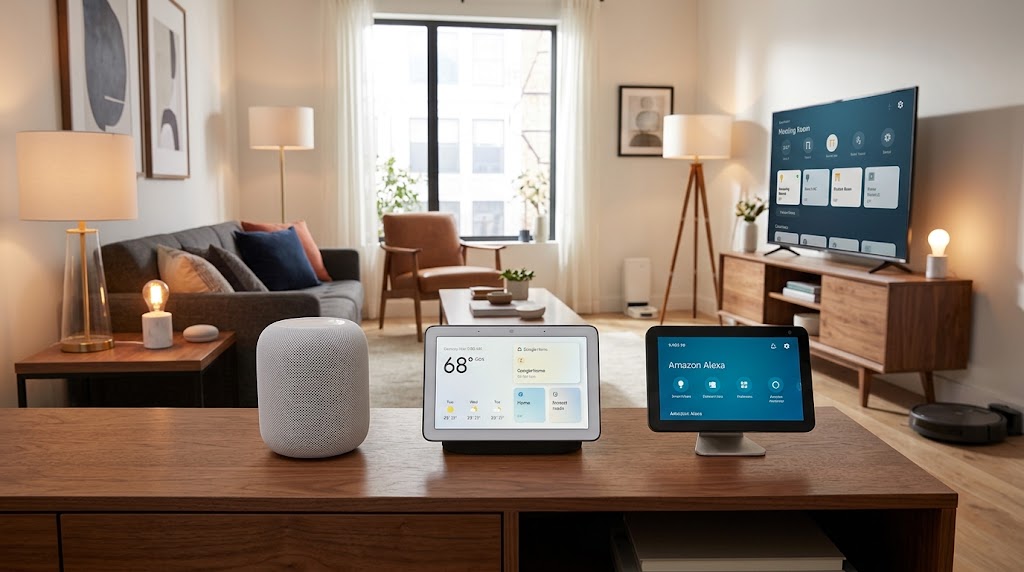
Quick answer
In 2026, Apple Home is the best ecosystem for Apple households that prioritize privacy, polished local control, Home Key, HomeKit Secure Video, and tight iPhone/Apple TV/HomePod integration. Google Home is the strongest all-around choice for mixed-brand households that want the most advanced AI-first home experience, because Gemini for Home can understand conversational commands, search home context, and help create automations. Amazon Alexa remains the strongest choice for users who prioritize device breadth, Echo hardware, Zigbee and Sidewalk support, Ring integration, and Alexa+ routines. Matter reduces platform lock-in, so the best strategy is increasingly to buy high-quality Matter devices and choose the ecosystem based on interface, assistant, cameras, media, and privacy preferences.
Table of contents
- The 2026 Verdict
- Best for Apple households and privacy: Apple Home
- Best overall AI-first smart home: Google Home
- Best for device breadth and smart-home hardware: Amazon Alexa
- At a Glance
- Apple Home in 2026: Privacy and Ecosystem Coherence
- Apple Home’s strongest advantages
- Apple Wins the Privacy Category
- Apple Home Hubs and Thread
- Why Apple Home feels simple
- Apple Automations: Solid but Not AI-First
- Apple Home’s Biggest Weakness: Hardware Breadth Outside Matter
- Google Home in 2026: The AI Winner
- Gemini for Home Changes the Interface
- Google Is Strongest for AI-Assisted Automations
- The Google Home Subscription Story
- Google Home and Matter
- Google’s major advantage
- Google Home’s Biggest Weakness: Some Automations Still Depend on Services
- Amazon Alexa in 2026: The Hardware and Integration Winner
- Alexa+ Can Create Routines by Voice
- Google vs. Alexa AI
- Echo Hub Is the Best Dedicated Smart-Home Controller of the Three
- Why this matters for existing smart homes
- Alexa and Matter
- Matter Makes Ecosystem Lock-In Less Important
- Multi-admin changes the buying strategy
- Matter Does Not Make Every Ecosystem Feature Equal
- Cameras Are Still Highly Ecosystem-Specific
- Apple Home
- Google Home
- Amazon Alexa
- Privacy Comparison
- Apple: strongest privacy-first architecture
- Google: strong controls, but more AI processing
- Amazon: strong user controls, larger cloud footprint
- Voice Assistant Ranking in 2026
- 1. Gemini for Home
- 2. Alexa+
- 3. Siri for Apple Home
- Automation Ranking
- Best for AI-assisted creation: Google Home
- Best for voice-created routines: Alexa+
- Best for deterministic Apple workflows: Apple Home
- Power-user caveat
- Device Compatibility Ranking
- For new Matter devices
- For legacy Zigbee devices
- For legacy Z-Wave
- For HomeKit-native legacy hardware
- For Nest-specific hardware
- For Ring / Blink / Sidewalk
- Music and Media
- Apple
- Amazon
- Household Sharing
- Subscription Comparison
- Apple Home
- Google Home
- Amazon Alexa
- Best Ecosystem by User Type
- All-iPhone household
- Android household
- Prime + Ring household
- Mixed iPhone + Android household
- Privacy-first household
- Automation enthusiast
- Can You Use All Three?
- The downside
- The Best 2026 Architecture
- Step 1: Buy Matter where the product is good
- Step 2: Choose one primary ecosystem
- Step 3: Avoid ecosystem-exclusive hardware where possible
- Step 4: Keep critical automations local
- Step 5: Add premium cloud AI only when it solves a real problem
- The 2026 Scorecard
- Frequently Asked Questions
- Is HomeKit being replaced by Matter?
- Does Google Home work locally?
- Does Alexa control Matter devices locally?
- Which ecosystem supports Matter 1.6?
- Which is best if I already own Home Assistant?
- Conclusion
Key takeaways
- Apple Home wins for privacy, Apple-device integration, Home Key, and a clean local-first experience.
- Google Home wins for AI-first control in 2026 because Gemini for Home can handle natural-language device commands, contextual questions, and automation creation.
- Amazon Alexa still offers the broadest smart-home hardware story, especially through Echo Hub's built-in support for Zigbee, Sidewalk, Thread, Bluetooth, Matter, and Wi-Fi.
- Matter has made device compatibility less ecosystem-specific, so cameras, subscriptions, voice assistants, household platforms, and privacy are now more important differentiators.
- No ecosystem supports every Matter feature at the same pace: Apple, Google, and Amazon can support different Matter versions, device categories, and vendor-specific functions.
Editorial transparency
Who worked on this article and how it was handled.
- Written by
- Maya Chen
- Creation method
- Editorial research
AI assistance: AI assisted with research organization and drafting. Sources, ecosystem features, current subscriptions, Matter support, and the final article should be reviewed by a human editor before publication.
In 2026, choosing a smart-home ecosystem is less about asking, “Which brand supports the most light bulbs?” and more about deciding which company you want to provide the interface, automation engine, voice assistant, camera experience, household permissions, and AI layer for your home.
Matter has changed the competitive landscape.
A growing number of locks, sensors, plugs, blinds, thermostats, fans, appliances, and other devices can now join more than one ecosystem. That means the same Matter accessory may work with Apple Home, Google Home, and Amazon Alexa instead of forcing you to choose one platform at purchase.
But Matter has not made Apple, Google, and Amazon interchangeable.
Their differences have moved up the stack.
Apple Home emphasizes privacy, local control, security, and tight integration with iPhone, Apple Watch, Apple TV, and HomePod.
Google Home has become aggressively AI-first through Gemini for Home, combining smart-home control, conversational reasoning, camera understanding, and natural-language automation creation.
Amazon Alexa has also moved into generative AI with Alexa+, while maintaining one of the broadest smart-home hardware ecosystems through Echo, Ring, eero, Zigbee, Sidewalk, Matter, and Thread.
So which one wins in 2026?
For most households, there is no universal winner—but there are now very clear winners by user type.
The 2026 Verdict
Best for Apple households and privacy: Apple Home
Choose Apple Home if:
- most household members use iPhone;
- Apple Watch and Apple TV matter;
- you want Home Key;
- HomeKit Secure Video matters;
- privacy architecture is a major buying criterion;
- you prefer a cleaner, less commerce-focused smart-home interface.
Best overall AI-first smart home: Google Home
Choose Google Home if:
- you use Android or mixed phone platforms;
- conversational voice control matters;
- you want Gemini integrated across the home;
- you use Nest cameras or thermostats;
- natural-language automation creation sounds more useful than manually building routines.
Best for device breadth and smart-home hardware: Amazon Alexa
Choose Alexa if:
- you have a large mix of third-party products;
- Ring or eero is central to the home;
- you want a dedicated Echo Hub dashboard;
- Zigbee or Amazon Sidewalk devices matter;
- you are a Prime household that can use Alexa+ without an additional Alexa+ fee.
At a Glance
| Category | Apple Home | Google Home | Amazon Alexa |
|---|---|---|---|
| Best for | Apple-first households | AI-first mixed homes | Device-heavy mixed homes |
| Voice assistant | Siri | Gemini for Home | Alexa+ |
| Matter | Yes | Yes | Yes |
| Thread | Yes, via compatible Home hubs | Yes, via compatible Nest/Google devices | Yes, via compatible Echo/eero |
| Zigbee hub built in | No | No on standard Google Home hubs | Yes on selected Echo hubs |
| Sidewalk | No | No | Yes |
| Local Matter control | Yes | Yes | Yes |
| Core smart-home subscription required | No | No | No |
| Premium AI/camera subscription | iCloud+ for selected services such as HSV | Google Home Premium for advanced features | Alexa+ $19.99/mo standalone in U.S.; included with Prime |
| Privacy positioning | Strongest | Strong, but AI/cloud-heavy | Strong controls, but cloud/commerce-heavy |
| AI automation creation | Limited compared with rivals | Excellent | Excellent |
| Camera ecosystem | HomeKit Secure Video partners | Nest | Ring / Blink |
| Multi-platform phone support | Best on Apple devices | Android + iOS | Android + iOS |
| Best dedicated smart-home dashboard | iPad/iPhone/Home app, Apple TV display experience | Nest Hub / Google Home app | Echo Hub |
This table summarizes ecosystem direction rather than every individual device capability. Matter versions and feature exposure can vary by controller and product.
Apple Home in 2026: Privacy and Ecosystem Coherence
The consumer platform is now best called Apple Home, although HomeKit remains the underlying compatibility and development framework for many accessories.
Apple’s biggest strength is not having the most devices or the most conversational assistant.
It is coherence.
If your household already uses:
- iPhone;
- Apple Watch;
- Apple TV;
- HomePod;
- Mac;
the smart home becomes another part of the same identity, security, and device ecosystem.
Apple Home’s strongest advantages
- strong privacy model;
- excellent local control;
- Home Key;
- HomeKit Secure Video;
- Apple Watch access;
- Apple TV and HomePod home hubs;
- Matter support;
- Thread support;
- mature scenes and automations;
- guest access for compatible security accessories.
Apple’s current Home architecture also supports:
- robot vacuum cleaners;
- Activity History;
- updated guest roles.
Support for the previous Apple Home architecture officially ended on February 10, 2026, making the newer architecture the baseline.
Apple Wins the Privacy Category
Apple says data related to the home is encrypted and stored so Apple cannot read it.
The company also says:
- Home data is encrypted in transit;
- HomeKit Secure Video recordings are analyzed privately on Apple devices in the home before encrypted cloud storage;
- Siri smart-home requests use random identifiers rather than being directly associated with the Apple Account.
No smart-home ecosystem should be treated as magically private by default.
However, among the three major platforms, Apple gives the clearest first-party privacy architecture for smart-home data.
That is meaningful because a smart home can reveal:
- occupancy;
- door activity;
- camera events;
- room temperature;
- sleep schedules;
- arrival times;
- routines.
For privacy-conscious households, Apple Home’s architecture is a substantial advantage.
Apple Home Hubs and Thread
A HomePod or Apple TV can operate as the Apple Home hub.
Apple currently requires a home hub to add Matter accessories to the Home app.
For Thread-based Matter accessories, Apple supports Thread-capable hubs such as:
- HomePod mini;
- HomePod (2nd generation);
- compatible Apple TV 4K models;
- supported third-party Thread Border Routers.
Apple also allows selected Thread-capable iPhones to pair and manage Thread accessories locally.
Why Apple Home feels simple
The user usually does not need to think about:
- Matter Controller;
- Thread Border Router;
- IPv6 mesh.
The Apple device assumes those infrastructure roles.
That is good consumer design.
Apple Automations: Solid but Not AI-First
Apple Home supports automations based on:
- time of day;
- sunrise and sunset;
- people arriving or leaving;
- accessory state;
- sensor activity.
Scenes can coordinate multiple devices at once.
You can also convert some Home automations into Siri Shortcuts for additional logic.
Technically, this is enough for a sophisticated smart home.
The difference in 2026 is how you create the automation.
Google and Amazon now explicitly let generative AI help create complex automations through natural language.
Apple’s public Home documentation still centers on:
- conventional scenes;
- triggers;
- conditions;
- Siri commands;
- Shortcuts.
For advanced users, Shortcuts can be powerful.
For a nontechnical user who wants to say:
“When everyone leaves after sunset, shut the lights off except the porch and make sure the door is locked,”
Google and Alexa currently provide a more explicitly AI-driven workflow.
Apple Home’s Biggest Weakness: Hardware Breadth Outside Matter
Apple does not provide the same built-in multi-radio hub story as Amazon.
There is no Apple equivalent of Echo Hub with direct support for:
- Zigbee;
- Sidewalk;
- Thread;
- Matter;
- Bluetooth
all in one smart-home control appliance.
Existing Zigbee and Z-Wave ecosystems typically enter Apple Home through:
- vendor bridges;
- Matter bridges;
- Home Assistant;
- another compatible controller.
Matter is improving this problem every year, but users with a large legacy smart home may need more bridge infrastructure.
Google Home in 2026: The AI Winner
Google Home changed more dramatically than Apple Home between 2025 and 2026.
The biggest shift is Gemini for Home.
Google announced Gemini for Home as the replacement for the traditional Google Assistant experience on supported speakers and displays, bringing:
- more natural conversations;
- contextual understanding;
- smart-home control;
- Gemini Live;
- Ask Home;
- AI-assisted automation creation;
- camera understanding.
This is the strongest argument for choosing Google Home in 2026.
Gemini for Home Changes the Interface
Classic voice assistants require precise commands.
For example:
“Turn off the kitchen lights.”
Gemini for Home is designed to understand more contextual requests such as:
“Turn off every light downstairs except the one over the sink.”
Google also lets users ask about the state of the home using conversational queries.
Its Ask Home system can:
- find devices;
- check status;
- control multiple devices;
- create automations.
This dramatically reduces the learning curve for automations.
Instead of navigating:
Automation → Starter → Condition → Action
you can describe what you want.
That is probably the largest UX improvement in consumer home automation since voice assistants became mainstream.
Google Is Strongest for AI-Assisted Automations
Google’s Help me create and Ask Home capabilities can generate automation structures from natural language.
Google gives examples such as describing an automation that:
- turns porch lights on;
- locks the door;
- runs at sunset.
The resulting automation can then be customized.
This matters because automations are where smart homes become genuinely useful—but also where many ordinary users stop because setup becomes too complicated.
Generative AI is well suited to translating:
“what I want my house to do”
into:
triggers, conditions, and actions.
Google is currently the clearest leader in this workflow.
The Google Home Subscription Story
Basic Google Home control does not require Google Home Premium.
However, Google’s most advanced AI and camera features increasingly sit inside Google Home Premium.
At launch, Google announced U.S. pricing of:
- Standard: $10/month or $100/year
- Advanced: $20/month or $200/year
The exact current regional price should always be checked in the Google Store because Google notes that pricing can change by market.
Premium features include combinations of:
- Gemini Live;
- advanced Ask Home capabilities;
- AI camera descriptions;
- Home Brief;
- searchable camera history;
- extended video history.
This is the trade-off for Google’s AI lead.
The ecosystem is extremely capable, but the premium experience is increasingly subscription-shaped.
Google Home and Matter
Google Home supports Matter and uses selected Nest and Google devices as Matter hubs.
For Matter-over-Thread accessories, compatible products can also function as Thread Border Routers.
Google’s developer documentation lists Thread-capable devices such as:
- Nest Hub (2nd generation);
- Nest Hub Max;
- selected Nest WiFi products.
The exact device list evolves, so verify the specific hub before buying.
Google’s major advantage
Android and Google Play Services can help coordinate Thread credentials and Matter commissioning.
This allows the phone, home hub, and Thread infrastructure to feel like one setup system.
For Android-first households, the experience can be particularly seamless.
Google Home’s Biggest Weakness: Some Automations Still Depend on Services
Matter gives Google a strong local-control layer.
But not every Google Home automation is necessarily local.
Google’s own automation support documentation warns that automations can depend on:
- internet;
- Wi-Fi;
- Google service availability;
- third-party manufacturer services.
That means two automations inside the same Google Home app can have very different reliability characteristics.
A Matter light controlled locally through a Nest hub is architecturally different from a cloud-connected device integrated through an external service.
For reliability-critical automations, understand the underlying path.
Amazon Alexa in 2026: The Hardware and Integration Winner
Alexa has also undergone a major transition.
Alexa+ is Amazon’s generative-AI version of Alexa.
In the United States, Amazon says Alexa+ is:
- available to everyone;
- included with Prime at no additional cost;
- $19.99/month for unlimited standalone access for non-Prime customers.
Regional availability and pricing vary.
Alexa+ brings:
- more natural conversations;
- household context;
- planning;
- personalized information;
- automation creation;
- broader task execution.
For a Prime household that already owns Echo devices, this is an unusually strong value proposition.
Alexa+ Can Create Routines by Voice
Amazon says Alexa+ can create complex Routines from natural-language requests.
Instead of opening the Alexa app, users can ask for a routine such as:
- turn on a device at a particular time;
- gradually change lighting;
- start music;
- add weather-based behavior;
- create personalized routines for household members.
That puts Amazon much closer to Google’s AI automation experience than the previous generation of Alexa.
Google vs. Alexa AI
Google’s advantage is the depth of Gemini across:
- search;
- contextual questions;
- cameras;
- Google services;
- natural-language home queries.
Alexa’s advantage is execution across:
- Echo;
- Amazon services;
- smart-home integrations;
- routines;
- shopping and third-party actions.
Both have moved well beyond the old “voice remote for a light bulb” model.
Echo Hub Is the Best Dedicated Smart-Home Controller of the Three
This is where Amazon clearly wins.
Echo Hub is purpose-built as a smart-home dashboard.
Amazon’s current 2026 documentation lists built-in support for:
- Wi-Fi;
- Bluetooth;
- Zigbee;
- Amazon Sidewalk;
- Thread;
- Matter.
It can control:
- cameras;
- locks;
- thermostats;
- lights;
- plugs;
- blinds;
- security systems.
That is a remarkably broad hardware bridge.
Why this matters for existing smart homes
Suppose you own:
- Zigbee contact sensors;
- Matter plugs;
- Ring cameras;
- Thread blinds.
Amazon has first-party hardware designed to bring those categories into one dashboard without requiring a separate hub for every protocol.
Apple and Google are strongest when devices use:
- Matter;
- Thread;
- Wi-Fi;
- vendor bridges.
Amazon is still more accommodating to mixed legacy hardware.
Alexa and Matter
Matter-enabled Echo devices support local Matter connections.
Amazon’s developer documentation says Matter devices can connect directly to Alexa locally, reducing latency and improving reliability.
Compatible Echo devices support:
- Matter over Wi-Fi;
- Matter over Thread.
Selected Echo and eero devices act as Thread Border Routers.
As of March 2026, Amazon says Matter-enabled Echo devices support Matter 1.5.
That is worth noting because the Connectivity Standards Alliance released Matter 1.6 in June 2026.
Platform support naturally trails specification release dates, so consumers should not assume every ecosystem immediately exposes every new Matter 1.6 capability.
Matter Makes Ecosystem Lock-In Less Important
Matter is the biggest reason this comparison is different in 2026.
The Connectivity Standards Alliance released Matter 1.6 on June 17, 2026.
The update focuses on:
- easier commissioning;
- multi-ecosystem device management;
- richer context;
- better device-state communication.
Matter does not require Apple, Google, and Amazon to provide identical interfaces.
It allows devices to speak a common smart-home language.
Multi-admin changes the buying strategy
A compatible Matter device can often join more than one ecosystem.
That means a household can potentially:
- use Apple Home for iPhone control;
- Google Home for Gemini;
- Alexa for an Echo Show;
with the same underlying Matter device.
Not every vendor feature will appear everywhere.
But the basic device no longer needs to belong exclusively to one platform.
Matter Does Not Make Every Ecosystem Feature Equal
This is the most important caveat.
Matter standardizes device capabilities.
An ecosystem decides how those capabilities appear.
For example, one Matter thermostat may expose:
- temperature;
- mode;
- fan state;
- schedules;
- energy information.
Apple, Google, and Amazon may not surface every feature in the same interface at the same time.
The same is true for:
- robot vacuums;
- cameras;
- appliances;
- energy management.
Always check the exact device + ecosystem combination.
Cameras Are Still Highly Ecosystem-Specific
Matter has not erased camera lock-in.
Apple Home
Best when:
- HomeKit Secure Video matters;
- iCloud+ is already part of the household;
- encrypted Apple Home integration is preferred.
Google Home
Best when:
- Nest cameras are central;
- Gemini camera intelligence matters;
- searchable video history and Home Brief are valuable.
Amazon Alexa
Best when:
- Ring or Blink is central;
- Echo Show live views matter;
- Ring and Alexa+ integrations are useful.
This is one area where ecosystem selection can still determine the long-term hardware path.
Privacy Comparison
Apple: strongest privacy-first architecture
Apple explicitly says:
- Home data is encrypted so Apple cannot read it;
- HomeKit Secure Video uses end-to-end encryption;
- Siri requests use random identifiers.
Winner: Apple Home
Google: strong controls, but more AI processing
Google says it does not train generative AI models outside Google Home using users’ personal home data.
Still, the 2026 Google Home experience increasingly includes:
- cloud AI;
- premium camera intelligence;
- Gemini context.
That increases the role of Google’s services in the home experience.
Amazon: strong user controls, larger cloud footprint
Amazon provides privacy dashboards and says Alexa+ is built around privacy and security.
But Alexa+’s core value comes from:
- cloud AI;
- personalization;
- external services;
- shopping;
- service integrations.
Users who want the smallest possible cloud footprint will generally prefer Apple.
Voice Assistant Ranking in 2026
1. Gemini for Home
Best for:
- complex natural language;
- contextual questions;
- camera queries;
- smart-home reasoning;
- automation generation.
2. Alexa+
Best for:
- natural conversation;
- routine creation;
- household tasks;
- service integrations;
- smart-home execution.
3. Siri for Apple Home
Best for:
- fast conventional commands;
- Apple-device ubiquity;
- privacy-focused Apple workflows.
Apple still provides a strong voice-control surface, but its current public Home documentation does not advertise a generative home assistant comparable to Gemini for Home or Alexa+.
That makes Siri the least ambitious smart-home assistant of the three in this specific 2026 comparison.
Automation Ranking
Best for AI-assisted creation: Google Home
Gemini can translate natural language into automations.
Best for voice-created routines: Alexa+
Alexa+ can create multi-step Routines directly from voice requests.
Best for deterministic Apple workflows: Apple Home
Home automations plus Shortcuts remain powerful, especially for Apple users willing to configure them manually.
Power-user caveat
None of these three consumer ecosystems matches a dedicated automation platform such as:
- Home Assistant;
- Hubitat;
- openHAB
for deeply conditional local automation.
You can still use one of those systems underneath Apple Home, Google Home, or Alexa as the household interface.
Device Compatibility Ranking
The situation is more nuanced than old “Works with Alexa has more products” comparisons.
Matter has narrowed the gap.
For new Matter devices
Near tie
All three are major Matter ecosystems.
For legacy Zigbee devices
Amazon wins
because selected Echo products include Zigbee radios directly.
For legacy Z-Wave
None of the three is a first-party universal Z-Wave platform.
Use:
- a compatible bridge;
- SmartThings;
- Hubitat;
- Home Assistant;
- another Z-Wave controller.
For HomeKit-native legacy hardware
Apple wins
obviously.
For Nest-specific hardware
Google wins
For Ring / Blink / Sidewalk
Amazon wins
Music and Media
This category often determines ecosystem satisfaction more than the light switches.
Apple
Best with:
- Apple Music;
- AirPlay;
- Apple TV;
- HomePod;
- Apple Podcasts.
Best with:
- YouTube;
- YouTube Music;
- Google TV;
- Google Photos;
- Nest displays.
Gemini for Home also ties directly into Google’s broader knowledge and media services.
Amazon
Best with:
- Amazon Music;
- Fire TV;
- Echo multi-room audio;
- Amazon Photos;
- Prime ecosystem.
Spotify and other third-party music services can work across multiple platforms, so check your specific service rather than choosing by brand loyalty.
Household Sharing
Apple’s latest Home architecture now provides more explicit household roles.
Apple supports:
- Residents;
- Guests.
Guests can receive local-only scheduled access to specific security-related accessories such as locks.
This is particularly useful for:
- cleaners;
- house sitters;
- short-term visitors.
Google Home and Alexa also support household membership and shared control, but the exact permission model differs.
If access-control delegation is important, compare the role model before buying locks.
Subscription Comparison
Apple Home
Core Home control: No subscription required
Potential paid layers:
- iCloud+ for HomeKit Secure Video and other Apple cloud services.
Google Home
Core Home control: No subscription required
Advanced AI/camera layers: Google Home Premium
U.S. launch pricing:
- Standard $10/month;
- Advanced $20/month.
Amazon Alexa
Core Alexa smart-home control: No separate Alexa+ subscription required for basic legacy Alexa smart-home functionality
Full Alexa+:
- included with Prime in the U.S.;
- $19.99/month standalone in the U.S.
Regional pricing and feature availability differ.
Best Ecosystem by User Type
All-iPhone household
Choose Apple Home.
You get:
- Apple Watch controls;
- Siri everywhere;
- Apple TV/HomePod hubs;
- privacy;
- Home Key;
- Matter and Thread.
There is little reason to make Google or Amazon the primary interface unless their AI features are specifically more important.
Android household
Choose Google Home.
Gemini integration plus Android’s Matter/Thread commissioning architecture creates the most natural fit.
Prime + Ring household
Choose Amazon Alexa.
Alexa+, Ring, Echo, and Prime create a tightly integrated value bundle.
Mixed iPhone + Android household
Choose Google Home or Alexa, then use Matter multi-admin if Apple Home is also useful.
Google provides the stronger AI-first interface.
Alexa provides the broader hub/radio story.
Privacy-first household
Choose Apple Home, ideally with local Matter/Thread devices and carefully selected camera services.
Automation enthusiast
Use:
- Home Assistant;
- Hubitat;
- openHAB
as the automation brain, then expose devices to the ecosystem your household prefers.
The best UI and the best automation engine do not need to be the same product.
Can You Use All Three?
Yes—and Matter makes this much more realistic.
A sophisticated setup can use:
- Apple Home for iPhone/Watch/Home Key;
- Google Home for Gemini;
- Alexa for Echo speakers and Ring;
- Home Assistant as the local automation layer.
This sounds excessive, but Matter multi-admin means some devices can be shared directly instead of requiring duplicate cloud integrations.
The downside
More ecosystems mean:
- more apps;
- more user accounts;
- duplicate rooms;
- conflicting automations;
- more troubleshooting.
Pick one primary household interface.
Use the others only where they provide a meaningful benefit.
The Best 2026 Architecture
If I were building a new smart home today:
Step 1: Buy Matter where the product is good
Prefer:
- Matter over Thread for battery sensors, locks, blinds, and low-power controls;
- Matter over Wi-Fi or Ethernet for powered devices where appropriate.
Step 2: Choose one primary ecosystem
Pick based on:
- phone platform;
- cameras;
- voice assistant;
- privacy;
- media.
Step 3: Avoid ecosystem-exclusive hardware where possible
A Matter plug gives you more future flexibility than a cloud-only plug tied to one assistant.
Step 4: Keep critical automations local
Use local Matter, Thread, Zigbee, Z-Wave, or a dedicated local automation controller.
Step 5: Add premium cloud AI only when it solves a real problem
Do not pay a subscription simply because a smart-home platform has one.
Pay when:
- searchable camera history;
- AI event understanding;
- advanced remote features;
- conversational automation
actually save time or improve security.
The 2026 Scorecard
| Category | Winner |
|---|---|
| Privacy | Apple Home |
| Apple integration | Apple Home |
| Home access / Home Key | Apple Home |
| AI voice assistant | Google Home / Gemini |
| AI automation creation | Google Home |
| Voice-created routines | Alexa+ |
| Legacy protocol breadth | Amazon Alexa |
| Dedicated smart-home hub | Amazon Echo Hub |
| Ring ecosystem | Amazon Alexa |
| Nest ecosystem | Google Home |
| Matter support | Three-way competitive field |
| Thread | Three-way competitive field on compatible hardware |
| Subscription-free core smart-home control | All three |
| Lowest cloud dependency potential | Apple Home |
| Best mixed-brand default | Google Home |
| Best for Prime households | Amazon Alexa |
Frequently Asked Questions
Is HomeKit being replaced by Matter?
No. Apple Home supports both HomeKit and Matter. Matter broadens cross-platform accessory compatibility; HomeKit and Apple Home still provide Apple’s ecosystem-specific features.
Does Google Home work locally?
Matter devices can communicate locally through compatible Google Home hubs, but not every Google Home integration or automation is local. Google explicitly notes that automations can depend on internet and third-party service availability.
Does Alexa control Matter devices locally?
Yes. Amazon’s Matter documentation states that compatible Matter devices can connect directly to Alexa locally through supported Echo hardware.
Which ecosystem supports Matter 1.6?
Matter 1.6 was released in June 2026 for platforms and device makers to integrate. Ecosystem rollout does not happen instantly. Amazon publicly documents Matter 1.5 support on compatible Echo devices as of March 2026. Verify exact Matter 1.6 feature support before buying around a specific new capability.
Which is best if I already own Home Assistant?
Use Home Assistant as the automation layer and choose Apple Home, Google Home, or Alexa based on household UX. Matter and bridge integrations can expose devices into multiple ecosystems.
Conclusion
There is no longer a single smart-home ecosystem that wins every category.
Apple Home is the best ecosystem for households that value privacy, local control, Home Key, and seamless Apple-device integration.
Google Home is the strongest all-around recommendation for a new mixed-brand smart home in 2026 because Gemini for Home changes how ordinary users control devices and build automations.
Amazon Alexa remains the strongest ecosystem for hardware breadth, mixed radio protocols, Echo Hub, Ring, and Prime households—and Alexa+ has made its voice experience dramatically more capable.
My default recommendation is:
Apple Home for Apple-first homes. Google Home for AI-first mixed homes. Alexa for device-heavy or Ring/Prime homes.
And whenever possible, buy Matter-compatible hardware so choosing an ecosystem today does not lock the device to that ecosystem forever.
Common questions
Questions this guide answers
Which smart home ecosystem is best in 2026?
Google Home is the strongest default for many mixed-device households because Gemini for Home adds conversational control and easier automation creation while Google maintains broad Matter and Thread support. Apple Home is better for privacy-focused Apple users, while Alexa is better for households that want the widest mix of smart-home integrations and Echo hub hardware.
Is Apple HomeKit still relevant now that Matter exists?
Yes. Apple Home is now both a HomeKit and Matter ecosystem. Matter expands the compatible device pool, while Apple still differentiates through the Home app, Siri, Home Key, HomeKit Secure Video, Apple TV and HomePod hubs, privacy architecture, scenes, automations, and deep integration with Apple devices.
Is Google Home better than Alexa in 2026?
Google Home has the stronger AI-first experience because Gemini for Home is deeply integrated into device control, natural-language queries, camera understanding, and automation creation. Alexa remains stronger for smart-home hardware breadth and direct hub radios such as Zigbee, Sidewalk, Thread, Matter, Bluetooth, and Wi-Fi on products such as Echo Hub.
Can Matter devices work with Apple, Google, and Alexa at the same time?
In many cases, yes. Matter supports multi-admin and multi-ecosystem use, allowing a compatible device to be shared across more than one Matter controller. Actual exposed features still depend on the device type, Matter version, vendor implementation, and which capabilities each ecosystem supports.
Evidence & further reading
Sources & references
Primary and authoritative references used to support or contextualize this article. Links open the original source.
- 1Set up your HomePod, HomePod mini, or Apple TV as a home hub
Apple Support · Accessed Aug 10, 2026
Supports Apple Home hub requirements, Matter support, and Thread-enabled HomePod/Apple TV home hub requirements.
- 2Pair and manage your Matter accessories
Apple Support · Accessed Aug 10, 2026
Supports Apple's current Matter accessory management and Thread requirements.
- 3Create scenes and automations with the Home app
Apple Support · Accessed Aug 10, 2026
Supports Apple Home scenes and automations based on accessory events, time, location, and sensors.
- 4Share control of your home
Apple Support · Accessed Aug 10, 2026
Supports current Apple Home Resident and Guest access roles, including scheduled guest access to compatible security accessories.
- 5Privacy - Features
Apple · Accessed Aug 10, 2026
Supports Apple's claims that Home data is encrypted so Apple cannot read it, HomeKit Secure Video uses end-to-end encrypted iCloud storage, and Siri smart-home requests use random identifiers rather than the Apple Account.
- 6Update Apple Home
Apple Support · Accessed Aug 10, 2026
Supports the February 2026 end of support for the previous Apple Home architecture and current features including guest access, robot vacuums, and Activity History.
- 7Gemini for Home: Your household’s new, more helpful assistant
Google · Accessed Aug 10, 2026
Supports Gemini for Home as Google's generative AI voice-assistant direction and its natural-language smart-home control.
- 8Gemini for Home: The helpful home gets an AI upgrade
Google · Accessed Aug 10, 2026
Supports Ask Home, natural-language device control, AI-assisted automation creation, and subscription requirements for advanced Gemini for Home features.
- 9Get started with Gemini for Home features
Google Home and Nest Help · Accessed Aug 10, 2026
Supports current Gemini for Home availability structure, Ask Home, Help me create, camera AI features, and Google Home Premium dependencies.
- 10Thread Play Services APIs
Google Home Developers · Accessed Aug 10, 2026
Supports Google's Matter-over-Thread architecture and current Nest devices that can function as Thread Border Routers.
- 11Manage smart home automations in Google Home
Google Home and Nest Help · Accessed Aug 10, 2026
Supports Google's current automation editor and Google's warning that automations can depend on internet, Wi-Fi, and third-party service availability.
- 12Google Home Premium
Google · Accessed Aug 10, 2026
Supports U.S. Google Home Premium Standard and Advanced pricing at launch and the inclusion of advanced Gemini for Home and camera features.
- 13Echo Hub tips: How to get the most out of your smart home control panel
Amazon · Accessed Aug 10, 2026
Supports Echo Hub's built-in Wi-Fi, Bluetooth, Zigbee, Sidewalk, Thread, and Matter smart-home hub capabilities.
- 14Connect Your Device to Alexa with Matter
Amazon Alexa Developer · Accessed Aug 10, 2026
Supports local Matter control through Alexa, Matter-over-Wi-Fi and Matter-over-Thread support, and Thread Border Router functionality in compatible Echo and eero devices.
- 15What's New in Alexa-Enabled Smart Home
Amazon Alexa Developer · Accessed Aug 10, 2026
Supports Matter 1.5 support on Matter-enabled Echo devices as of March 2026.
- 16Alexa+ now available to everyone in the US—and free for Prime members
Amazon · Accessed Aug 10, 2026
Supports Alexa+ U.S. availability, $19.99 monthly standalone pricing, and inclusion with Amazon Prime.
- 1750+ things to try with Alexa+
Amazon · Accessed Aug 10, 2026
Supports natural-language creation of Alexa Routines and Alexa+'s current household and smart-home capabilities.
- 18Matter 1.6 Enables More Intuitive Setup, Multi-Ecosystem Experiences, and Context-Driven Control
Connectivity Standards Alliance · Accessed Aug 10, 2026
Supports Matter 1.6 as the current June 2026 specification and its improvements to setup and multi-ecosystem device management.

About the author
Maya Chen
Maya covers residential energy, HVAC controls, and practical home automation, translating technical systems into useful decisions for homeowners and renters.
More from Maya →Make your home smarter without buying every gadget.
One useful idea, one product worth knowing, and one energy-saving action—delivered weekly.
No spam. Unsubscribe anytime.
Semantic recommendations
Related reading
Selected from topic cluster, entities, tags, search intent, and editorial relationships.

Zigbee vs. Z-Wave vs. Thread: Which Smart Home Protocol Wins in 2026?
Thread is the strongest choice for new Matter-first smart homes in 2026, while Zigbee remains the value and device-selection leader and Z-Wave excels in sub-GHz reliability, security, and long-range installations.
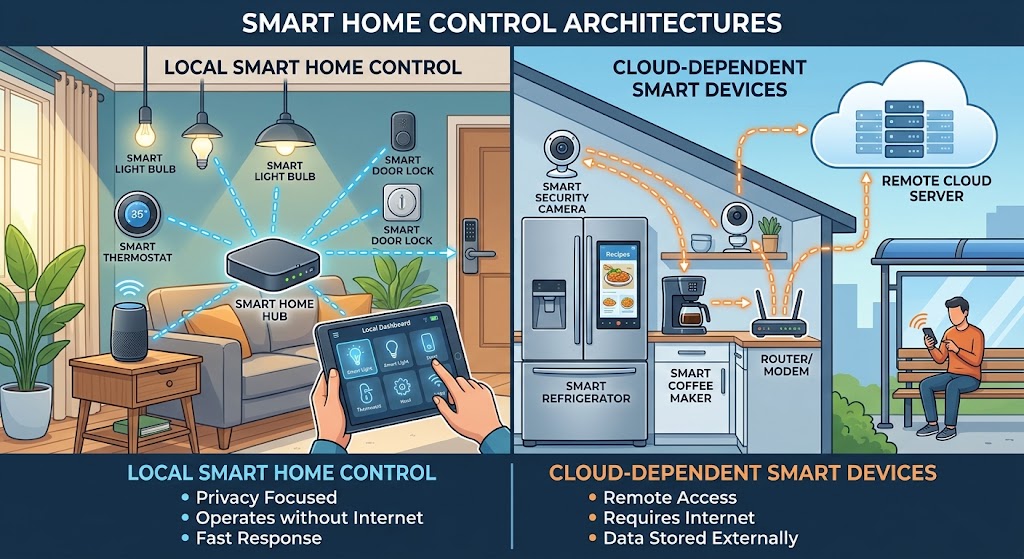
Local Control vs. Cloud Smart Home: Why You Should Avoid Cloud Dependency
Cloud features are useful, but your lights, locks, sensors, and core automations should not stop working when the internet or a vendor service fails. Here is how to build a local-first smart home in 2026.
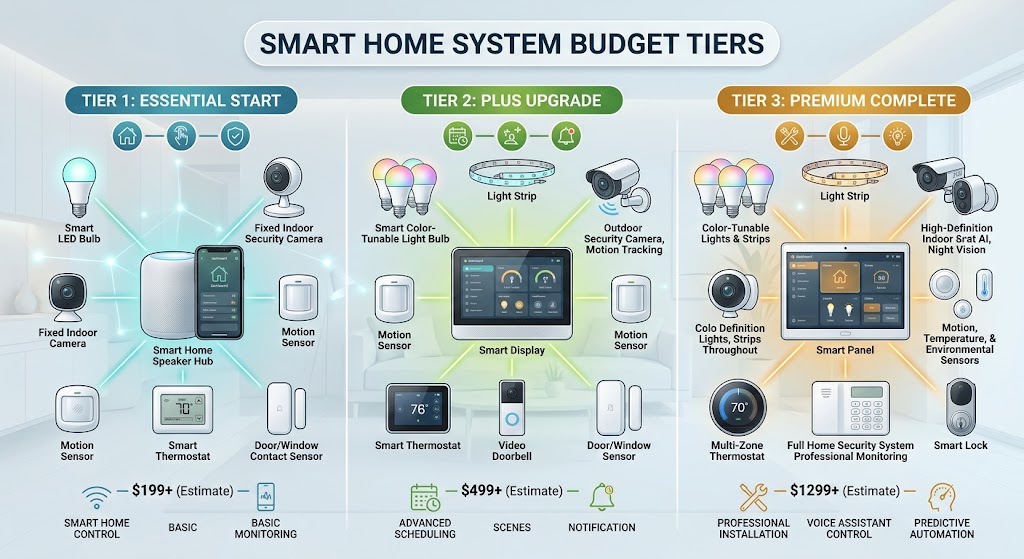
The Ultimate 2026 Smart Home Buying Guide: $500, $1,500, and $5,000 Budgets
Three practical 2026 smart-home builds for $500, $1,500, and $5,000, with current pricing, local-first architecture, Matter/Zigbee/Thread strategy, security, safety, and upgrade priorities.
The Best Renter-Friendly Smart Locks That Keep Your Landlord’s Key Working
The best renter smart locks retrofit the inside of your existing lock so the exterior cylinder and landlord’s physical key can keep working. Here are the strongest US and EU options.