
Are Smart Vent Covers Worth It? (HVAC Airflow Test & Energy Savings)
Smart vent covers can improve room-by-room comfort, but their energy savings are less certain than many homeowners expect. Here is how to judge whether they are worth buying.
Quick answer
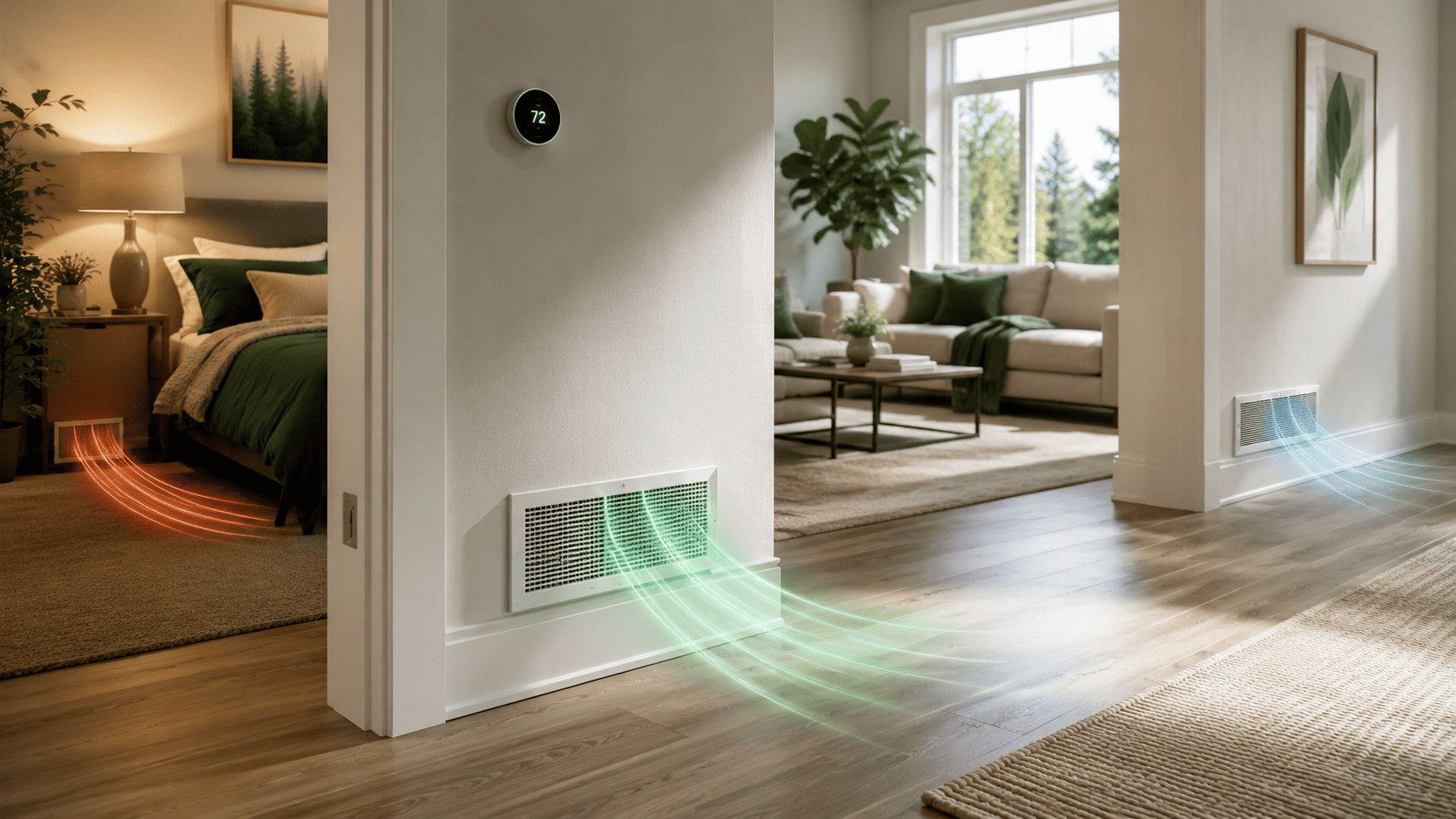
Smart vent covers are usually worth it for comfort first, not as a guaranteed utility-bill upgrade. They can help reduce overheating or overcooling in specific rooms, but they do not replace proper duct design, duct sealing, or a real zoning system, and savings are often modest or uncertain unless the home's airflow problems are relatively minor and the system manages static pressure safely.
Table of contents
- What Smart Vent Covers Actually Do
- Smart vent covers vs. real zoning
- The Main Question: Comfort or Energy Savings?
- When savings are possible
- When savings are often overstated
- The HVAC Airflow Test to Ask For Before You Buy
- 1. Static pressure
- 2. Delivered airflow to problem rooms
- 3. Duct leakage and duct condition
- 4. Equipment type and control behavior
- What the Technology Does Well
- What the Technology Cannot Fix
- Cost: What You Actually Pay
- A simple cost reality check
- When Smart Vent Covers Are Worth It
- Your goal is comfort first
- You have predictable room usage
- Your HVAC system has been checked for airflow risk
- You understand that savings may be modest
- When Smart Vent Covers Are Not Worth It
- You are trying to fix a fundamentally bad duct system
- You expect them to behave like full zoning
- You already have airflow or equipment-stress issues
- You want clear, guaranteed payback
- A Better Buying Framework
- The Bottom Line on Energy Savings
- Conclusion
Key takeaways
- Smart vent covers can be useful for room-by-room comfort, but they are not a guaranteed energy-saving fix.
- If your real problem is leaky ducts, poor duct design, or bad system sizing, smart vents will not solve it.
- Static pressure is the main technical risk, so protections that limit how many vents can close matter.
- A full zoning system and duct sealing have a stronger technical basis than simply closing registers.
- Smart vent covers make the most sense in homes with mild comfort imbalances, predictable room usage, and compatible forced-air systems.
Editorial transparency
Who worked on this article and how it was handled.
- Written by
- Daniel Reed
- Creation method
- Editorial research
AI assistance: AI assisted with research organization and drafting. Sources, factual claims, and the final article should be reviewed by a human editor before publication.
A lot of homeowners discover smart vent covers the same way: one bedroom is always too warm, the upstairs runs hotter than the main floor, or the guest room gets conditioned all day even when nobody is using it. Smart vents promise a simple answer—open and close registers automatically, redirect air where it is needed, and cut waste at the same time.
The catch is that HVAC airflow is not the same as water from a faucet. Closing a vent does not magically make unwanted heating or cooling disappear. In some houses it improves comfort, in others it changes very little, and in the wrong setup it can raise static pressure and make the system work harder.
This guide explains when smart vent covers are worth the money, when they are not, and what an HVAC airflow test should check before you buy. It also compares smart vents with alternatives that often deliver more reliable savings, such as duct sealing or a properly designed zoning system.
What Smart Vent Covers Actually Do
A smart vent cover is a motorized register that opens or closes based on room temperature, schedules, occupancy logic, or app-based settings. In practice, the goal is usually one of two things:
- reduce overheating or overcooling in specific rooms; or
- reduce conditioning in rooms that are not being used.
That sounds similar to HVAC zoning, but it is not the same thing.
Smart vent covers vs. real zoning
A true ducted zoning system uses dedicated dampers in the ductwork, one or more thermostats, and zone-control logic designed around the HVAC equipment. A smart vent cover is a lighter retrofit placed at room registers.
That matters because a ducted zoning system is engineered to manage airflow across zones. A smart vent cover system is trying to improve room-level comfort from the edges of the distribution system.
| Option | Main goal | Typical strength | Main limitation |
|---|---|---|---|
| Smart vent covers | Room-by-room trimming of airflow | Easier retrofit, app control, better comfort in selected rooms | Not a substitute for duct design or true zoning |
| Manual register balancing | Basic airflow reduction | Cheap and simple | Static settings only, no automation |
| Duct sealing | Reduce leakage and wasted conditioned air | Strong energy case when ducts leak | Does not provide room-by-room control |
| Full zoning system | Controlled delivery by zone | Better whole-system design for uneven homes | Higher installation cost and complexity |
| Mini-split in a problem room | Independent zone control | Excellent for a persistent hot/cold room | Higher equipment cost and visual impact |
The Main Question: Comfort or Energy Savings?
If your main reason for buying smart vent covers is comfort, the case can be reasonable.
If your main reason is major energy savings, the case gets much weaker.
That distinction is important because the most evidence-backed duct upgrade is still duct sealing. DOE says that in a typical house, about 20% to 30% of the air moving through the duct system is lost because of leaks, holes, and poor connections. ENERGY STAR likewise emphasizes that a well-designed, properly sealed duct system can make a home more comfortable and efficient.
In other words, if your home is wasting conditioned air in the attic, crawlspace, or garage, smart vent covers are addressing the wrong problem.
When savings are possible
Savings are more plausible when all of these are true:
- you have several rooms that are routinely unoccupied;
- the house has mild comfort imbalance rather than a severe airflow defect;
- your HVAC equipment and duct system can tolerate reduced airflow safely;
- the system uses room sensing and conservative closure limits;
- your thermostat strategy actually reduces runtime instead of merely shifting air around.
When savings are often overstated
Savings claims tend to be over-optimistic when:
- the home’s ducts leak badly;
- upstairs/downstairs imbalance is caused by undersized ducts or poor design;
- the system is already struggling with static pressure;
- the equipment is single-stage and sensitive to reduced airflow;
- the smart vents are expected to replace a proper zoning retrofit.
The HVAC Airflow Test to Ask For Before You Buy
The phrase “airflow test” in the title is important. You do not need a lab-grade research study, but you do need more than a guess.
Before spending hundreds of dollars on smart vents, ask an HVAC professional to evaluate the airflow problem itself. A good diagnostic conversation should cover four things.
1. Static pressure
Static pressure is the biggest technical risk with smart vents. When too many registers close, pressure on the supply side can rise. Vendors know this is a real issue: Flair’s support documentation says its back-pressure protection algorithm limits how many smart vents can close and can even force one vent open so another can close.
That is a strong clue about the real-world risk. If your system is already operating near its pressure limits, adding more automated restriction is a bad idea.
2. Delivered airflow to problem rooms
A room that is chronically too hot or too cold may have:
- an undersized duct run,
- excessive duct length,
- a poor return-air path,
- high solar gain,
- or a thermostat located in an unrepresentative part of the home.
A smart vent cannot fix those root causes. It can only reduce or redirect some supply airflow.
3. Duct leakage and duct condition
DOE and ENERGY STAR both point to duct leakage as a large energy problem in many homes. If the system is losing a significant share of conditioned air before it even reaches the rooms, money is usually better spent sealing and insulating ducts.
4. Equipment type and control behavior
A variable-speed system can sometimes tolerate airflow changes better than a simple single-stage system, but compatibility still depends on the specific installation. You also need to know how the thermostat and vent system interact. Some smart vents rely on room sensors and only attempt to close when a room drifts outside a temperature band, while back-pressure protection may override the closure anyway.
The practical point: if you cannot get a clear answer about airflow, static pressure, and compatibility, do not assume the vents will sort it out for you.
What the Technology Does Well
Smart vent covers have a real use case. They can make a home feel more balanced when the underlying system is mostly decent and the comfort issue is localized.
Common examples include:
- a guest room that only needs conditioning occasionally;
- a sunny upstairs bedroom that overheats relative to the hallway thermostat;
- a home office with electronics that runs warmer than the rest of the house;
- a multi-story layout where modest room-level trimming improves comfort.
In those situations, the biggest benefit may be less thermostat fighting. Instead of lowering the entire home’s thermostat because one room is uncomfortable, the system can sometimes redirect or limit room airflow enough to improve balance.
That is a quality-of-life benefit, even if the annual utility savings are modest.
What the Technology Cannot Fix
This is the part many buyers underestimate.
Smart vent covers do not solve:
- leaky ducts,
- poor duct layout,
- a badly located thermostat,
- undersized return air,
- oversized HVAC equipment,
- insulation and air-leakage problems in the building envelope,
- or severe upstairs/downstairs design issues.
A smart vent is a control accessory, not a full HVAC redesign.
If your second floor is hot because the attic ductwork leaks or because solar gain is extreme and insulation is weak, the vent cover may mask the symptom a little but will not fix the main energy loss.
Cost: What You Actually Pay
One reason the “worth it” question is tricky is that system cost adds up fast.
Keen Home currently lists individual Smart Vents at about $99.99 to $129.99, depending on size. Its Multi-Room Bundle starts at $619, which helps illustrate the real entry point for a system that covers more than one room.
That also means a homeowner can spend several hundred dollars before installation complexity, extra sensors, or bridge requirements are fully accounted for.
A simple cost reality check
If you only buy one or two vents to improve a specific comfort problem, the purchase behaves more like a comfort upgrade than an energy investment.
If you buy enough vents to manage several rooms, your comparison should not be “smart vents vs. doing nothing.” It should be:
- smart vents vs. duct sealing,
- smart vents vs. balancing and thermostat adjustments,
- smart vents vs. adding true zoning,
- smart vents vs. a mini-split for the worst room.
That is the comparison that reveals whether the money is really going to the right problem.
When Smart Vent Covers Are Worth It
Smart vent covers are most likely worth it when:
Your goal is comfort first
If the problem is a few mildly uncomfortable rooms and the rest of the system works fairly well, smart vents can be a reasonable comfort upgrade.
You have predictable room usage
Unused guest rooms, rarely used bonus rooms, or part-time workspaces are better candidates than homes where every room is occupied most of the time.
Your HVAC system has been checked for airflow risk
A contractor should be able to tell you whether static pressure and airflow margins make this kind of accessory sensible.
You understand that savings may be modest
The best buyers are usually not expecting a miracle payback. They are buying smarter room-level control and treating any bill reduction as a bonus.
When Smart Vent Covers Are Not Worth It
They are usually not worth it when:
You are trying to fix a fundamentally bad duct system
If the system loses a large share of air through leakage or poor design, duct repairs have a stronger case.
You expect them to behave like full zoning
True zoning is more expensive, but it is designed as a whole-system solution. Smart vents are not the same class of fix.
You already have airflow or equipment-stress issues
Because smart vents alter how air moves through the system, they are a poor choice when pressure, airflow, or equipment reliability is already questionable.
You want clear, guaranteed payback
Unlike duct sealing, where ENERGY STAR and DOE provide clearer efficiency justification, smart vent payback is much harder to predict. Comfort gains are more dependable than hard-dollar savings.
A Better Buying Framework
If you are evaluating smart vent covers, use this order of operations:
- Fix obvious envelope and duct waste first. Air sealing, insulation, and duct sealing often provide more certain savings.
- Check the HVAC basics. Confirm that filter condition, blower settings, and thermostat placement are not the real issue.
- Ask for an airflow and static-pressure assessment. Do not skip this if you plan to automate multiple vents.
- Define your primary goal. Is it comfort, convenience, energy savings, or all three?
- Compare alternatives honestly. A smart vent cover can be the right answer for a light comfort problem and the wrong answer for a structural HVAC problem.
The Bottom Line on Energy Savings
The most honest answer is this: smart vent covers can save energy, but that is not the reason they are most often worth buying.
They are usually worth it when they help you stop conditioning rooms that do not need as much air, or when they reduce the need to change the whole-house thermostat to fix one troublesome room. But if you are shopping for the strongest, most evidence-backed HVAC savings upgrade, duct sealing and core system improvements usually come first.
That is why smart vent covers are best described as a targeted comfort-control tool with possible secondary savings, not a universal bill-cutting upgrade.
Conclusion
Smart vent covers are worth it for the right house and the right expectation.
If you want better room-by-room comfort, have a mostly healthy forced-air system, and can confirm that airflow and static pressure stay within safe limits, smart vents can be a useful smart-home upgrade. If you want reliable, broad energy savings from an underperforming HVAC system, start with duct sealing, airflow diagnostics, and a proper zoning or system-design discussion instead.
The best next step is not buying vents blindly. It is getting the airflow problem diagnosed first, then deciding whether a smart vent cover is the best fix—or just the most convenient-looking one.
Common questions
Questions this guide answers
Do smart vent covers actually save energy?
Sometimes, but the case is usually stronger for comfort than for large energy savings. Smart vent covers can reduce conditioning in lightly used rooms, yet the savings are highly dependent on duct design, thermostat strategy, occupancy patterns, and whether the system can avoid excessive static pressure when vents close.
Can smart vent covers damage an HVAC system?
They can create problems if too many vents close and static pressure rises too high. That is why vendors such as Flair use back-pressure protection logic, and why smart vents are a poor fit for homes that already have airflow, duct-sizing, or equipment-stress issues.
Are smart vent covers the same as HVAC zoning?
No. A true zoning system uses dedicated dampers in ductwork, zone controls, and thermostats designed as one coordinated system. Smart vent covers are a lighter retrofit that adjusts individual room registers, so they can help with comfort but are not a full substitute for engineered zoning.
How much do smart vent covers cost?
Official pricing varies by brand and size. Keen Home currently lists individual Smart Vents at about $99.99 to $129.99, while its multi-room bundle starts at $619, so the total cost can rise quickly once you add enough vents, sensors, and any required bridge or hub.
Evidence & further reading
Sources & references
Primary and authoritative references used to support or contextualize this article. Links open the original source.
- 1Benefits of Duct Sealing
ENERGY STAR · Accessed Aug 10, 2026
Supports the comfort, air-quality, safety, and efficiency benefits of sealing duct leakage.
- 2Home Upgrades
U.S. Department of Energy · Accessed Aug 10, 2026
Supports DOE guidance that typical homes can lose about 20% to 30% of duct airflow because of leaks, holes, and poor connections.
- 3Back Pressure Protection (BPP) Algorithms / Smart Air Routing (How Flair protects your HVAC system).
Flair · Accessed Aug 10, 2026
Supports the concept of static-pressure protection and Flair's limit on how many smart vents can close.
- 4How to make Smart Vents Open or Close at a Specific Temperature
Flair · Accessed Aug 10, 2026
Supports how smart vents operate from room temperature and notes that back-pressure protection can keep a vent from closing.
- 5Smart Vent
Keen Home · Accessed Aug 10, 2026
Supports current official product pricing, embedded sensing, and core system requirements for a representative smart vent product.
- 6Multi-Room Bundle
Keen Home · Accessed Aug 10, 2026
Supports the current official starting price for a multi-room smart-vent bundle and illustrates realistic entry-level system cost.

About the author
Daniel Reed
Daniel writes about connected-home standards, small-space technology, device interoperability, and privacy-conscious urban living.
More from Daniel →Make your home smarter without buying every gadget.
One useful idea, one product worth knowing, and one energy-saving action—delivered weekly.
No spam. Unsubscribe anytime.
Semantic recommendations
Related reading
Selected from topic cluster, entities, tags, search intent, and editorial relationships.
Smart Ceiling Fan Controllers vs. Running the AC: Summer Energy Test
A smart ceiling fan controller can reduce cooling costs when it helps you run the fan only when people are present and raise the AC setpoint at the same time. Here is the real summer tradeoff.

How to Stop Drafts Under Exterior Doors Without Replacing the Frame
Cold air under an exterior door usually comes from a worn sweep, misadjusted threshold, tired weatherstripping, or unsealed trim. Here is how to fix it without replacing the frame.

5 Smart Thermostat Placement Mistakes That Can Waste Hundreds on HVAC Bills
Wrong thermostat placement can distort temperature readings, increase HVAC runtime, and quietly undermine both comfort and energy savings.
Baseboard Heater Smart Switches: Cut Costs on Older Heating Systems
Smart controls can make old electric baseboard heating cheaper to run by scheduling setbacks and controlling rooms independently—but only with the right line-voltage hardware.