
Smart Ceiling Fan Controllers vs. Running the AC: Summer Energy Test
A smart ceiling fan controller can reduce cooling costs when it helps you run the fan only when people are present and raise the AC setpoint at the same time. Here is the real summer tradeoff.
Quick answer
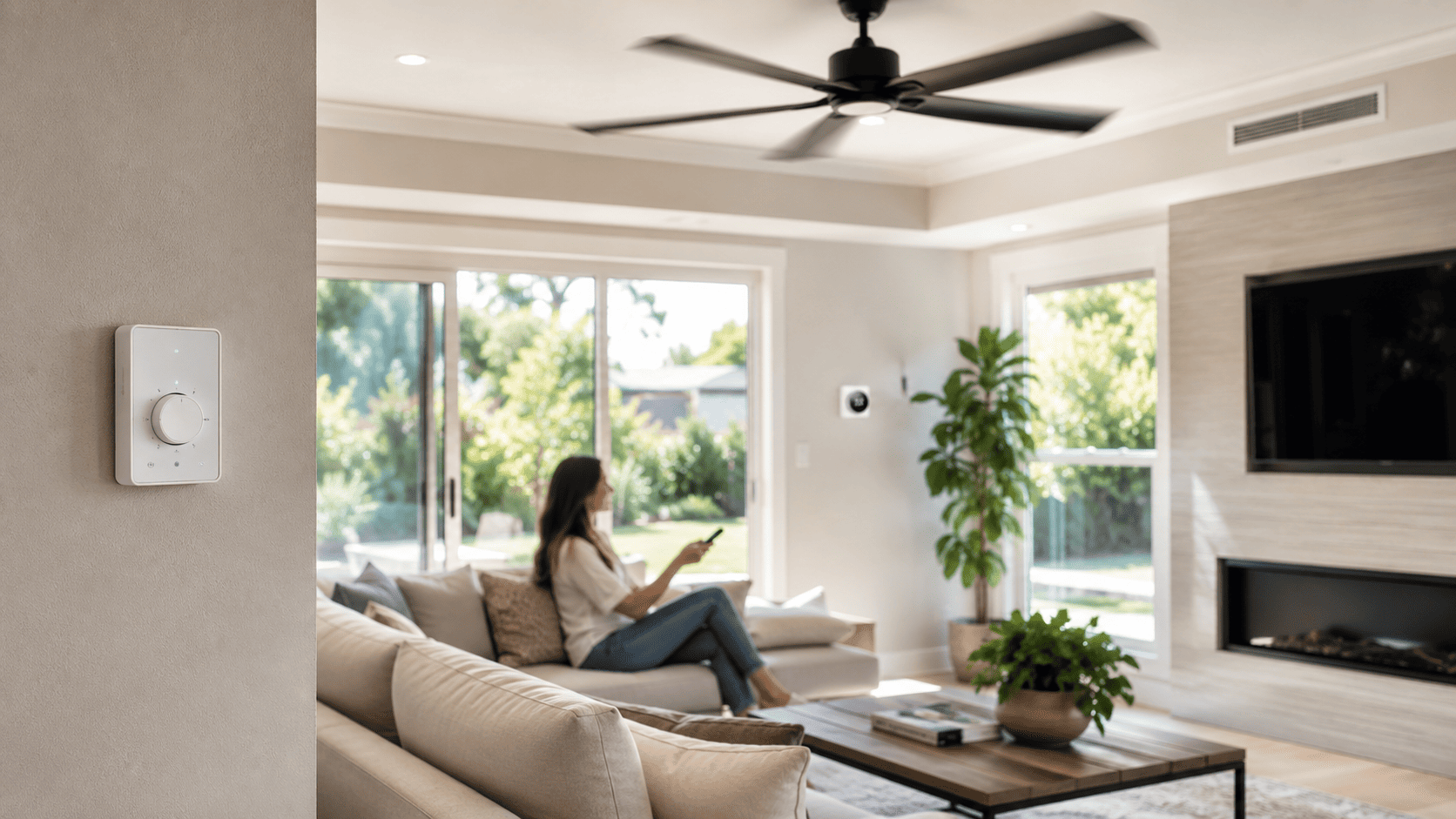
A smart ceiling fan controller usually beats “just run the AC colder” only when it changes behavior: it should turn the fan on when people are present, let you raise the thermostat while occupied, and turn the fan off when the room is empty. The fan itself does not lower room temperature; it cools people through air movement. DOE says using a ceiling fan can let you raise the thermostat setting about 4°F with no reduction in comfort, and ENERGY STAR says raising the thermostat only 2°F while using a ...
Table of contents
- The Core Rule: Fans Cool People, Not Rooms
- What a Smart Ceiling Fan Controller Actually Changes
- The Real Comparison Is Not Fan vs. AC
- Summer Energy Test: Three Common Scenarios
- Scenario 1: AC-only comfort strategy
- Scenario 2: Manual fan + warmer thermostat
- Scenario 3: Smart fan controller + warmer thermostat
- Where the Savings Actually Come From
- 1. AC reduction savings
- 2. Fan waste prevention savings
- 3. Better thermostat behavior
- A Simple Cooling Math Framework
- When a Smart Ceiling Fan Controller Is Worth It
- Occupied rooms with predictable routines
- Homes that already use a ceiling fan for comfort
- Households that forget to turn fans off
- Homes with a smart thermostat
- When It Is Not Worth It
- You already use the fan perfectly by hand
- You barely run air conditioning
- You expect the controller to replace air conditioning
- The room has poor air sealing or heavy solar gain
- Smart Controller vs. Smart Thermostat: Which Saves More?
- Buying Checklist
- 1. Confirm compatibility with the fan
- 2. Decide whether you want wall control or canopy control
- 3. Think about the light kit
- 4. Check whether neutral wiring is required
- 5. Plan the automation logic
- 6. Use a fan-rated control
- The Best Summer Strategy for Most Homes
- Conclusion
Key takeaways
- A ceiling fan saves money only if it lets you raise the AC setpoint or reduce AC runtime while maintaining comfort.
- A smart ceiling fan controller is most valuable when it automates on/off behavior, scheduling, and coordination with occupancy.
- Fans cool people rather than rooms, so leaving them on in empty rooms reduces or erases the savings benefit.
- Official guidance supports the concept: DOE says a ceiling fan can let you raise the thermostat by about 4°F, and ENERGY STAR says a 2°F increase with a fan can lower AC costs by up to 14%.
- The best strategy is usually fan plus smarter thermostat settings, not fan instead of AC on hot days.
Editorial transparency
Who worked on this article and how it was handled.
- Written by
- Daniel Reed
- Creation method
- Editorial research
AI assistance: AI assisted with research organization and drafting. Sources, factual claims, and the final article should be reviewed by a human editor before publication.
Ceiling fans and air conditioners are often discussed like opposing teams, but the real summer-energy question is more practical: Is it cheaper to use a smart ceiling fan controller and keep the AC a little warmer, or to skip the fan strategy and simply run the AC colder?
In most homes, the answer is not “fan instead of AC.” It is fan plus a higher thermostat setting.
That distinction matters because a ceiling fan does not cool a room the way an air conditioner does. It creates a wind-chill effect that helps people feel cooler. If you use that effect correctly, the AC can work less. If you use it poorly—especially by letting the fan run in empty rooms—you can end up using extra electricity for little or no benefit.
This guide treats the comparison as a practical summer energy test. It uses official DOE and ENERGY STAR guidance to show where the savings really come from, how much of the benefit depends on changing behavior, and when a smart controller is worth buying.
The Core Rule: Fans Cool People, Not Rooms
This is the most important line in the whole article.
DOE says that if you use air conditioning, a ceiling fan can allow you to raise the thermostat setting about 4°F with no reduction in comfort—but it also reminds homeowners to turn the fan off when they leave the room because fans cool people, not rooms.
ENERGY STAR says something similar in a more conservative example: if you raise your thermostat by only 2°F and use your ceiling fan, you can lower air-conditioning costs by up to 14%.
Those two official statements tell you almost everything you need to know:
- the savings come from a higher AC setpoint, not from the fan magically removing heat; and
- the strategy only works if the fan runs when comfort is needed and stops when it is not.
That is exactly where a smart ceiling fan controller enters the picture.
What a Smart Ceiling Fan Controller Actually Changes
A smart controller does not make the fan motor fundamentally more efficient on its own. The value comes from automation and coordination.
Depending on the system, a smart controller may give you:
- app-based on/off and speed control;
- schedules by time of day;
- scenes or routines with other smart-home devices;
- voice control;
- occupancy- or presence-based automations;
- integration with a smart thermostat;
- reminders or usage data.
In other words, the device is not the savings. The behavior it automates is the savings.
That is the same principle behind smart thermostats. ENERGY STAR says smart thermostats can learn schedules, use geofencing, offer remote control, and provide energy insights. Their average savings are around 8% of heating and cooling bills, or about $50 per year, according to ENERGY STAR’s FAQ.
A smart fan controller is similar in spirit. It is most useful when it helps your home avoid unnecessary cooling runtime or unnecessary fan runtime.
The Real Comparison Is Not Fan vs. AC
It is easy to frame the decision incorrectly.
Most homeowners are not truly choosing between:
- Option A: ceiling fan only
- Option B: AC only
On hot summer days, a ceiling fan alone is often not enough, especially in humid climates or upper-floor rooms with heavy solar gain.
The more realistic choice is usually between:
- Option A: AC set cooler, fan behavior mostly manual or inconsistent
- Option B: AC set warmer, fan used strategically and possibly automated
That is why a “smart ceiling fan controller vs. running the AC” test really means:
Can smart fan control reduce how much cooling you demand from the AC?
If the answer is yes, you save money.
If the answer is no—because the thermostat stays the same and the fan just runs more—you may not.
Summer Energy Test: Three Common Scenarios
To make the comparison concrete, think through three typical household patterns.
Scenario 1: AC-only comfort strategy
In this setup, the household mostly relies on the thermostat. When the room feels warm, someone lowers the AC setpoint.
Typical pattern:
- thermostat set lower than necessary for comfort;
- no ceiling fan, or fan rarely used;
- AC does almost all the comfort work.
This can feel effective, but it often means paying for compressor-based cooling when a simpler airflow fix could have handled part of the comfort need.
DOE’s summer guidance notes that running your air conditioning at 78°F instead of 72°F can save between 6% and 18% on your cooling bill, depending on conditions. That reinforces the basic idea that setpoint matters a lot.
Scenario 2: Manual fan + warmer thermostat
In this version, the household uses the ceiling fan during occupied hours and raises the thermostat.
Typical pattern:
- thermostat raised 2°F to 4°F;
- fan switched on manually in occupied rooms;
- fan switched off manually when the room is empty.
This is often the cheapest strategy if household habits are already disciplined. It can capture most of the benefit with very little hardware cost.
The problem is consistency. People forget to turn fans off. They forget to raise the thermostat. They leave the fan running in the guest room or family room long after everyone leaves.
Scenario 3: Smart fan controller + warmer thermostat
This is the strongest case for smart control.
Typical pattern:
- thermostat raised 2°F to 4°F in summer comfort mode;
- fan automatically turns on in the living room during occupied evening hours;
- fan turns off when the schedule ends or when a presence routine marks the house as away;
- optional integration with a smart thermostat supports broader cooling setbacks.
This setup does two jobs at once:
- it helps occupants feel comfortable at a warmer thermostat setting; and
- it reduces “human error” that wastes electricity.
That second point is why the controller can outperform manual fan use in the real world.
Where the Savings Actually Come From
To understand whether a smart controller is worth the money, separate the savings into three categories.
1. AC reduction savings
This is the biggest potential gain.
When the fan lets you stay comfortable at a higher thermostat setting, the air conditioner usually runs less. That matters because central AC uses much more energy than a ceiling fan.
Even without quoting an exact wattage, it is enough to understand the order of magnitude: compressor-based cooling is far more energy-intensive than air movement.
That is why ENERGY STAR’s “2°F higher + fan” guidance can produce meaningful cost reductions.
2. Fan waste prevention savings
This is where the smart part matters.
A manual fan strategy works only if you use it correctly every time. A smart controller can:
- shut the fan off overnight if you do not want it running;
- prevent long empty-room runtime;
- tie operation to scenes such as “Home,” “Movie Night,” or “Away”;
- reduce the chance that the fan stays on all afternoon for no reason.
These savings are usually smaller than the AC-setpoint savings, but they are often the difference between a good strategy in theory and a good strategy on the electric bill.
3. Better thermostat behavior
Many households buy a smart fan controller around the same time they improve thermostat control.
If the controller is part of a broader smart-home cooling routine—such as “raise the thermostat when away, use fan-assisted comfort when home”—the savings may partly come from improved thermostat behavior rather than the fan alone.
That does not make the controller pointless. It means the real savings system is combined control.
A Simple Cooling Math Framework
The most honest way to evaluate the purchase is to run a simple payback framework rather than chase a marketing headline.
Suppose a household spends $500 per summer on cooling.
If fan-assisted cooling plus better control reduces cooling cost by 10%, that equals:
$500 × 0.10 = $50 per summer
If the total controller and installation cost is $80, the simple payback is:
$80 ÷ $50 = 1.6 summers
If the strategy saves only 5%, the annual savings would be:
$500 × 0.05 = $25 per summer
Then the same $80 controller would take:
$80 ÷ $25 = 3.2 summers
This is why the best candidates are not every household, but households where behavior can change significantly.
The controller is easiest to justify when:
- cooling bills are meaningful;
- the fan is in a heavily used room;
- the thermostat can be raised because of the fan’s comfort effect;
- people are forgetful about turning the fan off;
- the room is occupied predictably enough for schedules or automations.
When a Smart Ceiling Fan Controller Is Worth It
A smart controller is most compelling in the following situations.
Occupied rooms with predictable routines
A family room, living room, or bedroom with consistent use patterns is ideal for automation. You can create a schedule that matches real life instead of relying on memory.
Homes that already use a ceiling fan for comfort
If you already know the room feels comfortable with fan airflow, smart control can turn a good habit into a repeatable energy-saving routine.
Households that forget to turn fans off
This is a more important use case than many people realize. Because fans do not cool empty rooms, forgetting to turn them off directly erodes the benefit.
Homes with a smart thermostat
If your thermostat already supports schedules, away mode, or geofencing, a smart fan controller can become part of a larger summer routine.
For example:
- thermostat rises during away periods;
- fan remains off because the house is empty;
- evening return triggers comfort mode;
- living-room fan comes on, allowing a slightly warmer setpoint.
That kind of coordination is where automation earns its keep.
When It Is Not Worth It
Smart fan control is less compelling when the home’s behavior pattern is already good or the cooling demand is low.
You already use the fan perfectly by hand
If you consistently turn it on only when occupied and keep the thermostat higher because of it, a smart controller may offer mostly convenience rather than meaningful new savings.
You barely run air conditioning
If the climate is mild or your home rarely needs cooling, the controller has less energy waste to solve.
You expect the controller to replace air conditioning
That is the wrong expectation. A ceiling fan helps you tolerate a warmer room, but it does not dehumidify the air or lower indoor temperature the way AC does.
The room has poor air sealing or heavy solar gain
If the room overheats because of west-facing glass, inadequate insulation, or air leaks, the fan can help comfort but it will not address the underlying load as effectively as envelope improvements.
Smart Controller vs. Smart Thermostat: Which Saves More?
This is a useful secondary question because some homeowners will buy only one device first.
A smart thermostat usually affects the whole home’s HVAC operation, so its savings potential is broader. ENERGY STAR says the average certified smart thermostat saves about 8% of heating and cooling bills.
A smart ceiling fan controller is narrower. It targets comfort and runtime behavior in the rooms that actually have ceiling fans.
That means:
- if your bigger problem is inconsistent whole-home cooling schedules, the thermostat may deliver the larger first improvement;
- if your main issue is “the family room feels warm unless we overcool the whole house,” the fan controller may solve a more specific comfort-and-cost problem.
In many homes, the best result comes from both:
- a smart thermostat manages the house-wide cooling schedule;
- a smart fan controller helps occupied rooms feel comfortable at a higher setpoint.
Buying Checklist
If you decide the controller may be worth it, use this checklist before buying.
1. Confirm compatibility with the fan
Some fans accept smart wall controls easily. Others have integrated remotes, DC motors, or proprietary electronics that limit controller options.
2. Decide whether you want wall control or canopy control
Some products replace a wall switch. Others sit inside the fan canopy and preserve the existing switch behavior.
3. Think about the light kit
If the ceiling fan also has a light, make sure the controller supports the combination the way you expect.
4. Check whether neutral wiring is required
Some wall-mounted smart controls need a neutral wire, while others do not.
5. Plan the automation logic
The whole value of the controller comes from behavior. Decide in advance:
- what time the fan should turn on,
- when it should turn off,
- whether it should be part of “Away” mode,
- and what thermostat setting it will support.
6. Use a fan-rated control
Do not treat a ceiling fan motor like a generic lighting load. Use a product intended for fan control and follow the manufacturer’s instructions and local electrical code.
The Best Summer Strategy for Most Homes
If your goal is a lower cooling bill rather than just new gadgets, the strongest everyday strategy is usually:
- keep the thermostat as high as comfort allows;
- use the ceiling fan in occupied rooms to extend that comfort;
- turn the fan off in empty rooms;
- automate that behavior if your household is inconsistent;
- combine fan control with smart thermostat schedules if possible.
In other words, the winning move is not “run the fan more.” It is “run the fan smarter so the AC can run less.”
Conclusion
A smart ceiling fan controller can absolutely save money in summer—but only if it helps you change the way the AC is used.
The fan does not replace air conditioning. It supports it by making a warmer thermostat setting feel comfortable. DOE says that support can be worth about 4°F of thermostat increase in the right situation, and ENERGY STAR says that even a 2°F increase with a ceiling fan can lower AC costs by up to 14%.
That is the real result of the summer energy test: if the controller helps you raise the thermostat, avoid empty-room fan runtime, and automate good cooling habits, it can be worth buying. If it simply adds app control without changing comfort settings or runtime behavior, the savings will be much smaller.
For many households, the smartest answer is not fan instead of AC. It is fan-assisted comfort with less AC work.
Common questions
Questions this guide answers
Do ceiling fans save more energy than running the AC?
A ceiling fan uses far less electricity than an air conditioner, but it does not actually remove heat from the room. The savings happen when the fan lets you raise the AC setpoint while staying comfortable. If you run the fan in an empty room, it wastes electricity instead of saving it.
Is a smart ceiling fan controller worth it?
It can be worth it if it prevents waste through schedules, occupancy-based use, app control, or automations that coordinate the fan with the thermostat. It is less compelling if you already use your fan perfectly by hand or if your home rarely uses air conditioning.
How much can a ceiling fan reduce AC costs?
Official guidance varies by scenario, but DOE says a ceiling fan can allow you to raise the thermostat about 4°F with no reduction in comfort, and ENERGY STAR says raising the thermostat by only 2°F while using a ceiling fan can lower air-conditioning costs by up to 14%.
Should I leave a ceiling fan running all day in summer?
No. Ceiling fans cool people, not rooms. Turn them off when the room is unoccupied unless you are using a very specific circulation strategy and have verified that it actually benefits comfort or HVAC operation.
Evidence & further reading
Sources & references
Primary and authoritative references used to support or contextualize this article. Links open the original source.
- 1Top 11 Things You Didn't Know About Saving Energy at Home: Summer Edition
U.S. Department of Energy · Accessed Aug 10, 2026
Supports DOE guidance that a ceiling fan can let you raise the thermostat about 4°F with no reduction in comfort and that fans cool people, not rooms.
- 2Keep Your Cool AND Save Your Money this Summer
ENERGY STAR · Accessed Aug 10, 2026
Supports ENERGY STAR guidance that raising the thermostat by 2°F while using a ceiling fan can lower air-conditioning costs by up to 14%.
- 3Smart Thermostats
ENERGY STAR · Accessed Aug 10, 2026
Supports common smart thermostat features such as learning schedules, geofencing, remote control, and energy insights.
- 4ENERGY STAR Smart Thermostats FAQs for EEPS
ENERGY STAR · Accessed Aug 10, 2026
Supports average ENERGY STAR smart thermostat savings of about 8% of heating and cooling bills or around $50 per year.
- 5Ceiling Fans
ENERGY STAR · Accessed Aug 10, 2026
Supports the statement that ENERGY STAR certified ceiling fans are up to 44% more efficient than conventional fans.
- 6Home Upgrades
U.S. Department of Energy · Accessed Aug 10, 2026
Supports broader thermostat-setback guidance and DOE's general emphasis on smart technology and cooling efficiency.

About the author
Daniel Reed
Daniel writes about connected-home standards, small-space technology, device interoperability, and privacy-conscious urban living.
More from Daniel →Make your home smarter without buying every gadget.
One useful idea, one product worth knowing, and one energy-saving action—delivered weekly.
No spam. Unsubscribe anytime.
Semantic recommendations
Related reading
Selected from topic cluster, entities, tags, search intent, and editorial relationships.
How to Optimize Your Smart AC for Late-Summer Heatwaves
Use smarter cooling schedules, sensible setpoints, humidity control, room sensors, and maintenance checks to stay comfortable during late-summer heatwaves without wasting energy.
Are Smart Vent Covers Worth It? (HVAC Airflow Test & Energy Savings)
Smart vent covers can improve room-by-room comfort, but their energy savings are less certain than many homeowners expect. Here is how to judge whether they are worth buying.
Smart Window Contact Sensors: Preventing Open Window AC Energy Waste
Use window contact sensors to pause cooling only after a window stays open, then restore the previous HVAC state safely after every monitored window is closed.

5 Smart Thermostat Placement Mistakes That Can Waste Hundreds on HVAC Bills
Wrong thermostat placement can distort temperature readings, increase HVAC runtime, and quietly undermine both comfort and energy savings.