
How to Track Appliance Energy Draw Before Fall Electricity Rate Hikes
Measure appliance electricity use before a tariff change so you can identify costly loads, estimate their real monthly cost, and cut waste with better data.
Quick answer
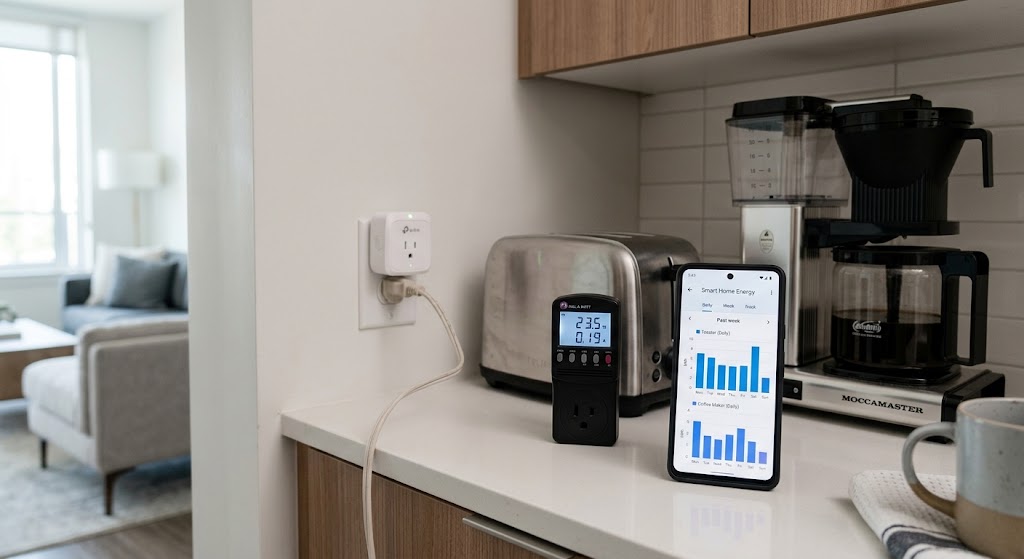
Track appliance energy use by measuring kilowatt-hours with an energy-monitoring smart plug or plug-in watt meter, then multiply the measured kWh by the electricity rate on your utility plan. For appliances that cannot safely use plug-in monitors, compare EnergyGuide data, manufacturer specifications, and whole-home or utility interval data instead; measure before any announced tariff change so you have a baseline for deciding which loads are worth reducing.
Table of contents
- First, understand watts, kilowatts, and kilowatt-hours
- The basic cost formula
- Why you should measure before a rate change
- Method 1: Use an energy-monitoring smart plug
- Best appliances to measure with a smart plug
- Measure cycling loads for several days
- Method 2: Use a plug-in watt meter when you do not need an app
- Why cumulative kWh is more useful than a single watt reading
- Method 3: Use EnergyGuide data for major appliances
- Convert annual kWh using your future rate
- Method 4: Use utility or whole-home interval data for hardwired loads
- Do not put every appliance on a smart plug
- Build a seven-day appliance energy audit
- Day 1: Pull your tariff and last three bills
- Day 2: List appliances by suspected impact
- Days 3–6: Measure representative loads
- Day 7: Rank by monthly cost and controllability
- How to calculate the effect of a future rate increase
- If you have time-of-use pricing, track when energy is used
- Build two baselines, not one
- Standby power: measure it, but keep perspective
- When measurement justifies replacement
- A simple pre-fall checklist
- Conclusion
Key takeaways
- Measure kilowatt-hours, not just the appliance's advertised wattage, when runtime or compressor cycling changes throughout the day.
- Use your own utility tariff instead of a national average because electricity prices and time-of-use structures vary by location and plan.
- A one-week appliance audit can reveal whether your best savings opportunity is reducing runtime, eliminating standby loads, changing schedules, or eventually replacing an inefficient appliance.
Editorial transparency
Who worked on this article and how it was handled.
- Written by
- Daniel Reed
- Creation method
- Editorial research
AI assistance: AI assisted with research organization and drafting. Sources, factual claims, and the final article should be reviewed by a human editor before publication.
An electricity rate increase hurts most when you do not know which devices are actually driving your bill. A refrigerator that looks expensive may be efficient, while a dehumidifier, portable AC, gaming setup, or forgotten office equipment quietly consumes more energy because it runs for far longer each day.
The useful number is not just an appliance’s nameplate wattage. Your bill is based primarily on energy consumed over time, measured in kilowatt-hours (kWh), and the cost of each kWh depends on your utility and rate plan. Electricity prices vary significantly by location, and some customers also face seasonal or time-of-use pricing, so there is no universal “fall rate hike” that applies to every household.
The best preparation is to build a short baseline before any announced tariff change takes effect. This guide shows how to measure appliance energy draw safely, convert that data into real operating cost, and rank your household loads so you know what is actually worth changing.
First, understand watts, kilowatts, and kilowatt-hours
Three units get mixed together constantly in home-energy discussions.
- Watts (W) describe instantaneous power: how fast a device is using electricity right now.
- Kilowatts (kW) are 1,000 watts.
- Kilowatt-hours (kWh) describe energy consumed over time and are the unit utilities commonly use to calculate electricity charges.
A 1,000-watt appliance running for one hour uses about 1 kWh. A 100-watt device running for 10 hours also uses about 1 kWh.
That distinction explains why wattage alone can be misleading. A 1,500-watt toaster may run for only a few minutes a day. A 300-watt dehumidifier can cycle for many hours. The lower-wattage device may easily consume more energy over a month.
The basic cost formula
Virginia Cooperative Extension documents the familiar calculation:
Daily kWh = watts × hours used per day ÷ 1,000
Then:
Operating cost = kWh × your electricity rate
For example, a device averaging 500 watts for four hours per day uses approximately:
500 × 4 ÷ 1,000 = 2 kWh per day
If your effective energy rate were $0.20 per kWh, that would be about $0.40 per day or roughly $12 over 30 similar days.
The example rate is only illustrative. Use the price on your own bill or tariff, not a national average.
Why you should measure before a rate change
If your utility has announced a new seasonal rate, supply charge, or time-of-use schedule, you want a baseline collected under your current routine.
That lets you answer three useful questions later:
- Did your household use more energy, or did the same amount of energy simply become more expensive?
- Which appliances contribute enough kWh to justify changing behavior or replacing equipment?
- Could shifting the time of use reduce cost under a time-of-use plan even if total kWh stays similar?
The U.S. Energy Information Administration shows large differences in residential electricity prices across states and regions. Your utility may also layer fixed charges, delivery charges, taxes, demand-related charges, or time-based pricing on top of the energy rate.
So do not turn your appliance audit into false precision. The goal is to identify relative load and avoidable kWh, then use your actual tariff to model the cost.
Method 1: Use an energy-monitoring smart plug
For ordinary plug-in appliances, an energy-monitoring smart plug is often the easiest measurement tool.
ENERGY STAR’s Smart Home Energy Management Systems criteria specifically recognize smart plugs, smart power strips, and home energy monitors that can report power or energy consumption. Some systems can also use time-of-use price schedules for control.
A useful smart plug should show at least one of these:
- current watts;
- daily or weekly kWh;
- cumulative kWh;
- historical usage by hour or day.
Best appliances to measure with a smart plug
Good candidates include:
- television and entertainment systems;
- desktop computers and monitors;
- dehumidifiers;
- window or portable AC units only if the smart plug is explicitly rated for that load and appliance type;
- lamps and lighting groups;
- network equipment;
- coffee stations;
- small kitchen appliances;
- portable electronics charging stations.
Measure cycling loads for several days
A television is fairly predictable: if it draws 80 watts while on, runtime tells most of the story.
A refrigerator is different. Its compressor turns on and off, defrost cycles occur, and room temperature changes the duty cycle. The same is true for dehumidifiers and many air conditioners.
For cycling loads, measure for at least several representative days. A full week is better if weekday and weekend behavior differ.
Method 2: Use a plug-in watt meter when you do not need an app
A basic plug-in electricity meter does the same core job without Wi-Fi, cloud accounts, or automations.
You plug the meter into the wall and the appliance into the meter. Depending on the model, it may show watts, volts, amps, power factor, elapsed time, and cumulative kWh.
This is often the better tool if your goal is a one-time audit rather than permanent monitoring.
Why cumulative kWh is more useful than a single watt reading
Suppose your refrigerator reads 120 watts when the compressor is running. That does not mean it uses 120 watts continuously for 24 hours.
A meter that accumulates kWh for 72 hours captures cycling automatically. You can then divide by three to estimate average daily energy under those conditions.
That is much stronger evidence than multiplying the maximum nameplate wattage by 24 hours.
Method 3: Use EnergyGuide data for major appliances
For covered appliances in the United States, the FTC’s EnergyGuide label provides estimated annual energy use or operating-cost information designed to help consumers compare models.
EnergyGuide can be useful when:
- the appliance is hard to reach with a plug meter;
- you are comparing your current appliance with a potential replacement;
- you want a standardized benchmark rather than a short real-world test.
The FTC explicitly cautions that estimated yearly operating cost is based on typical use and assumed energy prices. Your actual cost depends on your usage and local utility rate.
That makes EnergyGuide a comparison tool, not a substitute for your bill.
Convert annual kWh using your future rate
If the label says an appliance uses 500 kWh per year, you can model the cost at your current and future rates:
| Scenario | Rate | Estimated annual energy | Modeled annual energy cost |
|---|---|---|---|
| Current tariff | $0.18/kWh | 500 kWh | $90 |
| New tariff | $0.22/kWh | 500 kWh | $110 |
| Difference | +$0.04/kWh | Same usage | +$20/year |
This is a simplified energy-only calculation. Your real bill may include additional charges.
Method 4: Use utility or whole-home interval data for hardwired loads
Not every important load plugs into a normal wall outlet.
Central HVAC, electric water heaters, ranges, ovens, EV chargers, well pumps, and many clothes dryers may be hardwired or use high-power circuits that are not appropriate for ordinary plug-in smart plugs or consumer watt meters.
For those loads, safer options include:
- utility smart-meter interval data;
- a professionally installed whole-home energy monitor;
- appliance-level data exposed by the equipment itself;
- manufacturer energy reporting;
- EnergyGuide or specification data for comparison.
If your utility portal provides 15-minute, hourly, or daily consumption data, you can sometimes identify large loads by comparing periods when the appliance is running with similar periods when it is off.
It is less precise than a dedicated circuit monitor, but it costs nothing and is much safer than improvising around a high-voltage circuit.
Do not put every appliance on a smart plug
This deserves its own section because “measure everything” can become unsafe quickly.
A plug-in monitor is only appropriate when:
- the appliance uses the same plug and voltage the monitor is designed for;
- the appliance’s running current and startup load stay within the monitor’s ratings;
- the manufacturer allows that type of intermediate device;
- the smart plug or meter is properly certified for your region.
Do not use a normal household smart plug for:
- hardwired appliances;
- electric dryers or ranges;
- central HVAC equipment;
- EV charging equipment;
- high-power heaters that exceed or approach the plug’s rating;
- anything whose manual prohibits extension devices, adapters, or intermediary controls.
When measuring higher-power circuits, use equipment designed for that circuit or a qualified electrician.
Build a seven-day appliance energy audit
You do not need to monitor every outlet at once. A rotating one-week audit is usually enough to find the obvious loads.
Day 1: Pull your tariff and last three bills
Write down:
- current energy rate in $/kWh or ¢/kWh;
- any announced future rate;
- time-of-use periods if applicable;
- monthly kWh from recent bills;
- fixed charges that will not change when you reduce appliance use.
Separate energy charges from fixed charges. Reducing kWh will not eliminate a fixed monthly customer charge.
Day 2: List appliances by suspected impact
Do not start with every phone charger. Start with devices that combine either high wattage or long runtime.
A useful first-pass list is:
- room air conditioner or dehumidifier;
- secondary refrigerator or freezer;
- entertainment center;
- desktop computer workstation;
- aquarium or terrarium equipment;
- network/server equipment;
- portable heater when heating season begins;
- always-on kitchen or office clusters.
Days 3–6: Measure representative loads
For each plug-in appliance, record:
| Appliance | Test duration | Measured kWh | kWh/day | Current cost/day | Future cost/day |
|---|---|---|---|---|---|
| Example dehumidifier | 48 hr | 3.6 | 1.8 | Rate × 1.8 | New rate × 1.8 |
| Example TV setup | 24 hr | 0.45 | 0.45 | Rate × 0.45 | New rate × 0.45 |
Use measured kWh whenever possible rather than estimating from peak wattage.
Day 7: Rank by monthly cost and controllability
The most expensive appliance is not automatically the first one you should change.
Rank each load by two dimensions:
- Cost impact: how many kWh does it add?
- Controllability: can you reduce runtime without harming comfort, food safety, humidity control, security, or equipment life?
That creates a more useful decision matrix:
| Load | Energy impact | Easy to reduce? | Best action |
|---|---|---|---|
| Dehumidifier | High | Sometimes | Adjust humidity target, runtime, drainage, or room conditions |
| Old freezer | Medium-high | Low | Compare measured annualized use with replacement options |
| Entertainment center | Medium | High | Shut down standby cluster when unused |
| Wi-Fi router | Low | Low | Usually leave alone; savings may not justify inconvenience |
| Portable heater | Very high while running | Medium | Reduce runtime safely, improve room heat retention, use thermostat control |
How to calculate the effect of a future rate increase
Once you know an appliance’s measured monthly kWh, tariff modeling becomes easy.
Use:
Monthly appliance cost = measured monthly kWh × electricity rate
Example:
A dehumidifier uses 54 kWh in a representative month.
- At $0.16/kWh: $8.64
- At $0.22/kWh: $11.88
- Difference: $3.24/month
Now compare that with the effort required to reduce usage.
If changing the humidity setpoint or schedule cuts 15 kWh without creating moisture problems, the new tariff would make that reduction worth about $3.30/month in this simplified example.
Again, this is not a promise of savings. It is a decision model based on measured consumption.
If you have time-of-use pricing, track when energy is used
A flat-rate customer mainly cares about total kWh. A time-of-use customer also cares about the clock.
ENERGY STAR’s SHEMS criteria explicitly allow home energy management systems to control devices based on a time-of-use energy price schedule supplied by the user or utility integration.
This can matter for flexible loads such as:
- dishwasher cycles;
- laundry;
- EV charging;
- battery charging;
- some dehumidification;
- pre-cooling or pre-heating strategies where appropriate.
If your plan has expensive peak hours, the same 2 kWh can cost different amounts depending on when it is consumed.
Build two baselines, not one
For time-of-use plans, record:
- total daily kWh;
- kWh used during peak-price periods.
A successful change may leave total energy almost unchanged while moving part of it to a cheaper period.
Standby power: measure it, but keep perspective
Smart plugs make phantom loads easy to discover. That can be useful, but do not let a 2-watt standby device distract you from a 500-watt appliance running six hours a day.
For perspective:
- 2 W continuously for 30 days is about 1.44 kWh.
- 500 W for 6 hours per day for 30 days is about 90 kWh.
Standby savings become more interesting when many devices are grouped together—such as a television, game console, AV receiver, subwoofer, and streaming box—or when an older device has unusually high idle draw.
Use the meter to find real outliers instead of assuming every standby load deserves automation.
When measurement justifies replacement
Energy monitoring becomes especially valuable when you are deciding whether an old appliance should be replaced.
The process is:
- Measure or estimate current annual kWh.
- Find the EnergyGuide annual kWh for a plausible replacement.
- Calculate the kWh difference.
- Multiply that difference by your expected local rate.
- Compare the annual savings with the purchase price and other reasons to replace, such as reliability, noise, capacity, or repair risk.
This prevents a common mistake: buying a new appliance solely because it is labeled “efficient” without knowing whether the old one is actually costing enough to justify replacement.
A simple pre-fall checklist
Before any announced seasonal or tariff change, complete this checklist:
- Save a copy of your current utility rate and the new rate schedule.
- Record at least three recent monthly kWh totals.
- Measure the top five plug-in loads over representative periods.
- Identify any major hardwired loads using utility or whole-home data instead of unsafe plug-in measurement.
- Convert measured kWh into current and future cost.
- Separate fixed bill charges from charges that change with kWh.
- Rank loads by both cost and ease of reduction.
- Re-measure after making schedule or usage changes.
The final step matters. Without a before-and-after measurement, it is easy to assume a change worked when weather, occupancy, or billing-cycle length was actually responsible.
Conclusion
The best way to prepare for an electricity rate increase is not to guess which appliance looks expensive. Measure energy use in kWh, apply your actual utility tariff, and rank the loads that are both costly and controllable.
Start with an energy-monitoring smart plug or plug-in meter for ordinary household devices, use EnergyGuide or utility interval data for larger equipment, and never force a consumer plug meter into a circuit it was not designed to handle. A week of measurements now gives you a baseline you can reuse after the tariff changes—and turns “my bill went up” into a much more useful question: which kWh can I realistically eliminate or move to a cheaper time?
Common questions
Questions this guide answers
How do I calculate how much an appliance costs to run?
If you know the appliance's energy use, multiply kilowatt-hours by your electricity price per kWh. If you only know wattage, estimate daily use with (watts × hours used per day) ÷ 1,000, then multiply the resulting kWh by your applicable utility rate.
Is a smart plug accurate enough to track appliance electricity use?
An energy-monitoring smart plug is useful for comparing plug-in appliance loads over hours or days, provided the appliance stays within the plug's voltage, current, and power ratings. It is not appropriate for hardwired equipment or high-power appliances that exceed the device rating.
How long should I monitor an appliance before estimating monthly cost?
For steady loads such as lamps or simple electronics, a day may be enough. Cycling appliances such as refrigerators, dehumidifiers, and some air conditioners are better measured for at least several representative days so the result includes normal on-and-off behavior.
Should I use the national average electricity price to calculate appliance cost?
No. Electricity prices vary substantially by location and utility plan, and some customers pay different prices by season or time of day. Use the rate shown on your own tariff or utility bill, including time-of-use periods when they apply.
What appliances should I measure first?
Start with devices that combine high wattage with long runtime or frequent cycling, such as room air conditioners, dehumidifiers, portable heaters, older refrigerators or freezers, entertainment systems, and always-on office equipment. Measure before replacing anything so you know where the largest avoidable load actually is.
Evidence & further reading
Sources & references
Primary and authoritative references used to support or contextualize this article. Links open the original source.
- 1Prices and factors affecting prices
U.S. Energy Information Administration · Accessed Aug 22, 2026
Supports the point that retail electricity prices vary by customer type, locality, fuel costs, regulations, and other regional factors.
- 2Electric Power Monthly — Average Price of Electricity to Ultimate Customers by End-Use Sector, by State
U.S. Energy Information Administration · Accessed Aug 22, 2026
Provides current state-level residential electricity price data and reinforces why local rates should be used for cost estimates.
- 3Smart Home Energy Management Systems Key Product Criteria
ENERGY STAR · Accessed Aug 22, 2026
Supports the use of smart plugs, smart power strips, and home energy monitors that report power or energy consumption, including time-of-use-aware control.
- 4How To Use the EnergyGuide Label To Shop for Home Appliances
Federal Trade Commission · Accessed Aug 22, 2026
Supports using EnergyGuide energy-consumption data as a comparison tool and the caveat that actual operating cost depends on local energy price and individual usage.
- 5EnergyGuide Labeling: FAQs for Appliance Manufacturers
Federal Trade Commission · Accessed Aug 22, 2026
Supports the requirement for annual energy cost or efficiency information on covered appliances based on DOE test procedures.
- 6ENERGY SERIES: Estimating Appliance and Home Electronic Energy Use
Virginia Cooperative Extension, Virginia Tech · Accessed Aug 22, 2026
Supports the standard watts × hours ÷ 1,000 calculation for estimating kWh and multiplying kWh by the local utility rate to estimate operating cost.

About the author
Daniel Reed
Daniel writes about connected-home standards, small-space technology, device interoperability, and privacy-conscious urban living.
More from Daniel →Make your home smarter without buying every gadget.
One useful idea, one product worth knowing, and one energy-saving action—delivered weekly.
No spam. Unsubscribe anytime.
Semantic recommendations
Related reading
Selected from topic cluster, entities, tags, search intent, and editorial relationships.

How Much Can a Smart Thermostat Actually Save You?
A practical, data-first guide to comfort, schedules, occupancy sensing, and where real household savings come from.
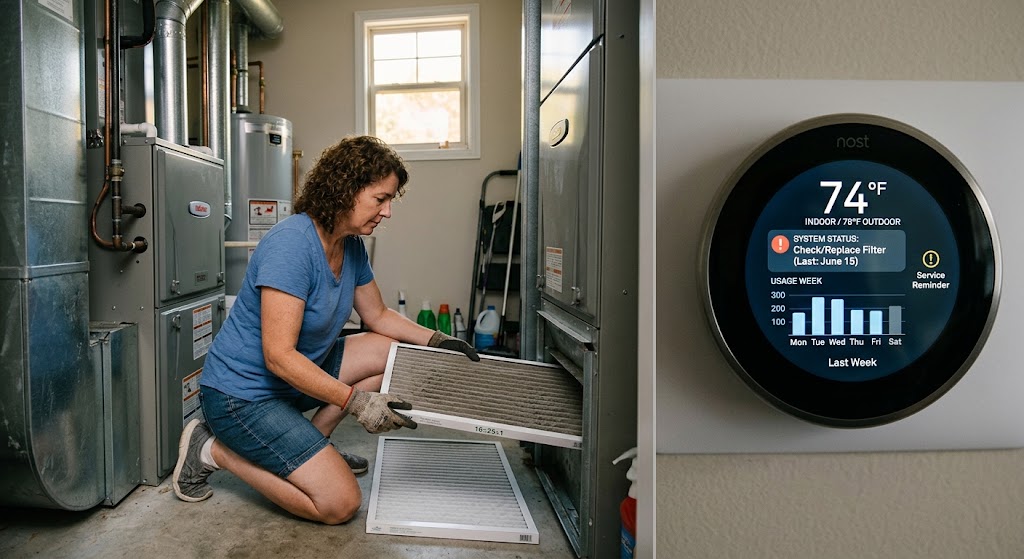
End-of-Summer HVAC Maintenance Checklist for Smart Thermostat Owners
Use your smart thermostat's runtime, filter reminders, temperature sensors, and system alerts to close out cooling season and prepare HVAC equipment for fall.
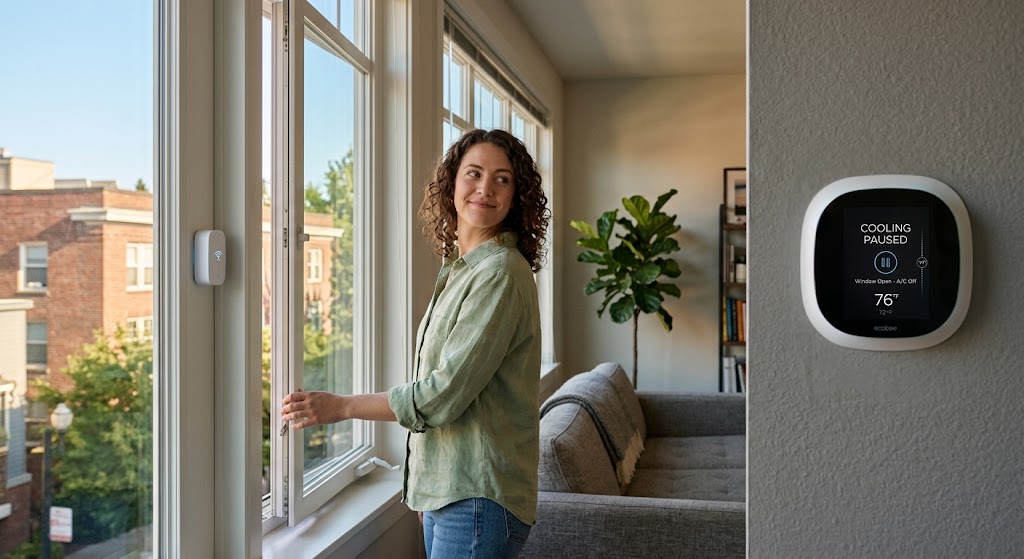
Smart Window Contact Sensors: Preventing Open Window AC Energy Waste
Use window contact sensors to pause cooling only after a window stays open, then restore the previous HVAC state safely after every monitored window is closed.

Window AC Energy Hacks: Saving Money in Peak August Temperatures
Lower your August cooling bill with practical window AC fixes, smarter settings, and airflow tricks that reduce waste without sacrificing comfort.