
Smart Irrigation Schedules: Adjusting Water Volume for Late Summer
Tune a smart irrigation schedule for late summer by matching watering volume to weather, soil moisture, plant needs, and seasonal changes instead of leaving peak-summer runtimes unchanged.
Quick answer
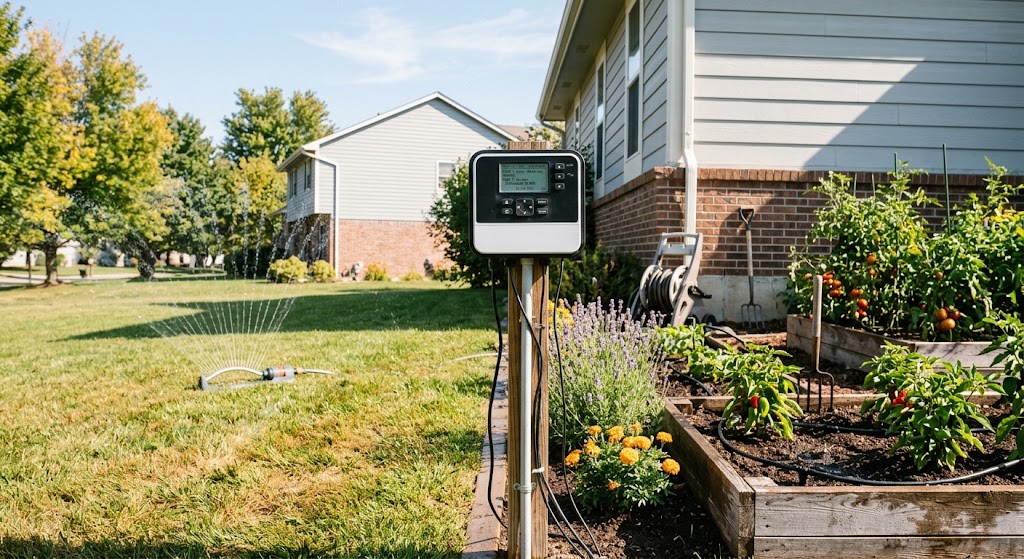
Adjust a smart irrigation schedule for late summer by reducing or increasing watering only in response to actual landscape demand, not the calendar alone. Use weather-based or soil-moisture data when available, review each zone separately, move watering away from hot midday hours, and use seasonal-adjust or water-budget controls as a starting point rather than leaving peak-summer runtimes unchanged through the transition toward fall.
Table of contents
- Late summer is a transition, not a preset percentage
- Watch the trend, not one hot afternoon
- Understand the three ways irrigation volume gets controlled
- 1. Fixed clock schedule
- 2. Weather-based scheduling
- 3. Soil-moisture-based control
- Start with a zone-by-zone audit
- Check what each zone is doing before changing runtime
- Use seasonal adjustment as a coarse control, not a diagnosis
- When a global percentage works well
- When it is too blunt
- For weather-based controllers, verify the inputs before trusting automation
- Do not disable smart adjustments just because one day looks strange
- For soil-moisture systems, validate the threshold and sensor location
- Reduce frequency or runtime? They are not the same decision
- A practical decision test
- Use cycle-and-soak when runoff starts before the root zone is wet
- Avoid watering during the hottest part of the day
- Check local restrictions before changing start times
- Do not let rain-delay features become permanent shortcuts
- A seven-day late-summer tuning process
- Day 1: Inspect every zone
- Day 2: Record the current baseline
- Day 3: Review landscape settings
- Day 4: Make one modest adjustment
- Day 5: Observe soil and plants
- Day 6: Compare automation with reality
- Day 7: Refine by zone
- A simple late-summer decision framework
- What smart irrigation cannot know automatically
- When a smart-controller upgrade is worth considering
- Conclusion
Key takeaways
- Late summer is a transition, not a universal signal to cut watering: use actual weather, soil moisture, and plant response before changing volume.
- Weather-based and soil-moisture-based controllers can respond to changing conditions more intelligently than a fixed clock schedule, but their zone and landscape settings still need to be correct.
- Seasonal-adjust or water-budget controls are useful for broad runtime changes, but mixed landscapes often require zone-specific adjustments rather than one percentage for the entire property.
- A monthly sprinkler inspection is part of smart scheduling because leaks, overspray, clogged heads, and poor distribution can waste water even when the controller logic is correct.
Editorial transparency
Who worked on this article and how it was handled.
- Written by
- Daniel Reed
- Creation method
- Editorial research
AI assistance: AI assisted with research organization and drafting. Sources, factual claims, and the final article should be reviewed by a human editor before publication.
Late summer is when irrigation schedules become easiest to get wrong. The controller may still be running the same aggressive program that made sense during the hottest part of July, even as daylight, rainfall patterns, nighttime temperatures, and plant demand begin to change.
The opposite mistake is just as common: cutting every zone by the same percentage because the calendar says fall is approaching. Late August can still be brutally hot in one region while another is already cooling, so a seasonal adjustment should respond to actual landscape conditions rather than a fixed date.
A good smart irrigation schedule uses weather, soil moisture, plant type, zone behavior, and local watering rules to decide how much water is needed now. This guide explains how to make that late-summer transition without leaving peak-summer runtimes in place or reducing water so quickly that lawns and plants become stressed.
Late summer is a transition, not a preset percentage
There is no universal “late-summer irrigation percentage.”
A yard in Phoenix, Madrid, Seattle, Minneapolis, or London can have completely different water needs on the same date. Soil texture, shade, wind, rainfall, plant species, slope, sprinkler efficiency, and local restrictions all affect the right schedule.
The useful question is not:
“How much should I reduce watering in August?”
It is:
“Has the landscape’s water demand changed enough that my current runtime or frequency is now excessive or insufficient?”
EPA WaterSense specifically warns that irrigation schedules are often set for the height of the growing season and then left unchanged as seasonal needs shift. That is exactly the problem smart irrigation is meant to solve.
Watch the trend, not one hot afternoon
One unusually hot day does not necessarily justify rebuilding your schedule. What matters more is the pattern across several days:
- daytime highs;
- nighttime temperatures;
- recent rainfall;
- forecast rain;
- wind;
- soil moisture;
- signs of plant stress;
- how long the soil stays wet after irrigation.
A late-summer schedule should become more responsive as conditions become less predictable.
Understand the three ways irrigation volume gets controlled
Before changing anything, identify how your controller actually manages water.
1. Fixed clock schedule
A traditional controller simply runs the programmed zones on specific days for specific durations.
Example:
- Lawn zone: Monday, Wednesday, Saturday — 18 minutes
- Shrub zone: Tuesday, Friday — 25 minutes
- Drip zone: Tuesday, Friday — 40 minutes
This is easy to understand, but it does not know whether yesterday’s storm already supplied enough water or whether a cool week reduced plant demand.
2. Weather-based scheduling
EPA says weather-based irrigation controllers use local weather data and landscape conditions to tailor watering schedules. Depending on the system, the controller may use weather-station data, onsite sensors, or a combination.
The value is not that the controller is “smart” in a marketing sense. The value is that watering can change when the weather changes.
A correctly configured weather-based controller can reduce watering after cool or wet periods and increase it when conditions create higher demand, subject to the controller’s limits and local watering rules.
3. Soil-moisture-based control
Soil-moisture-based irrigation controllers take a different approach. Instead of inferring how much water the landscape probably needs from weather, they measure moisture in the soil and enable or prevent watering based on a threshold.
EPA notes that this can prevent irrigation after sufficient rainfall or when the soil is still wet from a previous watering event.
For late summer, that is particularly useful because the same 85°F day can require very different irrigation depending on whether the root zone is already moist.
Start with a zone-by-zone audit
Do not adjust the entire property until you know what each zone is actually watering.
A typical yard might contain:
| Zone | Landscape type | Likely late-summer behavior |
|---|---|---|
| Front lawn | Turf in full sun | May still need substantial water during hot, dry weather |
| Side lawn | Turf in afternoon shade | May need less runtime than full-sun turf |
| Shrub bed | Established shrubs | Often different frequency and depth requirements from turf |
| Drip bed | Trees or perennials | Usually benefits from slower root-zone irrigation rather than lawn-style frequency |
| New planting | Recently established plants | May require a separate schedule until roots are established |
If all of those zones are receiving one global adjustment, you are probably simplifying too aggressively.
Check what each zone is doing before changing runtime
Run a short manual test and look for:
- broken heads;
- clogged emitters;
- misting caused by excessive pressure;
- sprinklers hitting pavement;
- blocked spray patterns;
- water running downhill before the cycle ends;
- dry patches caused by poor distribution rather than insufficient runtime.
EPA recommends inspecting irrigation systems monthly. That matters because no controller algorithm can compensate for a broken head spraying the sidewalk.
Use seasonal adjustment as a coarse control, not a diagnosis
Many controllers provide a setting called:
- Seasonal Adjust;
- Seasonal Adjustment;
- Water Budget;
- Percent Adjust;
- Runtime Percentage.
The idea is simple: change all eligible programmed runtimes by a percentage without editing every zone individually.
If a 20-minute zone is operating at a 75% seasonal adjustment, its effective runtime becomes:
20 minutes × 0.75 = 15 minutes
That is convenient during a seasonal transition, but it can also hide mistakes.
When a global percentage works well
A broad adjustment is reasonable when:
- most zones have similar plant types;
- sun exposure is fairly consistent;
- irrigation hardware is well balanced;
- the whole landscape is responding similarly to seasonal change.
When it is too blunt
A global percentage is less useful when:
- lawn and drip zones share the same controller;
- one side of the property receives intense western sun;
- some plants are newly installed;
- soil types differ significantly between zones;
- one area receives rainfall or roof runoff differently from another.
In those cases, use zone-specific adjustments if the controller supports them.
For weather-based controllers, verify the inputs before trusting automation
A weather-based controller can only make good decisions from good configuration.
Late summer is a useful time to review the assumptions you entered when the system was first installed.
Check:
- plant type;
- sprinkler or emitter type;
- sun exposure;
- soil type;
- slope;
- zone area, where required;
- allowed watering days;
- local weather source or station.
If a shady shrub bed is configured as full-sun turf, automatic scheduling can still be wrong even though the weather data itself is accurate.
Do not disable smart adjustments just because one day looks strange
Weather-based systems often smooth changes across recent conditions or use their own scheduling model. Before overriding them permanently, check whether the underlying landscape parameters are correct and whether the system is respecting recent rain.
A manual override should be temporary unless you have identified a real configuration problem.
For soil-moisture systems, validate the threshold and sensor location
Soil moisture is powerful because it measures the landscape directly, but sensor placement matters.
A sensor installed in an unusually wet, shaded, compacted, or poorly drained spot may not represent the rest of the zone. Likewise, a sensor sitting too close to an emitter can remain wet while the broader root zone dries.
For late-summer tuning:
- Confirm the sensor is still functioning.
- Check whether the sensor location represents the zone.
- Compare sensor readings with actual soil condition at root depth.
- Review the moisture threshold rather than blindly lowering runtime.
EPA’s WaterSense specification requires labeled soil-moisture-based controllers to consistently allow or prevent irrigation at a preset threshold. That does not mean one threshold is correct for every landscape.
Reduce frequency or runtime? They are not the same decision
When water demand falls, you can usually reduce total irrigation in two ways:
- run the same number of days for fewer minutes; or
- keep similar runtime per event but water less frequently.
Those choices affect the root zone differently.
For established landscapes, deeper and less-frequent watering is often preferable to frequent shallow watering, provided the soil can absorb the water without runoff and the plants are suited to that approach. University of Minnesota Extension similarly recommends deep, infrequent watering during heat stress rather than superficial sprinkling.
But this is not universal. New plants, containers, shallow-rooted species, sandy soil, and drip systems may need different frequency patterns.
A practical decision test
If the soil is still wet when the next irrigation event begins, reduce frequency first or allow a moisture controller to skip the event.
If the soil dries appropriately between events but water is running off before the zone finishes, reduce runtime per cycle or split the runtime into multiple shorter cycles.
If plants show stress before the next event despite good distribution, the schedule may be too conservative for current conditions.
Use cycle-and-soak when runoff starts before the root zone is wet
Late-summer soil can become compacted, hydrophobic, or simply unable to absorb sprinkler output as fast as the system applies it.
Instead of running a zone for 20 continuous minutes, a controller with cycle-and-soak can divide that runtime into smaller segments with rest periods in between.
For example:
- 7 minutes watering;
- soak period;
- 7 minutes watering;
- soak period;
- 6 minutes watering.
The total remains 20 minutes, but the soil gets more time to absorb the water.
This is especially useful on slopes and heavier soils where runoff appears before the intended runtime is complete.
Avoid watering during the hottest part of the day
EPA WaterSense recommends avoiding midday irrigation because more water can be lost to evaporation when the sun and temperatures are high.
For many landscapes, early morning is a strong default. EPA also identifies cooler evening periods as preferable to midday, although local disease pressure, municipal rules, humidity, and plant type can influence the best timing.
University of Minnesota Extension recommends early morning—roughly 5 to 9 a.m.—for hot-weather garden watering because plants can hydrate before the day’s heat while foliage has time to dry.
Check local restrictions before changing start times
Smart irrigation does not override watering rules.
Your city or water utility may restrict:
- watering days;
- start times;
- irrigation during drought stages;
- watering after rainfall;
- total allowed duration.
EPA’s WaterSense controller specifications explicitly account for day-of-week, odd/even, interval, prohibited-time, and full-shutoff restrictions. Use those controls instead of building automations that violate local requirements.
Do not let rain-delay features become permanent shortcuts
Rain delay is useful, but it is not the same as adaptive irrigation.
A one-day or two-day manual rain delay can make sense after a storm. The problem is using rain delay as your only response to seasonal change while the underlying schedule remains calibrated for peak summer.
A better late-summer system combines:
- correct base runtimes;
- weather or soil-moisture adjustment;
- rain interruption;
- local watering restrictions;
- occasional manual inspection.
That way, the controller returns to an appropriate baseline after a rain event instead of falling back to an outdated July schedule.
A seven-day late-summer tuning process
You do not need to redesign the whole system in one afternoon. A controlled one-week adjustment is safer and easier to evaluate.
Day 1: Inspect every zone
Run each zone manually and fix obvious leaks, blocked heads, overspray, and runoff issues.
Day 2: Record the current baseline
Write down:
- days per week;
- runtime per zone;
- seasonal-adjust percentage;
- current weather or soil-moisture mode;
- recent rainfall.
Without a baseline, it is difficult to tell whether the change helped.
Day 3: Review landscape settings
Verify plant type, soil, sun, slope, and emitter type inside the controller or app.
Day 4: Make one modest adjustment
If conditions are cooling and the soil remains wet longer, reduce the seasonal percentage or one zone’s frequency. Do not make several large changes simultaneously.
Day 5: Observe soil and plants
Look for:
- persistent wetness;
- runoff;
- dry patches;
- wilt that does not recover;
- uneven coverage.
Day 6: Compare automation with reality
If the smart controller skipped watering, check whether the root zone was actually moist. If it watered after rain, review weather-source or rain-sensor behavior.
Day 7: Refine by zone
Keep the global adjustment only if the whole landscape responds similarly. Otherwise, move to zone-specific tuning.
A simple late-summer decision framework
Use this table before changing volume:
| What you observe | Likely action |
|---|---|
| Soil is still moist when the next cycle starts | Reduce frequency or allow moisture-based skip |
| Cooler weather persists for several days | Consider a lower seasonal-adjust percentage |
| Hot, windy weather remains intense | Do not reduce watering just because fall is approaching |
| Runoff begins before the zone completes | Use shorter cycles with soak periods |
| One zone is dry while others are fine | Fix distribution or adjust that zone, not the whole property |
| Rain occurred but irrigation still runs | Check rain delay, weather source, sensor, or controller configuration |
| Sprinklers hit pavement | Correct head direction before increasing or decreasing runtime |
| New plantings are stressed | Keep them on an establishment schedule rather than matching mature zones |
This is more reliable than choosing a single “September setting” from a generic online chart.
What smart irrigation cannot know automatically
Even a sophisticated controller may not know that:
- a tree has grown enough to shade a previously sunny zone;
- a sprinkler head is partially clogged;
- a dog repeatedly damages one corner of the lawn;
- a downspout now drains into a planting bed;
- a gardener replaced drought-tolerant plants with thirstier species;
- soil compaction changed after construction;
- local watering restrictions changed this week.
Automation reduces repetitive decisions. It does not eliminate site maintenance.
That is why EPA combines smart-controller guidance with monthly irrigation inspection. The software and the physical system have to agree.
When a smart-controller upgrade is worth considering
If you still use a basic clock timer, late summer makes its limitations obvious. The same schedule continues regardless of rain, soil moisture, or cooler weather unless you manually intervene.
A WaterSense-labeled weather-based or soil-moisture-based controller can be a meaningful upgrade when:
- you frequently forget seasonal changes;
- the property has substantial in-ground irrigation;
- outdoor water bills are significant;
- travel makes manual schedule changes difficult;
- your local utility offers incentives for WaterSense-labeled products.
EPA says residential outdoor water use in the United States totals nearly 8 billion gallons per day, mainly for landscape irrigation, and estimates that as much as 50% can be wasted through overwatering and irrigation inefficiencies. That does not mean a controller will cut every household’s irrigation by 50%; it means there is substantial system-level waste that better scheduling and maintenance can address.
Before buying, confirm controller compatibility with your valves, number of zones, local weather service, smart-home ecosystem if relevant, and any rebate requirements.
Conclusion
The right late-summer irrigation adjustment is not a fixed percentage. It is a controlled response to changing weather, soil moisture, plant demand, and the physical performance of each irrigation zone.
Start by inspecting the system, verify the controller’s landscape settings, then make one modest change at a time. Use seasonal-adjust controls for broad tuning, but switch to zone-specific changes when lawn, shrubs, drip beds, shade, and new plantings behave differently. If your controller can use weather or soil-moisture data, let those signals do more of the work—but keep checking that the automation matches what is actually happening in the yard.
Common questions
Questions this guide answers
Should I reduce sprinkler runtime in late summer?
Often, but not automatically. Plant water demand can begin to decline as days shorten and temperatures ease, yet some regions remain extremely hot or dry well into late summer. Adjust runtime using local weather, soil moisture, plant condition, and utility guidance rather than applying the same reduction everywhere.
What does seasonal adjustment mean on a smart irrigation controller?
Seasonal adjustment, sometimes called water budget or percent adjust, changes the programmed runtime by a percentage without requiring you to edit every individual watering duration. EPA WaterSense specifications require a percent-adjust feature on labeled soil-moisture-based controllers, but the appropriate percentage still depends on site conditions.
Is a weather-based irrigation controller better than a fixed schedule?
A weather-based controller can reduce unnecessary irrigation because it uses local weather and landscape conditions to determine when and how much to water. A fixed clock schedule cannot respond automatically to changing weather unless the user updates it.
How does a soil moisture sensor change irrigation?
A soil moisture-based controller measures moisture in the landscape and can prevent or allow watering based on a preset threshold. This helps avoid scheduled watering when the root zone already has enough moisture from rain or previous irrigation.
What time of day is best for late-summer irrigation?
Avoid the hottest middle part of the day, when more water can be lost to evaporation. EPA WaterSense recommends watering during cooler periods such as early morning or evening, while local utilities or extension services may provide more specific guidance for your region.
Evidence & further reading
Sources & references
Primary and authoritative references used to support or contextualize this article. Links open the original source.
- 1WaterSense Labeled Controllers
U.S. Environmental Protection Agency · Accessed Aug 24, 2026
Supports the distinction between weather-based and soil-moisture-based irrigation controllers and EPA guidance on reducing overwatering.
- 2Weather-Based Irrigation Controllers
U.S. Environmental Protection Agency · Accessed Aug 24, 2026
Supports using local weather and landscape conditions to tailor irrigation timing and volume instead of relying only on clock schedules.
- 3Soil Moisture-Based Irrigation Controllers
U.S. Environmental Protection Agency · Accessed Aug 24, 2026
Supports using direct soil-moisture measurements to prevent irrigation when landscape moisture is already sufficient.
- 4Watering Tips
U.S. Environmental Protection Agency · Accessed Aug 24, 2026
Supports seasonal schedule adjustments, avoiding hot midday watering, monthly system inspection, and keeping irrigation on the landscape rather than pavement.
- 5Sprinkler Spruce-Up
U.S. Environmental Protection Agency · Accessed Aug 24, 2026
Supports checking irrigation systems for leaks, damaged heads, incorrect direction, and programming problems that can increase outdoor water use.
- 6WaterSense Specification for Soil Moisture-Based Irrigation Controllers Version 1.0
U.S. Environmental Protection Agency · Accessed Aug 24, 2026
Supports the percent-adjust or water-budget feature and controller capabilities for watering restrictions and schedule control.
- 7When It's Hot
U.S. Environmental Protection Agency · Accessed Aug 24, 2026
Supports the importance of limiting outdoor water waste during hot weather and watering during cooler parts of the day.
- 8Keep gardens thriving through the heat
University of Minnesota Extension · Accessed Aug 24, 2026
Supports early-morning watering and deep, less-frequent irrigation during hot conditions while emphasizing plant response to heat stress.

About the author
Daniel Reed
Daniel writes about connected-home standards, small-space technology, device interoperability, and privacy-conscious urban living.
More from Daniel →Make your home smarter without buying every gadget.
One useful idea, one product worth knowing, and one energy-saving action—delivered weekly.
No spam. Unsubscribe anytime.
Semantic recommendations
Related reading
Selected from topic cluster, entities, tags, search intent, and editorial relationships.
5 Essential Home Assistant Automations for Energy Saving
These five Home Assistant automations target the biggest sources of avoidable household energy use: HVAC runtime, unnecessary lighting, standby loads, expensive tariff windows, and solar heat gain.

How to Set Up Perimeter Lighting That Triggers During Security Alerts
Turn outdoor lights into a coordinated security response. This guide shows how to connect alarm states, door sensors, motion events, cameras, and Home Assistant so perimeter lighting activates only when it should.

How to Set Up NFC Tags Around the House for One-Touch Lighting
Use inexpensive NFC tags as intentional one-touch lighting controls for bedside scenes, entryways, desks, and whole-home off routines without adding wall switches.

Smart Motion Sensor Automations for Dark Apartment Hallways
Build hallway lighting that turns on only when needed, stays dim at night, and avoids the annoying false-offs common with basic motion automations.