
How to Schedule a Heat Pump Water Heater Around Off-Peak Rates
Use your utility’s actual time-of-use window, your water heater’s approved controls, and your household’s hot-water pattern to shift heating without sacrificing comfort.
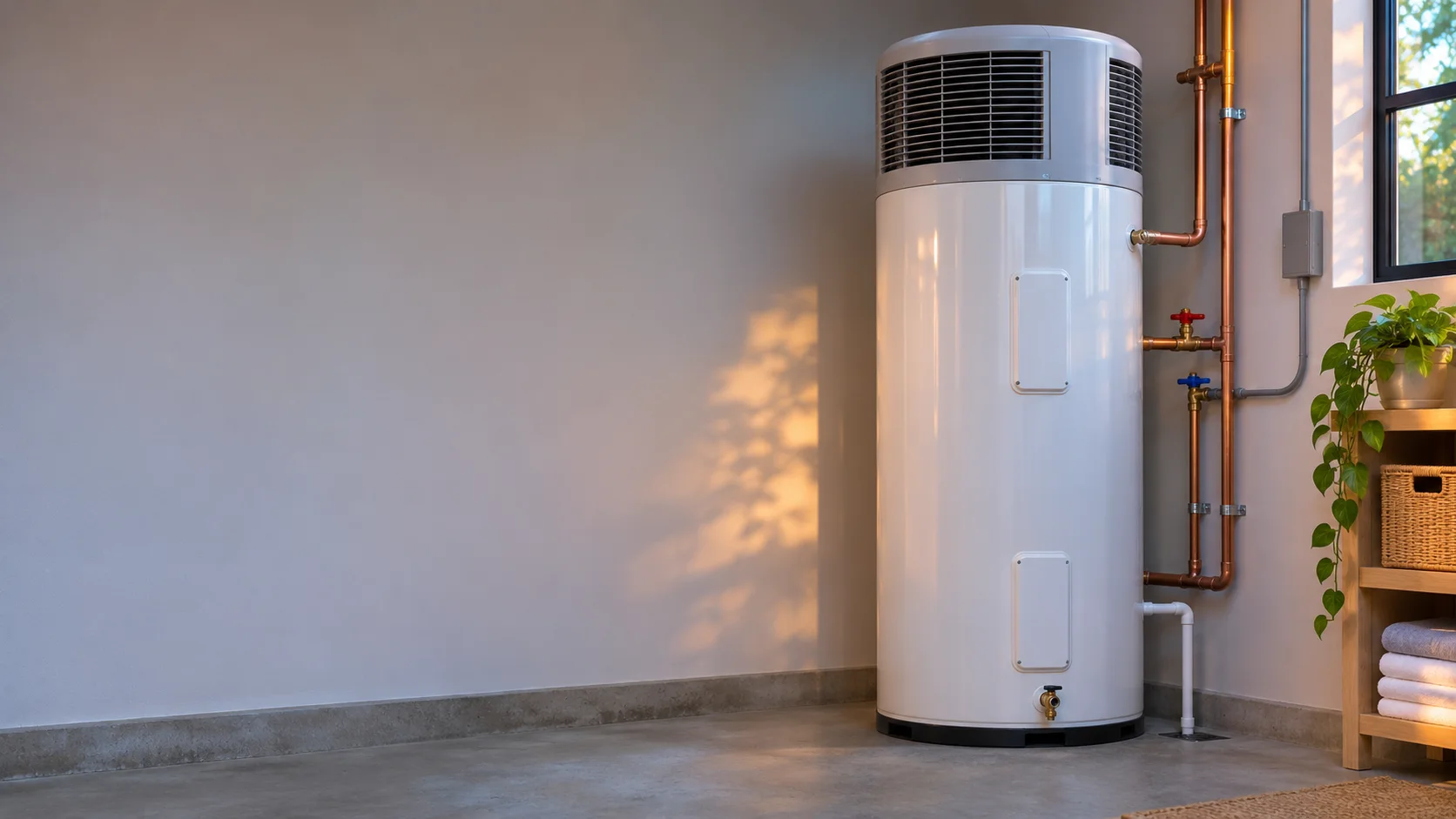
Quick answer
If your utility has time-of-use rates, use your heat-pump water heater’s manufacturer-approved schedule or connected controls to heat stored water during the lower-priced period, with enough recovery time before your household’s usual hot-water draws. Start with the operating mode recommended for your demand, then adjust the schedule only if hot-water availability remains reliable; there is no universal clock schedule for every tank, tariff, and household.
Table of contents
- Start with your utility’s actual off-peak window
- Work backward from when your household uses hot water
- Use the controls your model supports
- Choose an operating mode that still meets demand
- Set and evaluate a first schedule
- Check for settings that can undo the benefit
- When off-peak scheduling may not fit
- Bottom line
Key takeaways
- Check your own utility tariff first; off-peak hours and prices vary, and shifting use does not guarantee a lower bill.
- Schedule pre-heating around the household’s real hot-water draws and the tank’s recovery needs, using controls supported by the unit.
- Heat-pump-only mode recovers more slowly, while continuously running a hot-water circulation pump can undermine heat-pump operation.
Editorial transparency
Who worked on this article and how it was handled.
- Written by
- Maya Chen
- Creation method
- Editorial research
Method note: This guide synthesizes publicly available ENERGY STAR and U.S. Department of Energy guidance on heat-pump water-heater controls, storage, operating modes, and installation. No product was tested and no utility-specific tariff or household bill was analyzed.
AI assistance: AI assistance was used for source synthesis, drafting, and hero-image generation. No hands-on product test or independent human review is claimed.
If your utility has time-of-use rates, schedule your heat-pump water heater to store hot water during the lower-priced window and leave enough recovery time before your home’s usual draws. Use the unit’s own scheduling or approved connected controls, and do not assume that a generic “run it overnight” timetable will fit every household.[1][2][3]
The goal is to shift when the water is heated—not to promise a particular bill reduction or to run out of hot water. ENERGY STAR describes thermal storage and pre-heating as ways a connected electric water heater can participate in load management or time-of-use pricing, while DOE guidance emphasizes choosing an operating mode that meets actual hot-water demand.[1][2]
Start with your utility’s actual off-peak window
Look up the tariff that applies to your account—not a generic “cheap electricity at night” schedule.[1][3] Use the actual hours and rate windows shown for your service, since the storage-shift opportunity depends on the utility’s time-of-use tariff and program design.[1][3] ENERGY STAR notes that stored hot water can help a heat-pump water heater heat when electricity rates are low rather than during higher-priced periods; the opportunity depends on the rate plan and the unit’s controls.[1][3]
If your electricity price does not vary by time and you are not enrolled in a utility load-management program, a timer may shift the appliance’s operation without changing the price you pay.[1][3] Treat any bill savings as something to measure against your own tariff, not as a guaranteed result.[1][3]
Work backward from when your household uses hot water
Write down the usual large draws—such as morning showers or evening cleanup—and check the recovery guidance in your water heater’s manual.[2] Schedule a supported heating window so the tank has time to recover before the next important draw; do not copy another home’s clock settings without checking its rate window, tank, and usage pattern.[1][2]
Storage capacity matters: ENERGY STAR says that a larger tank increases the potential for thermal storage and can make utility load-management or time-of-use programs easier to use.[1] That is a design consideration, not a blanket recommendation to buy an oversized tank; match capacity to household demand and the installation space.[1]
Use the controls your model supports
If your unit has an app, built-in timer, or utility demand-response connection, start there.[1][2] DOE’s Federal Energy Management Program describes smart or IoT-enabled heat-pump water heaters as offering controls to toggle the unit, change operating modes, and adjust temperatures; available functions differ by model, so follow the product manual rather than assuming every heater supports the same schedule.[2]
Some connected water heaters can pre-heat in response to demand-response signals, but ENERGY STAR notes that this requires the communication ability to shift load.[1] If your model does not have that feature, use only its documented schedule or approved control options.[1][2]
Choose an operating mode that still meets demand
Heat-pump-only mode can be more efficient, but DOE says recovery takes longer and first-hour ratings are lower without the electric-resistance elements.[2] Its guidance is to select the mode that best meets hot-water demand, typically an efficiency or hybrid mode.[2]
That means a lower-priced heating window is not useful if the tank cannot recover before your household needs it.[2] If you notice a shortage, use the mode recommended for your demand or revise the schedule; do not disable backup heating or change temperature settings without checking the manufacturer’s instructions.[2]
Set and evaluate a first schedule
- Confirm the tariff. Record the actual off-peak hours and any weekday, weekend, or seasonal differences.[1][3]
- Mark the main hot-water draws. Note when the household needs a full tank, especially after a long interval without heating.[1][2]
- Schedule recovery before those draws. Use a manufacturer-supported “ready by” or pre-heat feature if available; otherwise choose a documented heating window within the lower-priced period.[1][3]
- Keep the right operating mode. Start with the mode recommended for your demand, not simply the mode with the fewest active heating elements.[2]
- Check comfort and usage. For a week, note any hot-water shortages and the unit’s reported energy use if available. Compare bills or meter data only over periods with similar use and tariff conditions before deciding whether the schedule helped.
A schedule is a starting point, not a universal setting.[1][2][3] Adjust one variable at a time—such as the pre-heat window—so you can tell whether a change affected comfort or energy use.
Check for settings that can undo the benefit
If your home has a hot-water recirculation loop, check how its pump is controlled.[3] ENERGY STAR recommends demand-based approaches such as on-demand, motion-sensor, or occupant-activated circulation rather than continuous operation; it warns that continuous circulation can force a heat-pump water heater into “Electric Only” mode, reduce hot-water availability, and increase energy use.[3]
Do not raise the tank temperature on your own just to store more heat.[3] ENERGY STAR explains that a thermostatic mixing valve can regulate fixture temperature to reduce scald potential when higher tank temperatures are used.[3] Follow the unit’s installation instructions and local plumbing requirements, and involve a qualified professional for any change to the plumbing or mixing-valve setup.[3]
When off-peak scheduling may not fit
A fixed schedule may be a poor fit if your household’s hot-water demand is unpredictable, the unit cannot recover within the available low-rate window, or your plan offers no time-based price difference.[1][2] In those cases, prioritize reliable hot water and the manufacturer-recommended mode; use time shifting only when the tariff or utility program gives it a clear purpose.[1][2]
If you are coordinating several home loads, our guide to smart EV charging under off-peak rates covers the same basic first step: check your own utility’s schedule before choosing an automation window.
Bottom line
Start with the tariff, then work backward from your household’s hot-water use and the heater’s recovery limits. Use the water heater’s own schedule or approved connected controls, choose a mode that meets demand, and monitor comfort before judging the bill. Off-peak pre-heating can shift water-heating demand, but the right schedule—and whether it saves money—depends on your utility plan, equipment, and household.[1][2][3]
Common questions
Questions this guide answers
When should I schedule a heat pump water heater?
Use the off-peak window listed by your utility and allow the unit enough time to recover before your household’s next large hot-water draw. Follow the water heater’s manual and use its built-in scheduling or approved connected controls.
Should I use heat-pump-only mode to save money?
Not automatically. Heat-pump-only operation can use less energy, but recovery takes longer; choose the operating mode that meets your household’s hot-water demand, which DOE guidance says is typically an efficiency or hybrid mode.
Can I raise the tank temperature to store more off-peak hot water?
Do not change the temperature setting as a shortcut without following the manufacturer’s instructions and applicable plumbing requirements. A thermostatic mixing valve can regulate fixture temperature and reduce scald potential when higher storage temperatures are used.
Evidence & further reading
Sources & references
Primary and authoritative references used to support or contextualize this article. Links open the original source.
- 1Heat Pump Water Heater Design Considerations
ENERGY STAR · Accessed Nov 18, 2026
Supports thermal storage, pre-heating, and the use of time-of-use rates or utility load-management programs.
- 2Purchasing Energy-Efficient Residential Water Heaters
U.S. Department of Energy Federal Energy Management Program · Accessed Nov 18, 2026
Supports smart-control capabilities, operating-mode selection, and heat-pump-only recovery trade-offs.
- 3Heat Pump Water Heater Installation Best Practices
ENERGY STAR · Accessed Nov 18, 2026
Supports low-rate pre-heating, mixing-valve safety context, and avoiding continuous recirculation-pump operation.

About the author
Maya Chen
Maya covers residential energy, HVAC controls, and practical home automation, translating technical systems into useful decisions for homeowners and renters.
More from Maya →Make your home smarter without buying every gadget.
One useful idea, one product worth knowing, and one energy-saving action—delivered weekly.
No spam. Unsubscribe anytime.
Semantic recommendations
Related reading
Selected from topic cluster, entities, tags, search intent, and editorial relationships.

How to Calculate the Real Payback Period of a Whole-House Solar Battery
A realistic solar-battery payback calculation must include export rates, time-of-use savings, efficiency losses, degradation, incentives, financing, and the value you place on backup power.

Window AC Energy Hacks: Saving Money in Peak August Temperatures
Lower your August cooling bill with practical window AC fixes, smarter settings, and airflow tricks that reduce waste without sacrificing comfort.

How to Stop Drafts Under Exterior Doors Without Replacing the Frame
Cold air under an exterior door usually comes from a worn sweep, misadjusted threshold, tired weatherstripping, or unsealed trim. Here is how to fix it without replacing the frame.

5 Smart Thermostat Placement Mistakes That Can Waste Hundreds on HVAC Bills
Wrong thermostat placement can distort temperature readings, increase HVAC runtime, and quietly undermine both comfort and energy savings.