
How to Schedule Smart EV Charging at Home for Off-Peak Rates
A practical guide to checking your utility tariff, setting a home EV charging schedule, and avoiding common cost and timing mistakes.
Quick answer
Smart EV charging at home means scheduling charging inside the lower-priced hours in your utility's current tariff while setting a departure time that keeps the car ready when needed. First compare the plan's total household costs and fees; an advertised off-peak rate does not by itself guarantee a lower bill.
Table of contents
- Check the tariff before changing your charging setup
- Choose Level 1 or Level 2 based on your routine
- Schedule around the departure time
- Avoid moving every charge to the same instant
- Check whether the plan saves money in practice
- Frequently asked questions
- Should I always charge my EV during off-peak hours?
- Do I need a Level 2 charger for overnight charging?
- Does a smart charger guarantee lower bills?
- The bottom line
Key takeaways
- Check the actual tariff, low-price hours, fees, and whether the rate applies to the EV alone or the whole home.
- Set charging around the vehicle's departure time; Level 1 may be enough for many daily driving patterns.
- Use Level 2 when your routine needs faster replenishment, and have a qualified electrician check capacity and code requirements.
- Review total household bills after scheduling; an off-peak price is not a guaranteed saving.
Editorial transparency
Who worked on this article and how it was handled.
- Written by
- Maya Chen
- Creation method
- Editorial research
Method note: Synthesized DOE Alternative Fuels Data Center home-charging guidance, a 2014 DOE evaluation of six utility projects, and a 2020 DOE/NREL smart-charging modeling presentation. No vehicle, charger, or utility tariff was independently tested; rates, eligibility, installation costs, and program controls vary by provider and location.
AI assistance: AI assisted with research synthesis and drafting; claims were checked against the listed official sources and the article was validated against the site's content requirements.
Timing home EV charging for off-peak hours can lower the price paid for each charging kilowatt-hour when your utility’s tariff offers a cheaper overnight window.[1] But the charger app is not the source of the discount: the utility’s current rate schedule is. DOE’s Alternative Fuels Data Center notes that residential EV charging costs depend on equipment, time of day, and how long the station is used; some utilities offer time-of-use rates or other charging incentives.[1]
The practical goal is simple: charge when electricity costs less without leaving before the battery is ready, buying faster equipment you do not need, or overlooking a rate plan that raises other parts of the household bill.[1]
Check the tariff before changing your charging setup
Find the current residential rate sheet on your utility’s website or ask its customer-service team for the EV-specific terms.[1] Confirm the exact off-peak start and end times, weekday and weekend differences, seasonal changes, enrollment rules, and whether the rate applies only to EV charging or to the whole home.[1] Do not rely on a charger manufacturer’s sample schedule or an old bill insert: utilities can update tariffs, and plans differ by service territory.[1]
Compare the full plan, not just its lowest advertised cents-per-kilowatt-hour price.[1] Check fixed charges, minimum bills, metering or enrollment fees, and any higher-priced hours that apply to the rest of your household. AFDC notes that actual home-charging costs vary with equipment and charging time, and that some utilities offer time-of-use rates; neither fact means every plan will reduce every customer’s bill.[1]
If the plan changes the whole home’s price by time of day, include cooking, heating or cooling, laundry, and other large loads in your comparison.[1] If it is an EV-only rate, verify how the utility measures charging and whether a separate meter or approved charger is required.[1] Ask the utility for a bill estimate using your usage history before enrolling if the plan is not straightforward.
Choose Level 1 or Level 2 based on your routine
A faster charger is not automatically a better off-peak strategy.[1] DOE’s AFDC says many EV owners can meet daily driving needs by charging overnight with Level 1 equipment when a suitable outlet on a dedicated branch circuit is available; Level 2 may suit less regular schedules, longer commutes, or vehicles with larger batteries that need more energy than the usual parking period can provide.[1]
Smart Level 2 equipment may add charging timers, communications, usage data, and other controls, but start by checking whether your vehicle already supports scheduled charging.[1] If that built-in timer can follow your utility’s low-price window and reliably have the car ready, a second app or wallbox may add complexity without solving a real problem.[3]
For a new 240-volt installation, have a qualified electrician assess the home’s electrical capacity and confirm local code and permit requirements.[1] DOE’s AFDC notes that some homes may not have enough capacity for Level 2 equipment and that EV charging installations must meet local and state requirements.[1] Do not treat an app’s breaker or charging-current setting as a substitute for a professional electrical assessment.[1]
Schedule around the departure time
Use the vehicle or charger control that best matches your utility plan, then set a ready-by time rather than guessing how long a session will take.[3] If both the car and the charger have schedules, check their manuals and avoid overlapping rules that could delay charging until after the low-price window or prevent the car from reaching the requested state of charge.[3]
A practical setup is:
- Confirm the tariff’s current low-price hours and any weekday, weekend, or seasonal exceptions.[1]
- Enter the desired departure time in the vehicle or charger, if that feature is available.[3]
- Set a charging limit that follows the vehicle manufacturer’s guidance and your daily driving needs.[1]
- Check the first few sessions in the vehicle or charger history to confirm charging began and finished when expected.[3]
- Revisit the schedule when your utility changes its tariff, your commute changes, or daylight-saving time affects the schedule.[1]
Treat the first week as a check, not proof of savings.[1] Confirm the car is ready when needed and that the actual session falls inside the utility’s low-price window.[3] If the utility offers managed charging or a demand-response program, read its override and departure-readiness terms before opting in.[3]
Avoid moving every charge to the same instant
Off-peak schedules can shift charging away from one busy period, but a shared start time may concentrate demand at the beginning of another window.[2][3] A 2014 DOE review of six utility projects reported that most in-home participants charged overnight during off-peak periods and that offered time-based rates encouraged more off-peak charging; it was a limited, historical program evaluation, not a promise about today’s rates or your utility’s results.[2]
A 2020 DOE/NREL project presentation also modeled residential charging scenarios in which highly correlated start times produced feeder-level impacts in an extreme, high-adoption case.[3] The same presentation listed time-of-use control with randomized charge times as a strategy under study.[3] Those results describe modeled grid conditions, not a prediction for an individual garage.[3] Still, if your vehicle or utility program supports randomized starts or managed charging, it can help avoid having every session begin at one exact clock time while preserving a ready-by target.[3]
Check whether the plan saves money in practice
Use the vehicle or charger history to estimate when and how much energy the car draws, then compare the utility’s bill before and after changing plans.[1] Include the whole bill if the tariff affects all household usage; a lower EV charging rate can be offset by higher prices or fees at other times.[1] If the utility provides a bill calculator, use your own usage data rather than a generic savings estimate.[1]
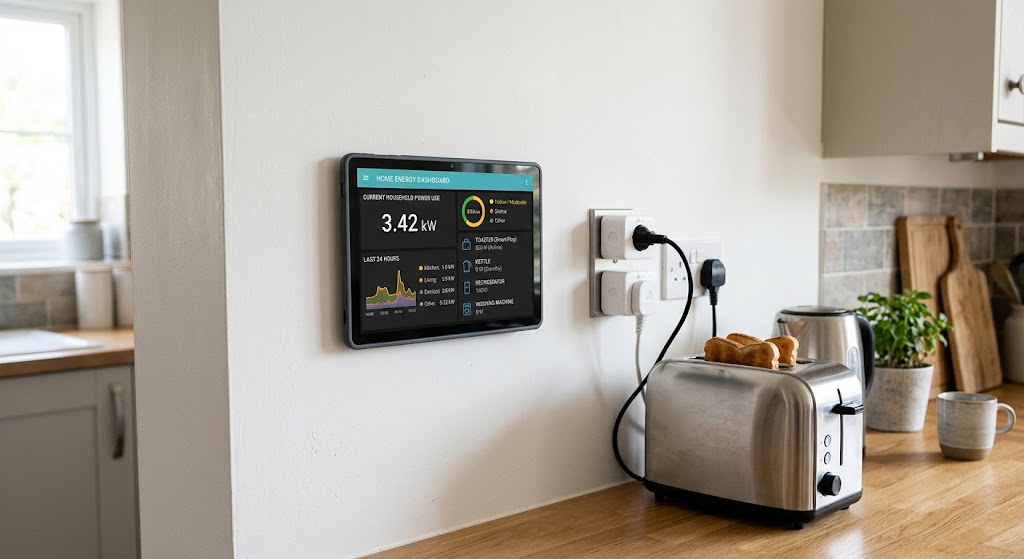
A home energy dashboard can make overlapping loads easier to spot. Our guide to Home Assistant dashboards for real-time household wattage explains one way to view household demand, while the smart thermostat savings guide shows why a time-based energy feature should be judged by its effect on the full bill—not the device label alone.
Frequently asked questions
Should I always charge my EV during off-peak hours?
Only if the tariff and schedule fit your home.[1] Check the current rate window, plan fees, and whether the plan changes prices for the whole household; retain a charging schedule that leaves the car ready when needed.[1]
Do I need a Level 2 charger for overnight charging?
No. DOE’s AFDC says many owners can meet daily driving needs with overnight Level 1 charging when a suitable dedicated circuit is available. Level 2 is more useful when a longer commute, larger battery, or irregular parking schedule makes the available charging time insufficient.[1]
Does a smart charger guarantee lower bills?
No. A timer can help move charging into a lower-priced window, but the utility tariff determines the price and the entire plan determines the bill. Check the plan and compare actual bills before assuming the equipment has paid for itself.[1]
The bottom line
Start with your utility’s current tariff, not a charger advertisement. Check whether the lower-price window applies to the EV or the whole home, use the vehicle’s scheduling features if they are enough, and buy Level 2 equipment only when your driving pattern needs faster charging. Then verify both morning readiness and the total household bill; off-peak charging is a useful control, not an automatic savings guarantee.[1]
Common questions
Questions this guide answers
Does a smart Level 2 charger automatically save money?
No. Savings depend on whether your utility offers a suitable time-of-use plan, the schedule matches its lower-priced window, and the plan reduces your total bill after fees.
Do I need a Level 2 charger to charge an EV overnight?
Not always. DOE's AFDC says many drivers can meet daily needs with overnight Level 1 charging when a suitable dedicated circuit is available; Level 2 is useful for less regular schedules, longer commutes, or larger batteries.
How should I choose an EV charging start time?
Use the current low-price window from your utility and set a ready-by time in the vehicle or charger. If supported, stagger or randomize the start rather than making every session begin at the same instant.
Evidence & further reading
Sources & references
Primary and authoritative references used to support or contextualize this article. Links open the original source.
- 1Charging Electric Vehicles at Home
U.S. Department of Energy, Alternative Fuels Data Center · Accessed Nov 17, 2026
Home Level 1 and Level 2 charging, smart charger features, electrical capacity, code and permit considerations, and variation in residential charging costs and utility rates.
- 2Evaluating Electric Vehicle Charging Impacts and Customer Charging Behaviors - Experiences from Six Smart Grid Investment Grant Projects
U.S. Department of Energy · Accessed Nov 17, 2026
A December 2014 evaluation of six utility projects; its summary reports overnight off-peak charging patterns and the effect of offered time-based rates.
- 3Charging Infrastructure Technologies: Smart Electric Vehicle Charging for a Reliable and Resilient Grid (RECHARGE)
U.S. Department of Energy; National Renewable Energy Laboratory, Sandia National Laboratories, and Idaho National Laboratory · Accessed Nov 17, 2026
A 2020 project presentation covering modeled residential EV load scenarios and smart-control strategies, including time-of-use rates with randomized charge times.

About the author
Maya Chen
Maya covers residential energy, HVAC controls, and practical home automation, translating technical systems into useful decisions for homeowners and renters.
More from Maya →Make your home smarter without buying every gadget.
One useful idea, one product worth knowing, and one energy-saving action—delivered weekly.
No spam. Unsubscribe anytime.
Semantic recommendations
Related reading
Selected from topic cluster, entities, tags, search intent, and editorial relationships.
Home Assistant Dashboards for Tracking Household Wattage in Real-Time
Build a Home Assistant power dashboard that shows live household watts, appliance loads, short-term trends, and daily energy without confusing W with kWh.

How Much Can a Smart Thermostat Actually Save You?
A practical, data-first guide to comfort, schedules, occupancy sensing, and where real household savings come from.

How to Calculate the Real Payback Period of a Whole-House Solar Battery
A realistic solar-battery payback calculation must include export rates, time-of-use savings, efficiency losses, degradation, incentives, financing, and the value you place on backup power.

How to Schedule a Heat Pump Water Heater Around Off-Peak Rates
Use your utility’s actual time-of-use window, your water heater’s approved controls, and your household’s hot-water pattern to shift heating without sacrificing comfort.