
Single-Stage vs. Two-Stage HVAC: Which Works Best with Smart Thermostats?
Two-stage HVAC gives a compatible smart thermostat more capacity control, while single-stage systems still benefit from scheduling, sensors, and smarter runtime management.
Quick answer
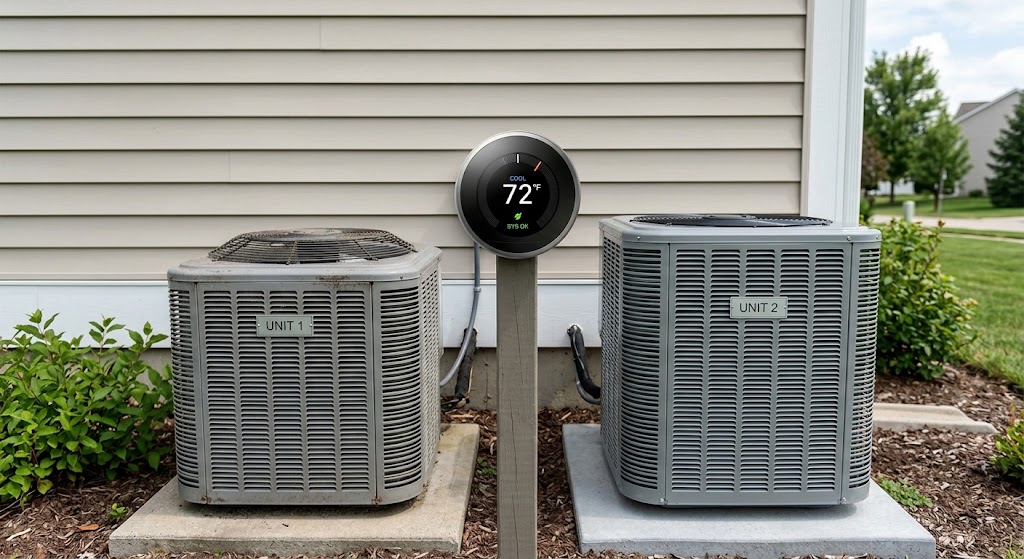
A two-stage HVAC system usually gives a compatible smart thermostat more control because the thermostat can call for low-stage heating or cooling first and bring on the second stage only when demand is higher. A single-stage system can still benefit from schedules, occupancy sensing, remote control, and smart recovery, but a thermostat cannot create a lower-capacity stage that the HVAC equipment does not physically have.
Table of contents
- The Short Answer
- What Single-Stage HVAC Means
- What Two-Stage HVAC Means
- Why the longer low-stage cycle matters
- Where the Smart Thermostat Adds Value
- W1, W2, Y1, and Y2 Explained
- Do not identify staging from wire color
- A missing W2 does not prove the furnace is single-stage
- Thermostat-Controlled Staging vs. Equipment-Controlled Staging
- Thermostat-controlled staging
- Equipment-controlled staging
- Communicating HVAC
- Google Nest: Stage Support Depends on the Model
- ecobee: The Same Model-Specific Rule Applies
- Which System Gets More Benefit From Smart Recovery?
- Comfort: Two-Stage Usually Wins
- Smaller temperature swings
- More consistent airflow
- Lower operating sound in stage one
- Humidity: Two-Stage Cooling Has a Real Advantage
- Energy Efficiency: Do Not Compare Stage Count Alone
- Installation can erase the equipment advantage
- When Single-Stage HVAC Is the Better Choice
- The climate is mild
- The home is small and simple
- Upfront cost is the priority
- The HVAC system rarely runs long enough for staging to matter
- You mainly want smart scheduling
- When Two-Stage HVAC Is the Better Choice
- Your climate varies significantly
- Humidity is a recurring summer problem
- The existing system short-cycles
- Noise matters
- You want the smart thermostat to manage capacity as well as schedule
- A Two-Stage HVAC System Does Not Require a Smart Thermostat
- What If a Two-Stage Furnace Is Connected to a Single-Stage Thermostat?
- What About Two-Stage Air Conditioning With a Single-Stage Furnace?
- Two-Stage Is Not the Same as Variable-Speed or Variable-Capacity
- Two-stage capacity
- Variable-capacity compressor or modulating furnace
- Variable-speed blower
- Smart Thermostat Compatibility Checklist
- Why the C wire matters
- Heat Pumps Need Extra Care
- Communicating Systems Can Change the Answer Completely
- Which One Works Best With Smart Thermostats?
- Choose single-stage when:
- Choose two-stage when:
- What to Ask the HVAC Contractor
- Safety: Thermostat Wiring Is Low Voltage, HVAC Equipment Is Not
- Conclusion
Key takeaways
- A smart thermostat can optimize either system, but only two-stage hardware can physically operate at two output levels.
- When W2 or Y2 is available, a compatible thermostat can participate directly in deciding when the second stage should run.
- Longer low-stage cycles can improve temperature stability, noise, airflow consistency, and summer humidity removal.
- Two-stage does not automatically mean higher AFUE or SEER2; equipment ratings and installation quality still determine actual efficiency.
- Before replacing a thermostat, verify whether staging is thermostat-controlled, equipment-controlled, or handled by a proprietary communicating system.
Editorial transparency
Who worked on this article and how it was handled.
- Written by
- Maya Chen
- Creation method
- Editorial research
AI assistance: AI assisted with research organization and drafting. Sources, factual claims, and the final article should be reviewed by a human editor before publication.
A smart thermostat can make an old single-stage furnace or air conditioner much easier to manage, but it cannot change the physical capacity levels inside the equipment. If your HVAC system only knows “off” and “100%,” the thermostat can decide when to run it more intelligently, not make it operate at 60% capacity.
A two-stage system changes that relationship. Instead of one fixed output, the furnace, air conditioner, or heat pump has a lower stage for lighter loads and a higher stage for harder weather. With the right wiring and thermostat, that gives the control system another decision to make: stay in low stage longer, or bring on stage two now?
For most homes where comfort and humidity control matter, two-stage HVAC is the better technical match for a capable smart thermostat. But that does not mean every homeowner should pay extra for staging, and it does not mean every two-stage system hands direct stage control to the wall thermostat. The details are in the equipment design and wiring.
The Short Answer
| Question | Single-stage HVAC | Two-stage HVAC |
|---|---|---|
| Capacity levels | One: full output | Two: low and high |
| Smart thermostat benefit | Scheduling, occupancy, recovery, remote control | All single-stage benefits plus possible direct staging control |
| Temperature consistency | More on/off cycling | Usually steadier with longer low-stage cycles |
| Summer humidity control | More dependent on sizing and cycle length | Often better because low stage can run longer |
| Noise | Full output whenever running | Quieter when operating in low stage |
| Upfront complexity | Lower | Higher |
| Thermostat wiring | Usually W1 / Y1 | Often W1 + W2 and/or Y1 + Y2 |
| Best fit | Mild climates, smaller homes, budget-focused replacements | Variable climates, longer runtimes, humidity-sensitive or comfort-focused homes |
The important word in the wiring row is often.
Some two-stage furnaces can accept a single-stage thermostat and decide internally when to move from low to high heat. Other systems expose W2 so the thermostat can make that call directly.
The same distinction exists with cooling equipment.
What Single-Stage HVAC Means
A single-stage conventional furnace has one heating output level.
When there is a call for heat:
- the thermostat energizes the first-stage heating circuit;
- the furnace operates at its designed heating capacity;
- the call ends when the thermostat is satisfied.
A single-stage air conditioner behaves similarly on the cooling side. The compressor is either off or operating at its one available capacity.
That does not mean the blower motor is necessarily primitive.
A system can have:
- single-stage heating or cooling;
- plus a multi-speed or variable-speed indoor blower.
“Stage” describes heating or cooling capacity, not every motor speed inside the HVAC system.
What Two-Stage HVAC Means
A two-stage system has two available levels of heating or cooling output.
For furnaces, current manufacturer descriptions commonly place low-stage output somewhere around roughly 60% to 65% of full capacity, with high stage providing full output. Cooling products often use a similar partial-capacity concept, although the exact percentage is model-specific.
The system can therefore spend much of a mild day running at reduced output.
When the load increases—because outdoor temperature becomes more extreme, the thermostat setpoint changes sharply, or the first stage cannot satisfy the home—the system can bring on stage two.
Why the longer low-stage cycle matters
A lower-capacity cycle typically lasts longer than a full-capacity blast.
That can improve:
- temperature consistency;
- air mixing;
- perceived comfort;
- sound levels.
In cooling mode, longer runtime can also improve moisture removal because the evaporator coil spends more time cold and actively condensing water from indoor air.
Lennox specifically highlights longer low-stage cooling as a reason two-stage systems can improve humidity control compared with single-stage operation.
Where the Smart Thermostat Adds Value
A smart thermostat provides useful features even when the HVAC system has only one stage.
Those features can include:
- schedules;
- away modes;
- occupancy sensing;
- geofencing;
- remote adjustment;
- smart recovery;
- runtime history;
- temperature alerts;
- remote room sensors.
But those are timing and setpoint decisions.
With a two-stage system, the thermostat may also participate in capacity decisions.
For example:
- Stage 1 is enough: keep W1 or Y1 active.
- The home is falling too far behind: add W2 or Y2.
- The scheduled setpoint must be reached quickly: start or escalate earlier.
- The load is mild: avoid high stage.
This is where a two-stage system gives a smart thermostat an additional control variable.
W1, W2, Y1, and Y2 Explained
On a conventional 24-volt thermostat:
- W1 usually represents first-stage heating.
- W2 usually represents second-stage heating.
- Y1 usually represents first-stage cooling.
- Y2 usually represents second-stage cooling.
If you remove the thermostat cover and find both W1 and W2 connected, the thermostat is likely involved in controlling multiple heating stages.
If you find Y1 and Y2, it is likely involved in controlling two cooling stages.
Google’s Nest documentation uses these same terminal patterns when explaining multistage systems.
Do not identify staging from wire color
Look at the terminal labels, not the insulation color.
Installers do not always use the same color conventions.
A missing W2 does not prove the furnace is single-stage
Some two-stage furnaces can be configured so the equipment control board decides when to enter high stage.
Carrier, for example, documents selected two-stage furnace controls that can operate with a single-stage thermostat.
That setup may use a timer or internal control strategy instead of an independent W2 call from the wall.
So if you are replacing a thermostat, check the furnace or air-handler model and its installation manual rather than assuming the thermostat cable tells the whole story.
Thermostat-Controlled Staging vs. Equipment-Controlled Staging
This is one of the most important distinctions in the article.
Thermostat-controlled staging
The thermostat has dedicated stage outputs.
Typical conventional example:
- W1 = low heat;
- W2 = high heat;
- Y1 = low cooling;
- Y2 = high cooling.
The smart thermostat decides when to call the additional stage according to its control logic and configuration.
Equipment-controlled staging
The thermostat may send only one heating or cooling call.
The furnace or equipment board decides when to escalate internally.
That decision can be based on:
- elapsed runtime;
- temperature behavior;
- proprietary equipment logic;
- other sensor inputs.
Communicating HVAC
Some premium HVAC systems use proprietary digital communication rather than conventional W1/W2/Y1/Y2 calls.
These systems can exchange richer information between:
- thermostat;
- furnace or air handler;
- outdoor unit.
Replacing the original communicating control with a conventional smart thermostat can remove features or may not be supported at all.
If the thermostat terminals use unfamiliar labels such as proprietary numbered or lettered bus connections, do not assume a standard smart thermostat is compatible.
Google Nest: Stage Support Depends on the Model
“Works with Nest” is not specific enough for a multistage system.
Google’s current compatibility documentation shows different stage limits across thermostat generations.
For example, the current Nest family includes models that can support:
- one stage of heating and cooling plus an additional second stage on one side;
- or more advanced combinations with multiple stages of conventional heating and cooling.
The Nest Learning Thermostat line supports more complex multistage configurations than some lower-tier models.
The buying rule is straightforward:
Count your W and Y stages before choosing the thermostat.
Do not buy the thermostat first and hope an unused terminal appears later.
ecobee: The Same Model-Specific Rule Applies
ecobee also supports multistage HVAC, but capability varies by product.
Current ecobee documentation says its Smart Thermostat Premium supports two-stage heating and cooling.
The lower-cost Smart Thermostat Essential has a more specific limitation: it can support two cooling stages with one heating stage, or two heating stages with one cooling stage, but not two stages of both heating and cooling at the same time.
That is an important real-world example of why the phrase “supports two-stage HVAC” can be misleading without the full terminal combination.
A home with:
- W1;
- W2;
- Y1;
- Y2
needs a thermostat that supports the complete 2H/2C conventional arrangement.
Which System Gets More Benefit From Smart Recovery?
Smart recovery is the feature that starts heating or cooling before a scheduled setpoint time so the room reaches the desired temperature at the scheduled time.
A single-stage system can benefit because the thermostat learns how quickly the home changes temperature.
A two-stage system potentially gives the thermostat more options.
Instead of choosing only:
- start now;
- start later;
the control logic may also choose:
- begin early in low stage;
- remain in low stage;
- escalate to high stage if the temperature trajectory requires it.
That can reduce the need for a sudden full-capacity recovery cycle.
Exactly how this works is thermostat- and equipment-specific, so do not assume every device uses the same algorithm.
Comfort: Two-Stage Usually Wins
If both systems are properly sized, two-stage HVAC generally has the stronger comfort case.
Smaller temperature swings
Single-stage equipment always runs at its available full output.
A correctly sized system can still maintain excellent comfort, but the cycle tends to have a more obvious on/off character.
A two-stage system can spend longer near the load the home actually needs.
That produces gentler temperature movement.
More consistent airflow
Longer cycles move conditioned air through the home for more time.
That can help rooms feel more even, although it does not fix:
- bad duct design;
- severe duct leakage;
- closed registers;
- poor return-air paths.
Lower operating sound in stage one
A two-stage furnace or AC running at partial output is often quieter than the same equipment family operating at full output.
The advantage is most noticeable when stage one handles the majority of routine weather.
Humidity: Two-Stage Cooling Has a Real Advantage
Humidity control is one of the strongest reasons to prefer two-stage cooling in a humid climate.
Air conditioners remove moisture while the evaporator coil is cold.
A single-stage system that is oversized can:
- start at full capacity;
- cool the room quickly;
- satisfy the thermostat;
- stop before enough moisture is removed.
ENERGY STAR specifically warns that oversized equipment can cycle too frequently and produce poorer comfort and humidity performance.
Two-stage cooling can reduce this problem by staying at lower capacity for longer periods.
But do not use staging as an excuse to oversize the equipment.
Proper sizing still comes first.
Energy Efficiency: Do Not Compare Stage Count Alone
Two-stage equipment often appears in higher-efficiency product lines, but two-stage is not itself an efficiency rating.
For heating, compare:
- AFUE;
- fuel type;
- blower design;
- actual matched-system performance.
For cooling, compare:
- SEER2;
- EER2 where relevant;
- matched indoor and outdoor components.
A high-efficiency single-stage furnace can have a higher AFUE than a lower-efficiency two-stage furnace.
Likewise, two-stage cooling can improve part-load behavior without automatically making every model more efficient than every single-stage model.
Installation can erase the equipment advantage
ENERGY STAR emphasizes that HVAC performance depends heavily on:
- correct sizing;
- airflow;
- refrigerant charge;
- duct condition.
Poor airflow or bad installation can undermine a premium two-stage system.
Do not spend more on staging while ignoring a leaking duct system or an oversized load calculation.
When Single-Stage HVAC Is the Better Choice
Single-stage is not obsolete.
It can be the better purchase when:
The climate is mild
If heating or cooling demand is light and seasonal, the extra comfort benefit may not justify the equipment premium.
The home is small and simple
A compact, well-insulated home may have relatively even temperatures with correctly sized single-stage equipment.
Upfront cost is the priority
Single-stage systems are mechanically simpler and often less expensive.
The HVAC system rarely runs long enough for staging to matter
A vacation property or lightly used space may not benefit enough from partial-capacity operation.
You mainly want smart scheduling
If your goal is remote control, schedules, away mode, and utility-program participation, single-stage equipment can still work very well with a smart thermostat.
The thermostat simply controls one capacity level instead of two.
When Two-Stage HVAC Is the Better Choice
Two-stage becomes more compelling when:
Your climate varies significantly
Low stage can handle mild weather while high stage remains available for design-day conditions.
Humidity is a recurring summer problem
Longer low-stage cooling can improve moisture removal.
The existing system short-cycles
First confirm the system is not badly oversized or suffering from another fault.
But when replacing equipment, properly sized staged capacity can provide gentler operation.
Noise matters
Low-stage operation is usually less intrusive.
You want the smart thermostat to manage capacity as well as schedule
This is the most relevant point for this article.
If the equipment exposes W2 and Y2 and the thermostat supports the correct stage combination, the thermostat can make richer control decisions.
A Two-Stage HVAC System Does Not Require a Smart Thermostat
A conventional two-stage thermostat can control two-stage equipment perfectly well.
The smart part adds features such as:
- learning or adaptive recovery;
- remote control;
- occupancy logic;
- usage reports;
- alerts;
- room sensors.
The two-stage part adds:
- low capacity;
- high capacity.
They complement each other, but they solve different problems.
Do not buy two-stage HVAC solely because you think a smart thermostat requires it.
It does not.
What If a Two-Stage Furnace Is Connected to a Single-Stage Thermostat?
This can be a legitimate configuration.
Some equipment can manage the second stage internally.
That means the furnace may:
- receive a W1 heating call;
- begin in low stage;
- wait for an internal condition or timer;
- move to high stage if needed.
The downside is that the wall thermostat may have less direct information about why stage two is needed.
If W2 wiring is available and the furnace manual supports thermostat staging, direct two-stage thermostat control may offer more responsive control.
But do not rewire stage control casually. The equipment manual determines the supported configuration.
What About Two-Stage Air Conditioning With a Single-Stage Furnace?
This is common and can work well.
The stage count does not need to match between heating and cooling.
You might have:
- W1 only;
- Y1 and Y2.
Or:
- W1 and W2;
- Y1 only.
Smart thermostat compatibility pages specifically account for these mixed arrangements.
This is also why lower-cost thermostats may work in one multistage home but not another.
Two-Stage Is Not the Same as Variable-Speed or Variable-Capacity
These terms are often mixed together.
Two-stage capacity
Two discrete output levels.
Example:
- low;
- high.
Variable-capacity compressor or modulating furnace
Many output levels across a broader range.
The equipment can match load much more closely.
Variable-speed blower
Refers to the indoor fan motor.
A variable-speed blower can be paired with:
- single-stage equipment;
- two-stage equipment;
- variable-capacity equipment.
Do not assume “variable-speed blower” means the outdoor compressor or furnace burner is variable-capacity.
Smart Thermostat Compatibility Checklist
Before buying a thermostat, photograph the existing wiring and check the HVAC model numbers.
Look for:
- R or Rc/Rh
- C
- W1
- W2
- Y1
- Y2
- G
- O/B for heat pumps
- AUX/E for heat-pump backup heat
- proprietary terminals that do not match standard 24V labels
Then check the exact thermostat model, not only the brand.
Why the C wire matters
Smart thermostats need continuous electrical power for:
- Wi-Fi;
- display;
- sensors;
- processor;
- radios.
Some installations can operate without a dedicated C wire or use a manufacturer power accessory.
But multistage systems already consume more thermostat terminals, so wiring limitations become more important.
ecobee currently uses dedicated 24VAC power through C or its compatible Power Extender Kit for supported systems.
Nest requirements vary by system and thermostat model.
Heat Pumps Need Extra Care
A two-stage heat pump is more complicated than a two-stage conventional AC.
Its thermostat may need to manage:
- compressor stage one;
- compressor stage two;
- reversing valve;
- auxiliary heat;
- emergency heat;
- possibly dual-fuel changeover.
Google recommends professional installation for some advanced systems such as dual fuel.
If your home has a heat pump plus gas furnace, do not map W2 and AUX labels by guesswork.
Incorrect configuration can produce expensive or unsafe operation.
Communicating Systems Can Change the Answer Completely
Some higher-end HVAC systems do not expose conventional stage calls to the wall.
They use a proprietary communicating thermostat.
The controller may exchange:
- temperatures;
- compressor capacity;
- blower commands;
- faults;
- humidity;
- equipment status.
A popular third-party smart thermostat may technically be attractive but can reduce functionality if adapting the equipment to conventional 24V control is even possible.
Before replacing a communicating thermostat:
- identify the equipment model;
- check manufacturer documentation;
- determine which features would be lost;
- compare the OEM connected thermostat with third-party options.
The most feature-rich consumer thermostat is not automatically the smartest choice for proprietary HVAC.
Which One Works Best With Smart Thermostats?
If the question is purely about control capability, two-stage wins.
A compatible smart thermostat can potentially control:
- when the system runs;
- what setpoint it targets;
- which rooms influence the target;
- and which capacity stage is needed.
A single-stage system gives it fewer physical options.
But if the question is which one should you buy, the answer depends on the house.
Choose single-stage when:
- upfront budget matters most;
- climate demand is moderate;
- the home is small and well insulated;
- humidity is not a major problem;
- you mainly want scheduling and remote control.
Choose two-stage when:
- you value steadier temperatures;
- you live in a variable or demanding climate;
- summer humidity matters;
- quieter low-capacity operation matters;
- the thermostat and wiring can directly support the stages;
- you expect long HVAC runtimes where part-load operation can be useful.
What to Ask the HVAC Contractor
Before approving a two-stage quote, ask:
- What are the exact low- and high-stage capacities?
- Will the thermostat control stage two directly or will the equipment self-stage?
- Will W2 and/or Y2 be connected at the thermostat?
- Which smart thermostat models support the complete equipment configuration?
- Is the system communicating or conventional 24V?
- What is the matched AFUE or SEER2 rating?
- Was the system sized from a Manual J load calculation?
- What airflow is specified in each stage?
- How will humidity be controlled during low-load weather?
- Will any feature be lost if I use a third-party smart thermostat?
Those answers are more useful than simply asking whether the unit is “smart thermostat compatible.”
Safety: Thermostat Wiring Is Low Voltage, HVAC Equipment Is Not
Conventional thermostat terminals usually use 24VAC controls, but the furnace, air handler, and outdoor unit contain line-voltage circuits.
Before removing or connecting thermostat wires:
- turn HVAC power off;
- photograph every existing connection;
- label wires by terminal;
- follow the thermostat and equipment manuals.
Do not open or modify high-voltage sections of the furnace, air handler, or condenser unless you are qualified to do so.
Professional installation is particularly appropriate for:
- dual-fuel systems;
- heat pumps with multiple auxiliary stages;
- proprietary communicating systems;
- dual-transformer systems;
- unclear or nonstandard wiring.
Conclusion
A smart thermostat works well with either single-stage or two-stage HVAC, but two-stage equipment gives it more physical control to work with.
With single-stage HVAC, the thermostat can optimize schedules, occupancy, recovery, sensors, and runtime—but every heating or cooling call still uses the system’s one available capacity.
With a properly configured two-stage system, a compatible thermostat can also decide when low output is enough and when the second stage is justified. That usually produces the stronger comfort and humidity-control experience.
Do not choose by stage count alone. Verify the actual AFUE or SEER2 rating, insist on correct sizing and installation, and confirm whether the thermostat or the HVAC control board will manage staging. If W1/W2 or Y1/Y2 are part of the design, make sure the exact smart thermostat model supports the complete combination before you buy it.
Common questions
Questions this guide answers
Does a smart thermostat work better with two-stage HVAC?
It can. When the thermostat and equipment are wired for separate stages, a compatible smart thermostat can control W1/W2 for heating and Y1/Y2 for cooling, allowing longer low-stage operation and higher-stage capacity only when needed. Some two-stage equipment self-stages internally, so the thermostat may not directly control both stages.
Can a smart thermostat turn a single-stage system into a two-stage system?
No. A smart thermostat can optimize when a single-stage system runs, but it cannot add a second compressor capacity, gas-valve stage, or other capacity level that the HVAC hardware does not contain.
Is two-stage HVAC always more energy efficient than single-stage HVAC?
Not automatically. Two-stage operation can reduce cycling and spend more time at lower output, but rated efficiency still depends on the specific furnace or matched cooling system, sizing, airflow, ducts, refrigerant charge, and installation quality. Compare AFUE or SEER2 ratings rather than assuming stage count alone determines efficiency.
How can I tell if my HVAC system is two-stage?
Conventional 24-volt systems often expose a second heating wire at W2 and a second cooling wire at Y2. However, some equipment performs staging at the furnace or air-handler control board, and communicating systems can use proprietary wiring, so thermostat terminals alone are not always conclusive.
Evidence & further reading
Sources & references
Primary and authoritative references used to support or contextualize this article. Links open the original source.
- 1HVAC Quality Installation
ENERGY STAR · Accessed Aug 12, 2026
Supports the importance of correct HVAC sizing, airflow, refrigerant charge, and duct evaluation rather than relying on equipment features alone.
- 2Nest thermostat compatibility
Google Home and Nest Help · Accessed Aug 12, 2026
Supports current Nest compatibility with single-stage and multistage 24-volt systems, stage limits by thermostat model, and the need for professional installation in some advanced configurations.
- 3Learn about multistage heating and cooling system
Google Home and Nest Help · Accessed Aug 12, 2026
Supports the distinction between single-stage and multistage systems, W1/W2 and Y1/Y2 wiring, and thermostat-controlled staging behavior.
- 4Smart Thermostat Premium
ecobee · Accessed Aug 12, 2026
Supports current ecobee two-stage heating and cooling compatibility and smart staging controls.
- 5Smart Thermostat Essential
ecobee · Accessed Aug 12, 2026
Supports current model-specific limitations showing that not every smart thermostat handles the same combination of heating and cooling stages.
- 6What is a Two-Stage Furnace and How Does It Work?
Carrier · Accessed Aug 12, 2026
Supports the functional distinction between single-stage and two-stage furnaces and the comfort benefits of longer low-stage heating.
- 7Single Stage vs Two Stage vs Variable Speed Air Conditioner
Lennox · Accessed Aug 12, 2026
Supports two-stage cooling behavior, longer low-stage runtime, more consistent temperatures, and improved humidity control.

About the author
Maya Chen
Maya covers residential energy, HVAC controls, and practical home automation, translating technical systems into useful decisions for homeowners and renters.
More from Maya →Make your home smarter without buying every gadget.
One useful idea, one product worth knowing, and one energy-saving action—delivered weekly.
No spam. Unsubscribe anytime.
Semantic recommendations
Related reading
Selected from topic cluster, entities, tags, search intent, and editorial relationships.

5 Smart Thermostat Placement Mistakes That Can Waste Hundreds on HVAC Bills
Wrong thermostat placement can distort temperature readings, increase HVAC runtime, and quietly undermine both comfort and energy savings.
End-of-Summer HVAC Maintenance Checklist for Smart Thermostat Owners
Use your smart thermostat's runtime, filter reminders, temperature sensors, and system alerts to close out cooling season and prepare HVAC equipment for fall.
How to Optimize Your Smart AC for Late-Summer Heatwaves
Use smarter cooling schedules, sensible setpoints, humidity control, room sensors, and maintenance checks to stay comfortable during late-summer heatwaves without wasting energy.

How Much Can a Smart Thermostat Actually Save You?
A practical, data-first guide to comfort, schedules, occupancy sensing, and where real household savings come from.