Best Smart Blinds for West-Facing Windows Blocking Afternoon Heat
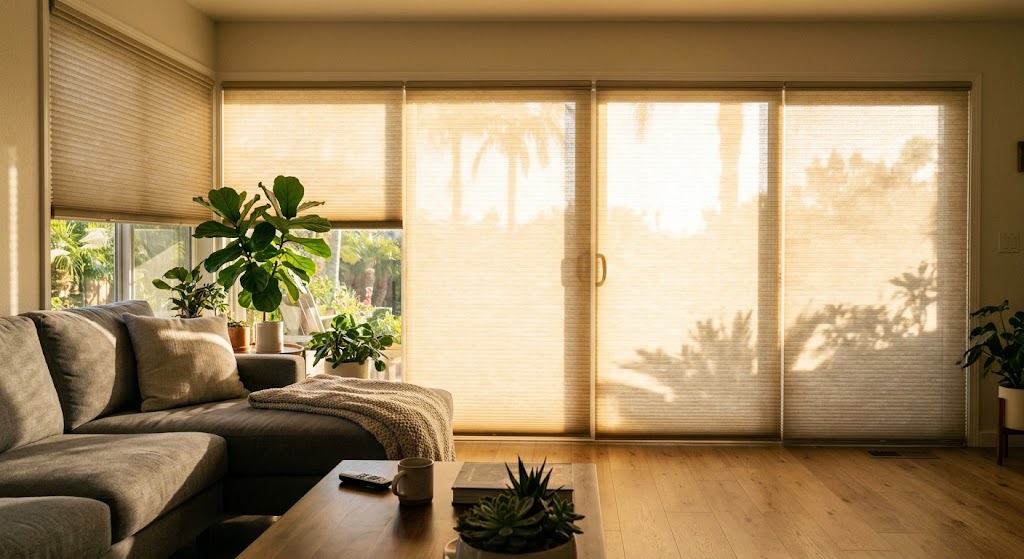
The best smart blinds for west-facing windows combine automation with heat-blocking materials that reduce afternoon solar gain without making rooms permanently dark.
Quick answer
For west-facing windows that overheat in the afternoon, motorized cellular or honeycomb shades are usually the strongest smart option because their insulating structure reduces heat transfer while automation can close them before peak sun arrives. Lutron Serena Honeycomb Shades are the strongest premium all-around choice, while SmartWings Cellular Shades are a compelling Matter- enabled alternative; retrofit motors such as SwitchBot Blind Tilt or Aqara Roller Shade Driver E1 are better for keeping existing coverings but cannot improve the thermal performance of the blind or fabric they automate.
Table of contents
- The short answer: cellular shades are the best starting point
- Best overall: Lutron Serena Honeycomb Shades
- Why Serena fits west-facing windows
- Strengths
- Limitations
- Best configuration for afternoon heat
- Best Matter option: SmartWings Motorized Cellular Shades
- Why SmartWings stands out
- Strengths
- Limitations
- Who should choose it over Serena?
- Best retrofit for existing horizontal blinds: SwitchBot Blind Tilt
- Where Blind Tilt works well
- Where it falls behind cellular shades
- Best retrofit for chain-operated roller shades: Aqara Roller Shade Driver E1
- The fabric determines whether this is a good heat solution
- Strengths
- Limitations
- Why west-facing windows need a different automation strategy
- Better rule: close before the room overheats
- Time-based vs temperature-based automation
- Blackout vs light-filtering: which blocks more afternoon heat?
- Choose blackout when:
- Choose light-filtering cellular shades when:
- Does the color of the shade matter?
- Should you choose cellular shades or exterior shading?
- Comparison: which smart blind should you buy?
- What to measure before ordering custom smart shades
- What matters more than Matter
- Best choice by scenario
- You want the strongest premium solution
- You want Matter and cellular insulation
- You rent or do not want to replace existing horizontal blinds
- You already own good chain-operated solar roller shades
- Your west-facing room is still extremely hot with the shade closed
- Conclusion
Key takeaways
- For west-facing rooms, shade construction and fit matter more for heat control than the smart-home protocol used by the motor.
- Motorized cellular shades are the strongest indoor option when reducing afternoon solar heat is the primary goal.
- Retrofit tilt and roller motors are useful for existing window coverings, but they inherit the thermal limitations of those coverings.
- The most effective automation closes shades before direct afternoon sun peaks rather than waiting until the room has already overheated.
Editorial transparency
Who worked on this article and how it was handled.
- Written by
- Maya Chen
- Creation method
- Editorial research
AI assistance: AI assisted with research organization and drafting. Sources, factual claims, and the final article should be reviewed by a human editor before publication.
West-facing windows can turn an otherwise comfortable room into the hottest space in the home between roughly mid-afternoon and sunset. The glass absorbs hours of low-angle solar exposure just as outdoor temperatures are near their daily peak, forcing air conditioning to fight both the weather outside and the heat entering through the window.
The obvious response is to buy smart blinds, but the motor is only half the decision. A highly connected blind that automates thin slats can be less effective at blocking heat than a simpler motorized cellular shade with better insulation. For west-facing rooms, the window covering itself matters at least as much as the app, protocol, or voice assistant controlling it.
This guide compares the strongest smart-blind approaches for afternoon heat, from full motorized cellular shades to retrofit motors for existing blinds. The recommendations are based on product specifications and energy-efficiency research rather than hands-on product testing.
The short answer: cellular shades are the best starting point
If reducing heat is the primary goal, begin with the window treatment type, not the smart-home ecosystem.
The U.S. Department of Energy describes cellular shades as an effective window attachment because their honeycomb-shaped cells trap air and reduce heat transfer. DOE research also notes that cellular shades can outperform conventional vinyl blinds in energy-saving potential and can reduce unwanted solar heat gain.
For a west-facing room, that leads to a simple hierarchy:
| Smart window treatment | Heat-blocking potential | Best use case |
|---|---|---|
| Motorized cellular/honeycomb shade | High | Hot west-facing rooms where comfort and cooling load matter most |
| Motorized blackout roller shade | Medium to high, depending on fabric and fit | Bedrooms, media rooms, strong glare control |
| Motorized light-filtering roller shade | Medium | Living spaces where daylight matters |
| Automated horizontal blinds | Low to medium | Existing blinds, glare control, lower-cost retrofit |
| Retrofit motor on existing shade | Depends entirely on existing shade | Renters or owners who want automation without replacing coverings |
The exact performance of any installed shade depends on material, fit, color, gaps around the edges, glass type, climate, and how consistently the shade is used.
Best overall: Lutron Serena Honeycomb Shades
Best for: homeowners who want strong heat control, mature automation, and broad smart-home integration.
Lutron Serena Honeycomb Shades are the strongest all-around fit for a west-facing room because they combine the insulating structure of a cellular shade with a well-developed automation platform.
Lutron offers Serena in honeycomb, roller, and wood-blind styles. For this specific problem, the honeycomb version is the one that matters. The cellular construction gives it a meaningful advantage over a conventional horizontal blind when direct afternoon sun becomes a cooling problem.
Why Serena fits west-facing windows
Serena supports schedules as well as sunrise- and sunset-relative operation. That is particularly useful because west-facing heat is predictable: you generally want the shade down before the strongest sun hits the glass rather than reacting after the room has warmed.
Lutron also supports major ecosystems including Apple Home, Amazon Alexa, and Google Home through its smart-shade platform. The company offers battery-powered configurations, so a professional hardwired installation is not always required.
Strengths
- Honeycomb construction is suited to thermal control.
- Mature scheduling and automation options.
- Broad smart-home compatibility.
- Battery-powered options avoid running new power wiring in many installations.
- Available with different fabric and light-blocking choices.
Limitations
- A full custom shade is a larger purchase than a retrofit motor.
- Window measurement matters; poor fit leaves light and heat gaps.
- The premium integration experience may require Lutron’s smart hub and ecosystem components.
Best configuration for afternoon heat
For a living room, a light-filtering honeycomb fabric can be a better balance than full blackout because it lowers glare and solar load while preserving some daylight. Bedrooms or media rooms may benefit more from blackout fabric.
If maximum cooling performance matters, prioritize the shade’s thermal characteristics and edge fit before prioritizing color or voice-control features.
Best Matter option: SmartWings Motorized Cellular Shades
Best for: buyers who want cellular-shade insulation with a Matter over Thread option and broader platform flexibility.
SmartWings’ motorized cellular range is a strong alternative because it combines honeycomb construction with several smart-motor options, including Matter over Thread on supported configurations.
The Nowa cellular line uses honeycomb construction designed to reduce heat transfer and is offered in light-filtering configurations. SmartWings also offers blackout and other cellular variants, which makes the range flexible for west-facing bedrooms, offices, and living spaces.
Why SmartWings stands out
Matter does not make the shade more energy efficient, but it can simplify smart-home integration. SmartWings says its Matter motor can work with major Matter ecosystems including Apple Home, Google Home, Amazon Alexa, and SmartThings when the required Matter controller and Thread Border Router are present.
That makes it attractive if you want the window covering to participate in automations without committing to a single proprietary ecosystem.
Strengths
- Cellular construction is appropriate for heat-control use.
- Matter over Thread motor option on supported configurations.
- Rechargeable battery design.
- Scheduling, scenes, app, remote, and voice-control options vary by motor choice.
- Multiple cellular styles allow more control over daylight and privacy.
Limitations
- Matter still requires compatible controller and Thread infrastructure.
- Motor protocol choices can be confusing during ordering.
- Custom sizing means installation accuracy still matters.
Who should choose it over Serena?
Choose SmartWings if Matter interoperability is a higher priority and you are comfortable selecting the motor protocol that matches your home. Choose Serena if you value Lutron’s mature shading ecosystem and broad integration history more than Matter-native control.
Best retrofit for existing horizontal blinds: SwitchBot Blind Tilt
Best for: people who already own horizontal blinds and want inexpensive automated sun control without replacing the window treatment.
SwitchBot Blind Tilt takes a different approach. Instead of replacing the blind, it attaches to the existing tilt mechanism and rotates the slats automatically. SwitchBot also includes a solar panel that can help maintain the device battery.
This is clever for west-facing rooms because the slats can close before late-afternoon sun becomes intense. But it is important to understand what the product cannot change: it does not make your existing blind more insulating.
Where Blind Tilt works well
It makes sense if your main problems are:
- glare on a television or monitor;
- direct sunlight hitting furniture;
- forgetting to close blinds before leaving home;
- wanting automation without custom window treatments.
You can angle slats instead of fully darkening the room, which may preserve daylight while reducing direct beam radiation.
Where it falls behind cellular shades
DOE research is clear that ordinary blinds do not provide the same insulation as cellular shades. Automating them makes their use more consistent, but automation cannot create an insulating air pocket that the blind does not have.
For a room that is genuinely overheating, SwitchBot is better viewed as a budget solar-control upgrade, not the highest-performance heat-blocking solution.
Best retrofit for chain-operated roller shades: Aqara Roller Shade Driver E1
Best for: existing beaded-chain roller shades that already have a heat-blocking fabric you like.
Aqara’s Roller Shade Driver E1 motorizes the bead chain of an existing roller blind or shade. It uses Zigbee and requires a compatible Aqara hub for smart operation.
The advantage is obvious: if you already own a good solar or blackout roller shade, you can add schedules and automation without ordering an entirely new treatment.
The fabric determines whether this is a good heat solution
Aqara’s motor does not add thermal performance. If the existing shade is a thin decorative fabric, automating it will make it easier to use but will not suddenly turn it into an effective thermal barrier.
The product makes much more sense when paired with a roller shade that already:
- has reflective or solar-control properties;
- blocks a meaningful amount of direct sun;
- fits close to the window opening;
- is already effective when manually lowered.
Strengths
- Retains your existing roller shade.
- Useful schedules and smart-home automations through the Aqara ecosystem.
- Rechargeable design.
- Lower disruption than replacing the entire shade.
Limitations
- Requires a compatible Aqara Zigbee hub.
- Intended for compatible beaded-chain mechanisms.
- Heat performance depends on your existing fabric and installation.
Why west-facing windows need a different automation strategy
West-facing heat is not evenly distributed across the day. A room may be comfortable at breakfast and still become difficult to cool at 4 p.m.
DOE guidance has long recommended closing window coverings on south- and west-facing windows during warm weather. The key advantage of a smart shade is that you no longer have to remember to do it manually.
The best automation is therefore predictive rather than reactive.
Better rule: close before the room overheats
A basic schedule might look like this:
| Time or condition | Shade behavior |
|---|---|
| Morning | Open for daylight |
| Early afternoon | Partially close if glare begins |
| Before direct west sun peaks | Close to the heat-control position |
| After sunset | Reopen if privacy is not a concern, or remain closed for nighttime privacy |
The exact time changes with latitude, season, window geometry, nearby buildings, and trees. If your ecosystem supports sun position, light sensors, or temperature-based automations, you can make the schedule more adaptive.
Time-based vs temperature-based automation
Temperature sounds like the obvious trigger, but it often reacts too late.
If you tell the shade to close only when the room reaches 80°F, much of the solar energy has already entered the space. The air conditioner then has to remove that heat.
For west-facing windows, a time or sun-position rule is usually the better primary automation. Indoor temperature can be used as a secondary override.
A practical strategy is:
- Schedule the shade to close before the sun hits the window directly.
- Use room temperature as an additional trigger on unusually hot days.
- Keep a manual override for occupants who want more daylight.
- Reopen after the direct solar period ends if cooling conditions allow.
This is where smart shades earn their value: the covering is more likely to be in the correct position at the correct time every day.
Blackout vs light-filtering: which blocks more afternoon heat?
Blackout and heat control are related, but they are not identical.
A blackout fabric primarily describes visible-light blocking. Thermal performance depends on more than opacity, including shade structure, material, coatings, air gaps, and how tightly the shade fits the window.
Choose blackout when:
- the room is a bedroom or media room;
- direct sun creates severe glare;
- maximum room darkening is desirable;
- privacy is a high priority.
Choose light-filtering cellular shades when:
- the room is used during the day;
- you want diffuse daylight instead of darkness;
- reducing heat matters more than eliminating every ray of light;
- you want to avoid switching on electric lighting every afternoon.
For many west-facing living rooms, light-filtering cellular shades are the best compromise because the cellular structure addresses heat transfer while the fabric still admits usable daylight.
Does the color of the shade matter?
It can.
DOE warm-weather guidance recommends light-colored or white window coverings because they can reflect more incoming solar energy than dark surfaces. That does not mean every white shade automatically outperforms every dark shade; the complete material system matters.
Still, if two shade fabrics have similar construction and ratings, a lighter exterior-facing surface is generally a sensible choice for a window that receives intense summer sun.
For serious energy performance, look beyond marketing descriptions and check whether the product has credible window-attachment energy ratings such as AERC performance information where available.
Should you choose cellular shades or exterior shading?
Interior smart blinds are convenient, but they are not the theoretical maximum for blocking solar heat.
The most effective strategy is to intercept solar radiation before it passes through the glass. Exterior awnings, shutters, and solar screens can therefore outperform interior coverings for certain applications.
However, exterior systems are more complex, may face building or HOA restrictions, and are much harder for renters or apartment owners to install. Smart interior cellular shades offer a practical compromise: meaningful heat control without changing the building envelope.
For most homeowners asking specifically for smart blinds, cellular shades remain the strongest indoor answer.
Comparison: which smart blind should you buy?
| Product/approach | Heat-control potential | Smart-home approach | Best for | Main compromise |
|---|---|---|---|---|
| Lutron Serena Honeycomb | High | Lutron hub + major ecosystems | Premium whole-room solution | Higher total investment |
| SmartWings Cellular | High | Matter/Thread and other motor options | Matter-focused smart homes | More configuration choices to understand |
| SwitchBot Blind Tilt | Low to medium | Retrofit smart tilt | Existing horizontal blinds | No added insulation |
| Aqara Roller Shade Driver E1 | Depends on existing shade | Zigbee via Aqara hub | Existing roller shades | Fabric determines heat performance |
No product in this table was hands-on tested for this article. The ranking reflects the suitability of each design for the specific goal of controlling west-facing afternoon heat, based on manufacturer documentation and window-efficiency research.
What to measure before ordering custom smart shades
Custom shades can perform well only if they fit correctly.
Before ordering:
- measure window width and height according to the manufacturer’s method;
- decide between inside and outside mount;
- check depth requirements for the headrail and brackets;
- note handles, trim, locks, and other obstructions;
- identify whether the window receives direct sun across the entire pane or only part of it;
- decide where batteries, charging ports, or power wiring will be accessed.
An outside mount can sometimes improve coverage by reducing edge gaps, while an inside mount usually looks more integrated. The best choice depends on the frame and product.
For hardwired shades or installations near mains wiring, follow the manufacturer instructions and local electrical requirements. Use a qualified installer where required rather than improvising power connections.
What matters more than Matter
Matter is useful, but it should not be the first filter for this purchase.
Use this buying order instead:
- Shade type: cellular/honeycomb if heat reduction is the main goal.
- Fit: minimize unnecessary edge gaps.
- Fabric: choose the right balance of solar control, visible light, and privacy.
- Automation: make sure the shade can close before peak west sun.
- Power: battery, rechargeable, solar-assisted, or hardwired based on access.
- Smart-home protocol: Matter, proprietary hub, Zigbee, or another ecosystem that fits your home.
A Matter motor on a poor window covering is still a poor heat-control solution. A well-fitted cellular shade with reliable scheduling can deliver more practical comfort even if it uses a proprietary bridge.
Best choice by scenario
You want the strongest premium solution
Choose Lutron Serena Honeycomb Shades. They combine a heat-appropriate shade design with mature scheduling and broad ecosystem support.
You want Matter and cellular insulation
Choose a SmartWings cellular configuration with Matter over Thread, provided your smart-home platform has the required Matter controller and Thread Border Router.
You rent or do not want to replace existing horizontal blinds
Choose SwitchBot Blind Tilt if your current blinds already block enough direct sun and you mainly need automation and glare control.
You already own good chain-operated solar roller shades
Choose Aqara Roller Shade Driver E1 if you are comfortable using an Aqara hub and want to automate coverings that already perform well manually.
Your west-facing room is still extremely hot with the shade closed
Do not assume a smarter motor will fix it. Consider whether the window itself has a high solar heat gain coefficient, whether the covering leaves large gaps, and whether exterior shading or improved glazing is the more appropriate building-level solution.
Conclusion
For west-facing windows, the best smart blind is the one that combines real thermal performance with reliable afternoon automation. That makes motorized cellular shades the strongest category overall, with Lutron Serena Honeycomb as the premium all-around pick and SmartWings Cellular as an attractive Matter-enabled alternative.
Retrofit options such as SwitchBot Blind Tilt and Aqara Roller Shade Driver E1 are still useful when replacing the window covering is impractical, but they automate what you already have rather than improving its insulation. Before buying, decide how much heat the room needs to reject, choose the shade material accordingly, then automate it to close before the afternoon sun starts heating the space.
Common questions
Questions this guide answers
What type of smart blind is best for blocking afternoon heat?
Motorized cellular or honeycomb shades are generally the best indoor smart window covering for afternoon heat because their air-pocket construction adds insulation and reduces unwanted solar heat gain more effectively than ordinary horizontal blinds.
Should west-facing smart blinds close automatically in the afternoon?
Yes. A useful automation closes or lowers west-facing shades before direct afternoon sun reaches the glass, then reopens them after the solar load falls. Time-based or sun-position schedules are usually more reliable than waiting until the room is already hot.
Are blackout smart shades always better for west-facing windows?
Not necessarily. Blackout cellular shades are useful when maximum light blocking is important, but a well-fitted light-filtering cellular shade can still reduce heat while preserving daylight. The best choice depends on glare, privacy, room use, and how dark you want the space to become.
Can SwitchBot Blind Tilt reduce heat from a west-facing window?
SwitchBot Blind Tilt can automatically angle existing horizontal blinds to reduce direct sun, which may improve comfort, but it does not add insulation. Its heat-control performance therefore depends on the blinds you already own and is generally weaker than a well-fitted cellular shade.
Does Matter make smart blinds better at blocking heat?
Matter improves smart-home interoperability, not thermal performance. A Matter-enabled cellular shade can be convenient to automate across Apple Home, Google Home, Alexa, or SmartThings, but the shade material, fit, opacity, and automation timing determine how well it controls heat.
Evidence & further reading
Sources & references
Primary and authoritative references used to support or contextualize this article. Links open the original source.
- 1Interior Cellular Shades Boost Home Energy Performance
U.S. Department of Energy · Accessed Aug 23, 2026
Supports cellular-shade insulation, solar heat gain reduction, and higher energy-saving potential than conventional vinyl blinds.
- 2EnergySavers: Tips on Saving Money and Energy at Home
U.S. Department of Energy · Accessed Aug 23, 2026
Supports closing coverings on west-facing windows and using light-colored window coverings to reflect heat.
- 3Window Treatments: The Undervalued, Highly Efficient Energy-Efficiency Measure
U.S. Department of Energy · Accessed Aug 23, 2026
Supports automated cellular-shade control as a strategy for lowering solar heat gain and cooling demand.
- 4Custom Smart Blinds and Shades | Serena Shades by Lutron
Lutron · Accessed Aug 23, 2026
Supports Serena honeycomb availability, smart schedules, app and voice control, and major ecosystem integrations.
- 5SmartWings Motorized Light Filtering Cellular Shades Nowa
SmartWings · Accessed Aug 23, 2026
Supports cellular construction, rechargeable power, automation, Matter over Thread option, and multi-platform integration.
- 6SwitchBot Smart Blind Tilt
SwitchBot · Accessed Aug 23, 2026
Supports retrofit installation on existing blinds and included solar-panel charging.
- 7Roller Shade Driver E1 Product Introduction
Aqara · Accessed Aug 23, 2026
Supports retrofit automation of beaded-chain roller shades using Zigbee and an Aqara hub.

About the author
Maya Chen
Maya covers residential energy, HVAC controls, and practical home automation, translating technical systems into useful decisions for homeowners and renters.
More from Maya →Make your home smarter without buying every gadget.
One useful idea, one product worth knowing, and one energy-saving action—delivered weekly.
No spam. Unsubscribe anytime.
Semantic recommendations
Related reading
Selected from topic cluster, entities, tags, search intent, and editorial relationships.
Smart Window Contact Sensors: Preventing Open Window AC Energy Waste
Use window contact sensors to pause cooling only after a window stays open, then restore the previous HVAC state safely after every monitored window is closed.
Are Smart Vent Covers Worth It? (HVAC Airflow Test & Energy Savings)
Smart vent covers can improve room-by-room comfort, but their energy savings are less certain than many homeowners expect. Here is how to judge whether they are worth buying.
Smart Ceiling Fan Controllers vs. Running the AC: Summer Energy Test
A smart ceiling fan controller can reduce cooling costs when it helps you run the fan only when people are present and raise the AC setpoint at the same time. Here is the real summer tradeoff.
Solar Generator Backup Basics for Late-Summer Storm Outages
Learn how to size and safely use a portable battery power station with solar charging for storm outages, from watt-hours and surge loads to refrigerators and recharge planning.